
Conifers
Spruce
Picea
Spruce – a genus of evergreen trees in the family Pinaceae. Includes about 50 species.
\r\nThe age of the oldest representative of the genus – the European spruce – is 9550 years and it is called «Old Tjikko». This specimen grows in the western part of Sweden in Fulufjället National Park. It is the oldest known organism on Earth. Lifespan on average 250—300 (up to 600) years. Slow-growing, especially in the first years of life. At 10 years reaches 1.5 m in height.
\r\nWidely distributed in Northern Europe, Central and Northeastern Asia, North America and western and central China. Forests composed of spruces are very dark and dense, often lacking an understory.
\r\n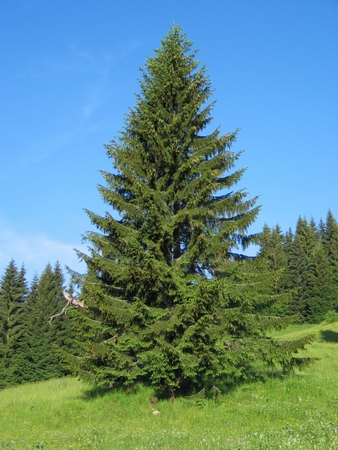
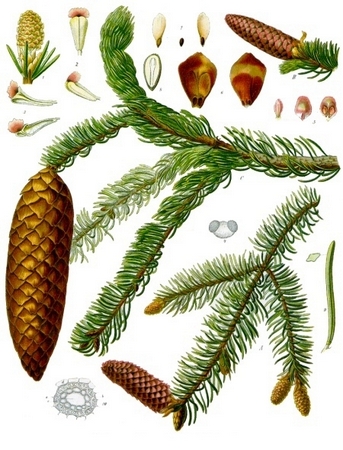
Members of the genus are evergreen monoecious trees up to 30 m tall with a beautiful conical or pyramidal crown. Branch arrangement is in whorls, horizontally spreading or pendulous. In the first 3-4 years they do not produce lateral branches. Under the top of the plant several buds are formed, from which lateral branches sprout in spring, and from the apical bud a vertical shoot with a ring of lateral buds develops. The age of the tree can be determined by counting the whorls and adding 3-4 years.
\r\nBark is gray in color, peeling in thin plates.
\r\n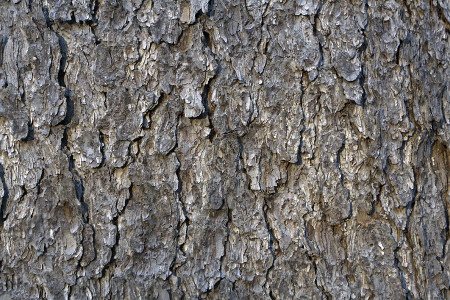
The root system in youth (first 10-15 years) is taprooted, later becoming shallow because the main root dies off.
\r\nNeedles are acicular, short, four-sided, less often flat, green, stiff and sharp, with the back side turned upward, with two keels located on the lower and upper sides, rhombic in cross-section. They grow singly, spirally, and sit on leaf cushions – outgrowths of the bark, which are especially noticeable after needle fall. They are retained on shoots for six or more years. After needles are eaten by insects, broom-like shoots appear with short and stiff needles that resemble brushes in appearance.
\r\n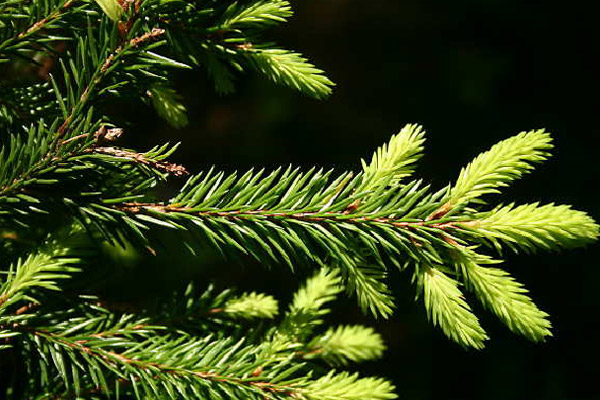
Male strobili are small catkin-like structures composed of numerous stamens with elongated bilobed longitudinally-dehiscing anthers, located in the axils of the needles at the tips of the previous year's shoots. They flower in May.
\r\n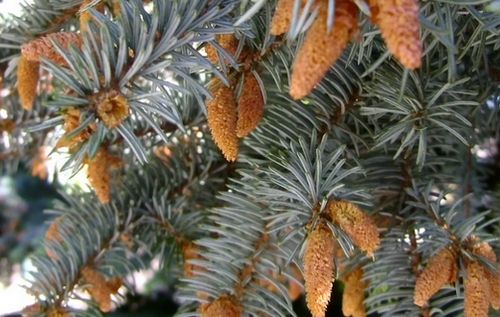
Female strobili grow at the tips of branches and form small cones. After wind pollination these cones enlarge and become pendulous.
\r\n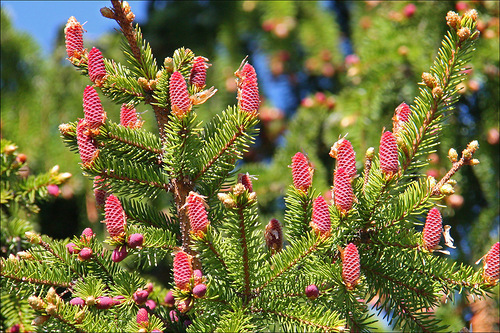
Cones are pointed, oblong-cylindrical in shape, do not disintegrate, and fall when the seeds mature in the first year after fertilization. Mature cones are leathery or woody, dry, pendulous, up to 15 cm long and 3-4 cm in diameter. They consist of an axis on which numerous bract scales grow, in the axils of which are the seed scales. On the upper surface of the seed scales two ovules develop, each provided with a "false" wing.
\r\n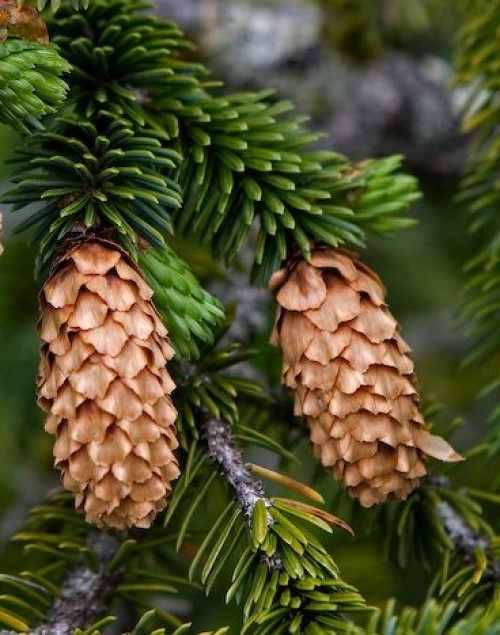
Seeds mature in October and are dispersed by wind. Seed viability is retained for 8-10 years. Depending on growing conditions the tree begins to bear seed at 10-60 years.
\r\n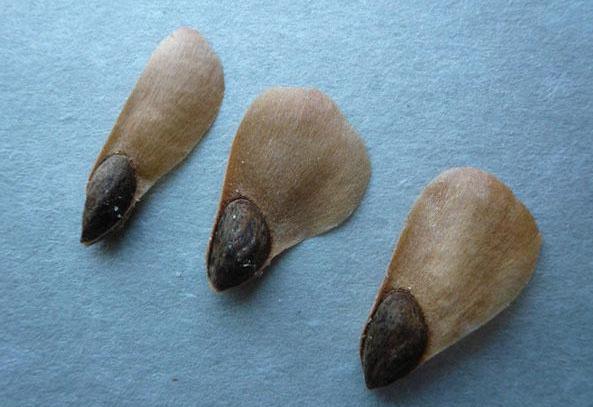
Species: the genus Spruce according to the Royal Botanic Gardens, Kew includes 37 primary species and 4 hybridogenic species. Almost every species has several ornamental forms.
\r\n- \r\n
- Picea abies — Common spruce or European spruce \r\n
- Picea alcoquiana — Alcock's spruce, or two-colored spruce \r\n
- Picea asperata — Rough spruce \r\n
- Picea aurantiaca \r\n
- Picea austropanlanica \r\n
- Picea brachytyla — Chinese spruce \r\n
- Picea breweriana — Brewer's spruce \r\n
- Picea chihuahuana \r\n
- Picea crassifolia \r\n
- Picea engelmannii — Engelmann spruce \r\n
- Picea farreri \r\n
- Picea glauca — White spruce, or glaucous spruce \r\n
- Picea jezoensis — Ayan spruce \r\n
- Picea koraiensis — Korean spruce \r\n
- Picea koyamae \r\n
- Picea likiangensis — Likiang spruce \r\n
- Picea linzhiensis \r\n
- Picea mariana — Black spruce \r\n
- Picea martinezii \r\n
- Picea maximowiczii — Maximowicz's spruce \r\n
- Picea meyeri — Meyer's spruce \r\n
- Picea morrisonicola — Morrison spruce \r\n
- Picea neoveitchii — New Veitch's spruce \r\n
- Picea obovata — Siberian spruce \r\n
- Picea omorika— Serbian spruce \r\n
- Picea orientalis — Oriental spruce \r\n
- Picea polita — Elegant spruce, or Japanese spruce (Picea torano) \r\n
- Picea pungens - Prickly spruce, or Blue spruce \r\n
- Picea purpurea — Purple spruce \r\n
- Picea retroflexa — Retroflex spruce \r\n
- Picea rubens — Red spruce \r\n
- Picea schrenkiana — Schrenk's spruce \r\n
- Picea schrenkiana subsp. tianschanica — Tien Shan spruce \r\n
- Picea sitchensis — Sitka spruce \r\n
- Picea smithiana \r\n
- Picea spinulosa — Spiny spruce, or East Himalayan spruce \r\n
- Picea wilsonii — Wilson's spruce \r\n
Hybridogenic species
\r\n- \r\n
- Picea ×albertiana \r\n
- Picea ×fennica — Finnish spruce (Picea abies × Picea obovata) \r\n
- Picea ×lutzii \r\n
- Picea ×notha (Picea glehnii × Picea jezoensis) \r\n
Hardiness zone: 5b
\r\n\r\nLocation/siting: trees are prone to windthrow. Many species are light-loving but fairly shade-tolerant, and young trees can even be shade-loving. They require fertile soil and air humidity. Prefer a relatively continental climate and can tolerate slight waterlogging. Do not tolerate air pollution, which affects needle longevity. Do not like soil compaction and shallow groundwater.
\r\nPlanting: does not tolerate transplanting well. Soil mix: leaf and turf soil, sand, peat in the ratio 2:2:1:1. Drainage of crushed brick and sand 15-20 cm thick is required. Recommended spacing for group planting is at least 2-3 m. Planting depth is 50-70 cm. When transplanting avoid dry roots. At planting you can apply 100-150 g of nitroammophoska. Large trees are recommended to be transplanted in winter with a root ball.
\r\nCare: poorly tolerate dry soil, so regular spraying is recommended on hot days. Also in heat water once a week with 10-12 L per plant. Loosening is recommended for young trees to a depth of 5-7 cm. Peat mulching in a layer of 5-6 cm can be used and after winter it can be mixed with the soil. Most species do not need winter covering, but protection from spring sun is necessary. For this, in February you can throw non-woven fabric over the tree in 2 layers or use special dense shields installed on the southern side.
\r\nPruning: when using spruces to create hedges severe pruning is allowed, after which the crown thickens. Under normal conditions only sanitary pruning is recommended. It is also possible to regularly pinch dominant shoots and shorten lateral ones during the active growth period.
\r\nDiseases: shoot blight (Schütte), snow blight, fusariosis, stem and root rot, bark necrosis, canker (ulcerative cancer), cone rust, spruce weevil.
\r\nPests: Sitka spruce aphid, red and yellow gall aphids, caterpillars of the nun moth, green adelgid (spruce-leaf), spruce needle-roller, spruce spider mite, spruce false scale, root aphid, conifer mealybugs, spruce sawfly, spruce bud sawfly, spruce moth, weevil, caterpillars of the spotted noctuid, dark-gray inchworm and angle-winged conifer moth, cone borer, bark beetle (typographer), large spruce bark-borer, black spruce longhorn beetle, spruce longhorn beetle.
\r\nPropagation: propagated mainly by seeds; garden forms by cuttings and grafting. Seeds germinate in the year of sowing, but germination is noticeably accelerated by 2-3 months of stratification. Nonstratified seeds before sowing are recommended to be soaked for a day in settled or snow water. Spruce seedlings are small (up to 4 cm) whorls of cotyledons at the tip of a thin stem.
\r\nUses: From spruces are produced rosin, methyl alcohol, paper and cardboard, tar, turpentine, wood vinegar. Wood is used as building material, for making musical instruments, crafts and processing into wood pulp. Widely used to create windbreaks along roads. Bark is used in leather tanning. From needles a conifer-vitamin feed supplement for livestock is prepared. Boughs (broken branches) are used to cover plants. In landscape design used alone in open areas, for decorating large gardens and parks, for creating live clipped hedges; dwarf forms can be used in rock gardens and containers. As companions one can use larch, pine, deciduous trees and shrubs.
\r\n