
Flowers for the garden
Pokeweed
Phytolacca
Pokeweed (Eng. Phytolacca) — a genus of perennial herbaceous plants of the family Phytolaccaceae (Phytolaccaceae). In gardening known under the name phytolacca, among Americans — Eng. pokeberry. The genus includes about 25 species of pokeweeds, occurring in the tropical and subtropical regions of Africa, Asia, North and South America.
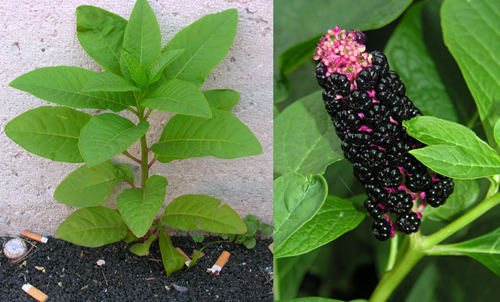
Perennial herbs, rarely shrubs and tree-like forms with alternate entire leaves. Flowers small, mostly bisexual, in racemose inflorescences, less often dioecious, with 5 sepals, 10—20 stamens, 4—10 carpels, free or fused. Each carpel with one ovule. The fruit is fleshy, berry-like. Still rare in our gardens, this plant has been cultivated in Europe since 1615, having appeared there as an introduced species. In gardens only one species is grown - the American pokeweed.
In cultivation:
American pokeweed, or ten-stamened - Phytolacca americana = Phytolacca decandra
A herbaceous perennial with stems that die back each year. In spring, new shoots sprout from renewal buds located on the rhizome and at the base of last year’s stems. The rhizome of pokeweed is very powerful, fleshy, spreads extensively and penetrates the soil to a depth of more than half a meter. Its mass in a five-year specimen can reach 10 kg. Stems are robust, woody, up to 2 m tall, branching at the top. Leaves are large, alternate, petiolate, entire, elliptic, light green, and contain a large amount of oxalic acid.
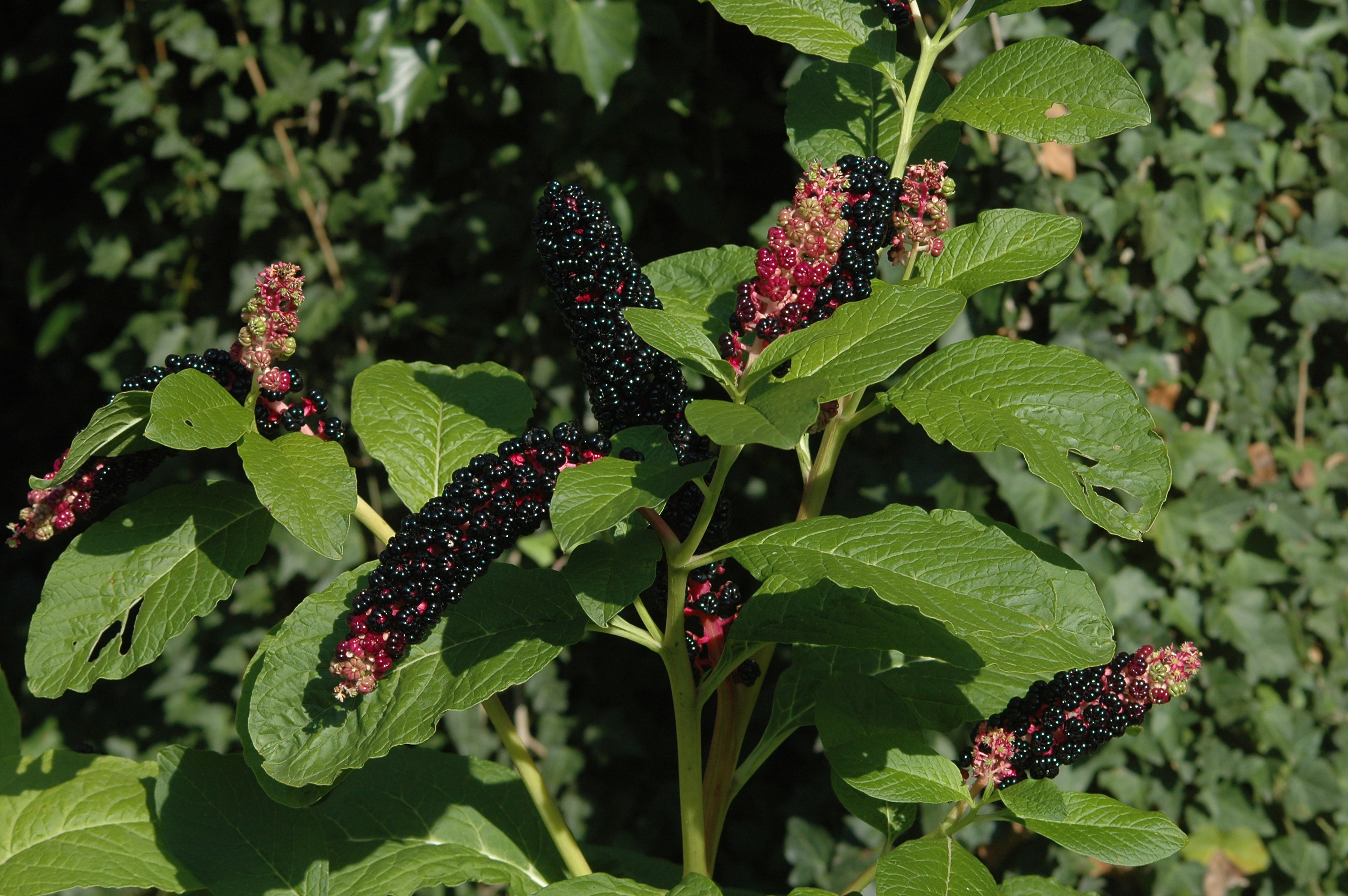
Flowers are small, greenish-white, gathered in dense erect raceme inflorescences resembling catkins, 15–25 cm high and up to 5 cm in diameter. Flowering begins in July and lasts until the end of August, berries ripen in September. If there are no severe frosts, the plant remains decorative until October. It needs abundant watering because the broad leaves transpire a lot of water.
Location: prefers good light; the plant often suffers from spring and autumn frosts, so it is better to plant it in a place sheltered from cold winds.
Soil: pokeweed is not demanding of soils, it grows well on both light and medium-heavy, not too acidic grounds. It is fairly moisture-loving, but with its powerful root system it secures moisture well.
Care: in autumn with the onset of frosts, stems are cut at the base and pokeweed is covered for the winter with peat, humus or leaves to a layer up to 10 cm.
Propagation: by dividing the rhizome early in spring or by seeds. Sow them freshly collected, without removing the pulp. Seeds are small, so they are sown shallowly. Seedlings appear uniformly in spring when the soil has warmed sufficiently. Some seedlings flower in the same year in August. In the second year early in spring they are transplanted to their permanent place.