
Indoor plants
Hart's-tongue fern
Phyllitis scolopendrium. = Asplenium scolopendrium L. = Scolopendrium vulgare Sm.
A montane species, distributed in Eurasia in regions with Mediterranean and humid climates. In the wild it is found in the forests of the Caucasus, the Carpathians, southern Europe, Asia and North America. It grows on calcareous rocks and screes, in moist, shaded forests, often on thin humus accumulated in rocky crevices. Occurs from uplands to the mountain belt.
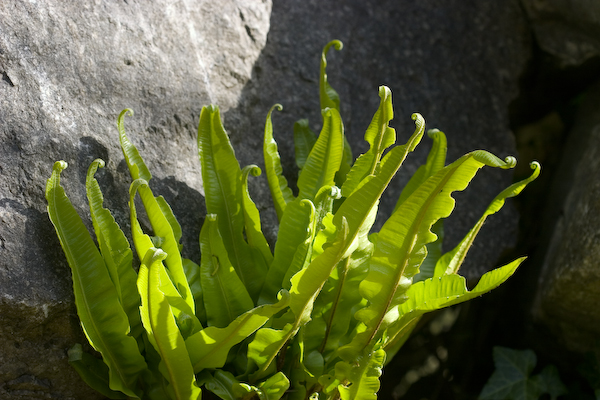
Perennial fern up to 60 (15–30) cm tall, with a thick rhizome densely covered with scales. The frond blade is entire, strap-shaped, 3–7 cm wide, with nearly parallel, sometimes wavy margins, an acute or blunt apex, and a cordate base. The stipe is three times shorter than the blade, covered with green or brown scales in the form of short hairs. Sori are arranged in pairs along the entire frond. Spores mature in the second half of summer.
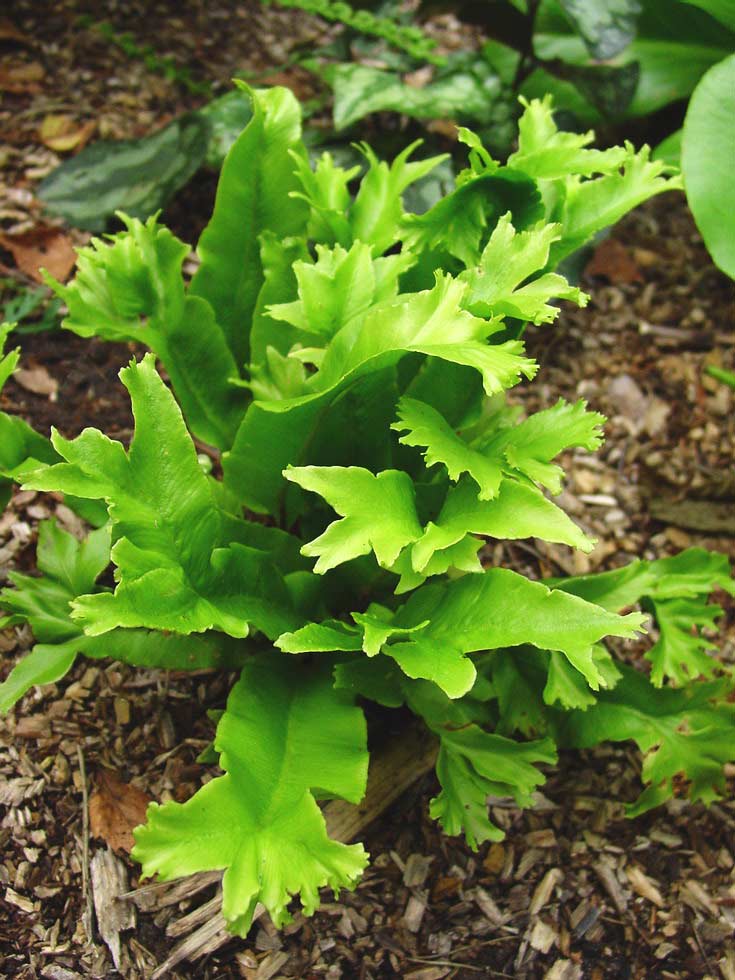
Especially attractive are its ornamental forms: with wavy fronds — f. undulata; f. marginatum — with narrow pinnae having wavy edges or divided into lobes; f. cristatum — the frond blade mostly entire and smooth and only the apex ciliated on the margin; also of interest are: headed (f. capitaturn); curly (f. crispum) and lacerate (f. laceratum); f. ramosum - frond blades dichotomously branched; f. ramo-cristatrum — combines blade division with fan-shaped tips of the leaf segments.
Location: a moisture- and warmth-loving plant (+22..+23 °C), does not like drafts. Lighting moderate; abundant watering and misting in summer.
Light: diffused light, can tolerate some shading.
Watering: requires misting. The root ball should neither dry out nor be waterlogged.
Additional information:
The fronds should be regularly misted and washed. In dry air the tips of the leaves often dry out; they should not be trimmed.
Care: from March to September provide feedings with organic or mineral fertilizers.
Propagation: propagated in spring by dividing the rhizome.