
Indoor plants
Zonal pelargonium
Pelargonium zonale
Family Geraniaceae.
Zonal pelargonium is a warmth-loving perennial native to South Africa. It reached European gardens in the 19th century. French gardeners played the leading role in its cultivation. In 1900 the cultivar 'Поль Кремплель' was bred, becoming for many years unsurpassed in color intensity and ease of cultivation. Pelargonium retained its popularity until the First World War, after which it was largely forgotten for a long time. In the 1950s these flowers came back into fashion. To this day they remain one of the best decorations for windows and balconies, small gardens and large parterre parks, streets and squares.
This species of pelargonium is often confused with geranium and is commonly called that. It can be grown outdoors as well as indoors on a sunny windowsill. For the plant to overwinter, it should be kept indoors until the next spring in a cool, dry, well-lit place. There are few plants that can rival geraniums in flower brilliance and length of flowering. They are probably the most popular of house and balcony plants.
In appearance the zonal pelargonium has light-green leaves with a zone of brownish color, sometimes white or slightly purple. Its name "zonal" (from the Greek zona — "belt") arose because of this concentric pattern in the form of a band of darker color on the leaf that follows its shape. Stems are upright and slightly woody at the base.
Flowers are single or double, gathered in inflorescences — loose umbels borne on long, sturdy flower stalks. Flower colors include bright red, delicate pink, raspberry, coral, white, dark cherry, lilac, etc. In the past young women tinted their lips with juice from the petals of zonal pelargonium. The aromatic leaves of this plant were used by cooks in confectionery.
Varieties of zonal pelargoniums
Hybrids of zonal pelargonium now number over 75,000 cultivars. Initially these were fairly tall shrubs with woody stems and small umbels of flowers. Since 1710 directed breeding has focused on reducing plant height and increasing and diversifying the forms of inflorescences and leaves.
Zonal pelargonium cultivars differ in plant height, leaf and flower shape and coloration. Leaves are rounded, softly pubescent, on long petioles.
Low-growing, or dwarf, pelargoniums include cultivars whose plant height does not exceed 20 cm; medium-height ones reach up to 40 cm; tall varieties reach 42 cm and more.
Depending on flower structure and coloration, cultivars are divided into groups — phlox-like, having petals raspberry at the edge and white in the center, as in cultivars 'Hollywood Star',
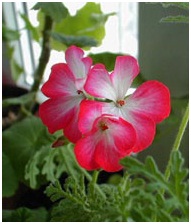
'Kardia' and others; star-shaped — with sharply toothed petals, as in the cultivar 'Fireworks';
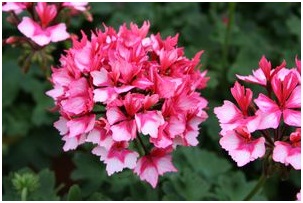
cactus-like, with flowers having narrow, horizontally arranged, sometimes twisted petals, as in the cultivars 'Attraction' and 'Noel'; rosebud or rose-like — cultivars with densely double flowers whose petals do not fully unfold, as in the cultivar 'Denise'
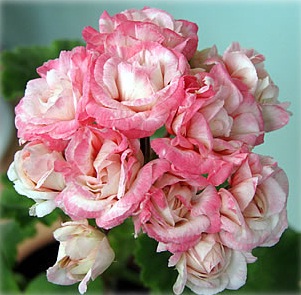
'Rosebud',
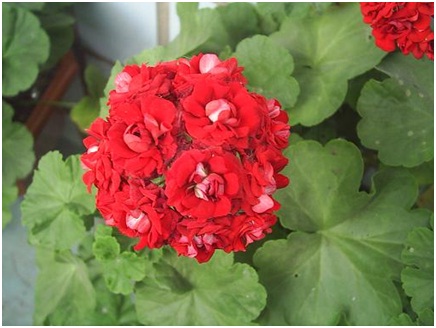
and those whose flowers resemble small-flowered polyantha roses in form; bouquet types — cultivars characterized by simple flowers gathered in dense, large inflorescences, such as 'Salmon Flash', 'Сhеггу' and others.
The zonal pelargonium group also includes variegated-leaved pelargoniums, whose breeding is carried out solely for decorative foliage. One of the first such cultivars, 'Mrs. Pollock',
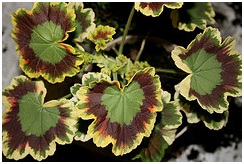
appeared in England as early as 1858; later cultivars such as 'Miss Burdet Courts' (in 1860) and 'A Happy Thourght' (in 1877) were also created there.
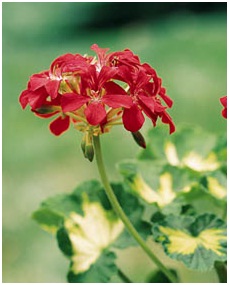
Variegated pelargoniums have beautifully colored leaves in white, yellow, silver and bronze shades in various combinations and tones, with unusual patterns on the leaf blade and its margin. Modern variegated cultivars display more complex color combinations than earlier ones — yellow, bronze, red, pink and brown, often in striking two- and three-color contrasts, and not only in concentric but also in sectoral patterns on the leaf.
Most cultivars of this subgroup, especially older ones, have small inconspicuous flowers. They are grown mainly for their attractive foliage.
These plants are usually low-growing. They are used as potted and container plants indoors, but most of all as groundcover plants.
The zonal pelargonium group is the most widely used in the world and includes over 1,000 cultivars; there are also mutant and hybrid forms.
Zonal pelargonium is not difficult to grow. For watering you can even use tap water that has not been left to stand. However, the soil in the container must be allowed to dry out between waterings.
This pelargonium should be kept dry and not misted.
A mature plant should be planted in fertile clay soil or in a potting mix for houseplants.
Light requirements. Mature plants require very good, full lighting, but filtered light is also suitable.
Propagation. Zonal pelargoniums are propagated from seed or by cuttings. For sowing seeds and rooting cuttings it is better to use a soilless substrate. Seeds are sown in early spring into moist soil and germinated at temperatures of 18 °C and above. Seedlings grown indoors need good lighting.
Cuttings for indoor propagation are taken in early autumn or early spring. Typically 3–4 cuttings are rooted in a 10 cm pot. During rooting the cuttings should be shaded. The optimal temperature for rooting is 18 °C. Plants can be gradually hardened off, but remember that pelargoniums do not tolerate frost. Rooted plants planted on a balcony should have their tips pinched back in mid-summer or early autumn.
Uses. Zonal pelargoniums are among the most resilient, abundant and long-flowering plants of universal use. They are recommended for growing in rooms (except on south-facing windows); in conservatories and general-purpose spaces (vestibules, offices); as container crops for greening loggias and balconies; and as annuals when planted outdoors. They can be grown as a shrub or trained into a small standard tree. They can live up to 20 years or more.