
Indoor plants
Passiflora
Passiflora
Family Passifloraceae. The name comes from the Latin passus — suffering and flos — flower, because the first missionaries who arrived in South America saw in the unusually beautiful flower features symbolizing the sufferings of Christ. In Europe these plants were first described by the monastery scholar Giacomo Bosio as early as the 17th century. In common usage passiflora became known as the passionflower.
The vast majority of passionflowers, these evergreen vines, originate from the forest regions of South America, with only a few species from North America, Asia and Australia. In their natural habitat — the tropics — passifloras have to compete for light. Using tendrils they climb trees to reach the upper canopy. Some plants reach lengths of up to 45 m. Despite their tropical origin, many species have adapted well to subtropical and even temperate climates.
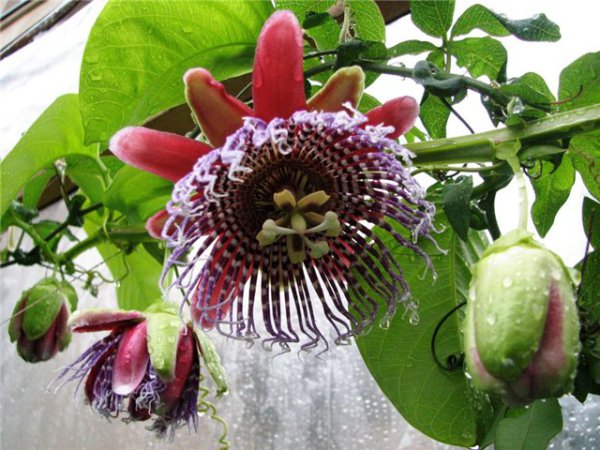
Thanks to their beautiful fragrant flowers, many species of this genus are cultivated in many countries of the world as ornamental and exotic plants. Passiflora is grown as a hanging plant to decorate both apartments and balconies or loggias. Passionflower blooms are beautiful and unusual, but not long-lasting. It grows quickly, occupying the whole window by the end of summer. The flower of this vine is unlike any other flower in the world. Inside the widely opened brightly colored double perianth there is an even more striking corona of long straight or curved filaments. In the center of the flower is an ovary with three stigmas arranged in a cross, around it 5 stamens with large, elongated anthers.
Passiflora caerulea - a climbing vine with pinnate, deeply divided leaves; the stems bear simple, unbranched tendrils located in the leaf axils that reach out to supports. Flowers are solitary, up to 10 cm in diameter, with a slight fragrance. Fruit is an orange, egg-shaped berry up to 6 cm long.
Passiflora trifasciata - a climbing vine with a ribbed stem and three-lobed leaves, which on the dark pattern show grayish-purple stripes along the main veins, purple on the underside. Flowers are yellowish-white up to 4 cm in diameter; fruits are a bluish rounded berry up to 2.5 cm in diameter.
Care tips
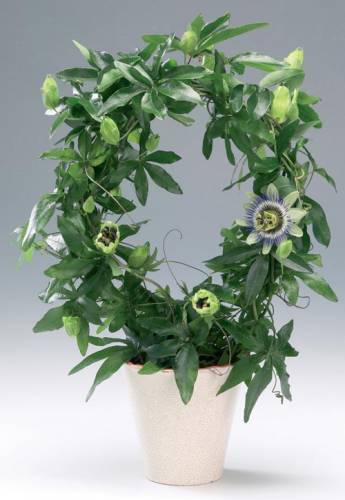
Indoors, place passiflora on a well-lit window, preferably facing south. Bright sunlight is very beneficial provided the air temperature does not rise above 27 °C. Air should be as humid and fresh as possible, not stagnant. In summer this vine feels much better in the garden than in a room. Therefore it is recommended to move plants outdoors and use them for decorating yards. The annual Passiflora gracilis (P. gracilis) is suitable for those gardeners who do not have the possibility to overwinter other species.
Temperature: Moderate or cool; in summer from 18 to 24°C. In a too warm room the leaves yellow and dry, few buds and flowers are produced, and the plant quickly loses its decorative appeal. From autumn passiflora needs a cooler location with a temperature of about 13-16°C. If it is not possible to keep passiflora cool in winter, it is better to grow it as an annual, renewing it each spring from seed. In a warm, heated room passiflora will defoliate, losing all its leaves, and may even die.
Light: Maximum light. On a south-facing window passiflora can be completely covered in flowers and buds, though shading may be needed during the hottest hours. On a north-facing window passiflora will grow and bloom if the window is not shaded, but flowering will be sparse. East- and west-facing windows that are not shaded by trees are suitable.
Soil: Well-drained soils are required, preferably neutral to slightly alkaline. In nature they generally grow on sandy, often very poor soils. Avoid excessively rich substrates, as this can cause overly vigorous growth at the expense of flowering. Allow the soil to dry between generous waterings.
Watering: Abundant from spring to autumn. The soil should remain moist. In winter water sparingly, about once every 7-10 days.
Feeding: From April to August use fertilizers for indoor flowering plants, at approximately half the recommended dose. Feed every two weeks.
Humidity: Spray regularly in spring and summer, but only when the plant is not in direct sunlight.
Repotting: Annually in spring. Before repotting, and before buds appear, prune passiflora by about 1/3 of the length of the shoots. Soil mix: 1 part turf, 1 part leaf mold, 1 part peat soil and 1 part sand.
Propagation: By seeds in early spring and by stem cuttings in summer. Soak seeds in water for a day, then sow in a soil mix composed of: 30% fine sand, 50% loam and 20% peat. Sowing depth 2-5 mm. Optimal germination temperature +20...+24°C. Do not let the substrate dry out; cover the sown seeds with glass or transparent film. When shoots appear, uncover them. Seedlings need a 12-hour photoperiod; use supplemental lighting if necessary. Prick out at the stage of the first pair of true leaves. Try not to expose the roots or damage the stem. Do not deep-plant leggy seedlings. Some seeds may take up to 12 months to germinate.
Diseases and pests: Spider mites, scale insects, aphids.
Source: www.flower.onego.ru