Indoor plants
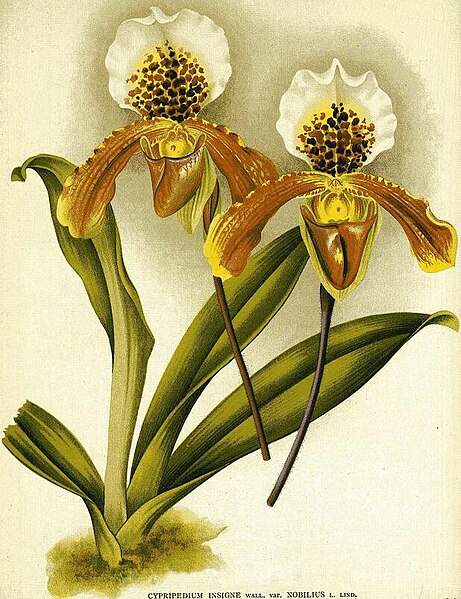
Paphiopedilum insigne (The Splendid Paphiopedilum)
Paphiopedilum insigne
Family: Orchidaceae. Grows on mossy rocks at an altitude of 1800-2000 m above sea level in the Himalayas and the hills of Assam (India).
In translation from Latin, insigne has several meanings: sign, token, omen, mark of distinction, ornament, luxury item, highest point. The species does not have an established Russian common name; Russian-language sources usually use the scientific name Paphiopedilum insigne. English name — The Splendid Paphiopedilum.
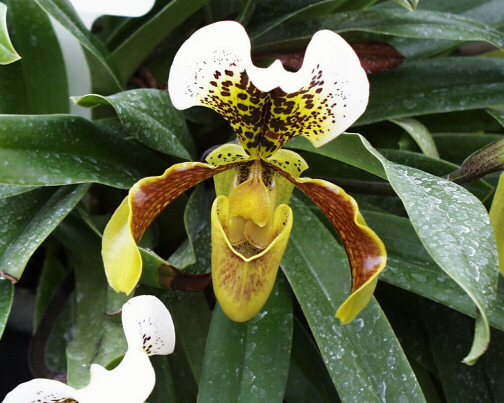
Found in India by the Danish botanist Nathaniel Wallich. It flowered for the first time at the Liverpool Botanic Garden in the autumn of 1920. The describer of this species, John Lindley, together with Wallich, compiled an entire atlas of forms of Paphiopedilum insigne, dividing them into four categories by the pattern of the perianth: green and yellow forms, which in turn were divided into spotted and plain.

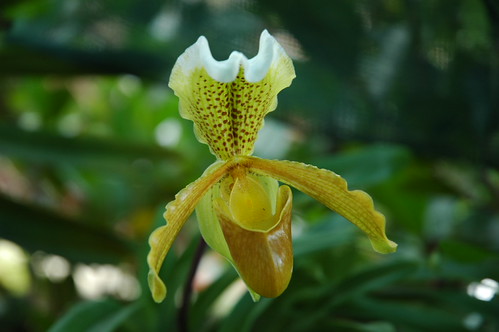
Stem very short, with a rosette of linear, green leaves folded lengthwise. Flower stalk no more than 20 cm high. Flowers mostly solitary, large, 4-5 cm in diam., glossy. Bract large, leaflike. The dorsal sepal is broadly ovate, greenish, with purple-brown spots along the green veins and a white wavy upper margin. Petals linear, wavy, reflexed. The labellum is slipper-shaped, yellow-green with a brown tinge. Flower coloration is very variable.
Temperature group — intermediate. For successful flowering a day/night temperature difference of 5-8°C and a drop in temperature during the winter period are essential.
Light: 20000-30000 lux. Relative humidity 60-80 %.
Pot in plastic or ceramic pots with several drainage holes in the bottom to ensure even drying of the substrate.
Some collectors consider Paphiopedilum insigne a calciphile and recommend adding calcium-containing additives to the substrate.
Watering frequency should be adjusted so that the substrate inside the pot has time to dry almost completely, but does not dry out completely.

A very rare form, Paph. Insigne var., has variegated foliage. Because such plants lack chlorophyll in much of their leaves, they grow very slowly and when dividing should never be split into very small parts.
Has been actively used in hybridization for about 100 years.