
Indoor plants
Paphiopedilum or Venus's Slipper
Paphiopedilum
A genus of perennial herbaceous plants of the orchid family (Orchidáceae) from Nepal, India, China, Thailand, Malaysia, the Philippines, Kalimantan, Sumatra and New Guinea. The genus name is formed from two words: from the name of the homeland of the goddess Aphrodite (Venus in Roman mythology) — the city of Paphos in Cyprus — and the word pedilon — slipper, sandal. Literally Paphiopedilum translates as Paphian slipper or slipper from Paphos. Because of the characteristic labellum of the flower, resembling a shoe or slipper, members of the genera Paphiopedilum and Cypripedium are often called lady's slipper.
This genus of orchids owes its popularity to its original flowers, which cannot be confused with any other because of the whimsical pouch-shaped labellum of the flowers, reminiscent of a little shoe. Most are geophytes — terrestrial rhizome-rosette plants with leathery leaves. Many lead a semi-epiphytic lifestyle, and some can grow epiphytically. By cultivation requirements they can be divided into warm-loving species and species with moderate conditions. Some species do well under certain fluorescent lamps, but preferably in a cool room.
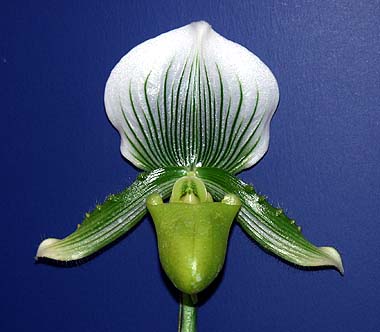
As a rule, species with mottled leaves are warm- and moisture-loving, and their development cycle is not tied to specific seasons of the year.
Paphiopedilum insigne
Originates from the western Himalayas. A semi-epiphyte with the broad-lanceolate leaves typical of this genus. Flowers solitary, less often two, 10–12 cm in diameter, on a long straight scape. The dorsal sepal is almost rounded, yellowish-green in the lower and middle parts, in the upper part white with brownish-maroon spots and the same-colored stripe along the midrib. The petals are narrower, linear-elongated, with a wavy margin, coloring similar to the sepals. The labellum is large, pouch-shaped, yellowish-green with a brownish tinge, inside with small brownish-maroon spots.
Paphiopedilum bellatulum
Originates from Myanmar and Thailand. A small plant with more or less mottled leaves, bluish-dark-green above with numerous pale spots, densely covered with red speckles beneath. Unlike most species of the genus, the flower sits on an extremely short scape, as if on the leaves, compact, almost round in outline, white or slightly creamy, sprinkled with wine-red spots and speckles. The dorsal sepal is rounded, keeled on the underside. The petals are larger than the sepals, broadly ovate, directed obliquely downward. The labellum is the same color as the sepals and petals.
Paphiopedilum hirsutissimum
Originates from northern India. The scape, ovary and lower surface of the flower are densely covered with short dark, almost black-red hairs. The dorsal sepal is broadly cordate, at the base and center with wine-red merging spots, pale green along the margin. Petals are long, spatulate, with a strongly undulate margin, at the base with numerous dark hairs, the upper half violet-red. The margins of the sepals and petals are densely set with dark cilia. The labellum is greenish-red-brown, covered with dark warts.
Paphiopedilum fairieanum
Originates from northern India. A compact plant with vertically elongated flowers. The dorsal sepal is ovate-elongated, with a hairy keel underneath, strongly undulate along the edge, white with numerous wine-red longitudinal lines. The petals are intricately curved, yellowish-white, with longitudinal violet lines and a similarly colored margin along the strongly undulate, almost curly edge, set with clusters of small dark hairs. The labellum is reddish-green with darker veins.
Paphiopedilum harrisianum

A garden hybrid P. villosum Pfitz × P. barbatum Pfitz. Leaves are elongated, light green, with a dark netted pattern. The dorsal sepal is wine-red transitioning to green at the tip, white along the edge, with dark veins. The petals have a dark purple midrib, in the upper half brown-red with dark veins, in the lower half dirty-yellow with green veins. The labellum is pale purple with darker colored veins. The staminode is dark brown with a greenish tint.
Paphiopedilum callosum
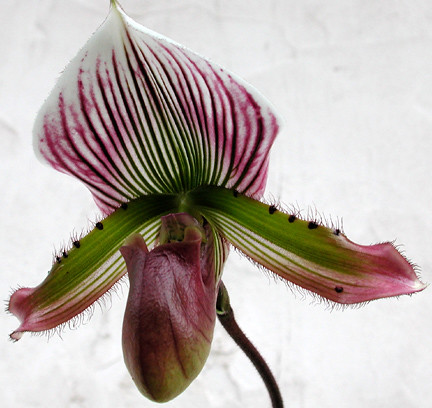
Leaves are light or bluish-green with dark green spots and lines forming a marbled pattern. Flowers are among the largest in the genus. The dorsal sepal is broadly cordate, up to 7.5 cm wide, white with numerous longitudinal lines along the veins, greenish below and wine-red in the upper half. The petals are directed obliquely upward, slightly turned back, pale green, becoming pale pink toward the tip, ciliate along the margin, with 4–7 dark, almost black tubercles along the upper edge. The labellum is brownish wine-red. The staminode is horseshoe-shaped, with a prominent knob in the center on the lower edge. Blooms in spring — early summer. Native to Thailand, Vietnam. In cultivation since 1885.
Paphiopedilum spicerianum
Leaves have wavy margins. Flower 7.5 cm in diameter. The dorsal sepal is broadly obcordate, with strongly reflexed margins at the base, in the upper half strongly curved forward, almost horizontal, white with a narrow central purple midrib and a large greenish spot at the base. Petals are strongly undulate along the margin, light green with purple speckles and a midrib of the same color. The labellum is dark brown, greenish beneath. The staminode is almost round, purple-crimson with a white margin. Blooms in November–January. Native to the state of Assam (India). In cultivation since 1878.
Paphiopedilum sukhakulii
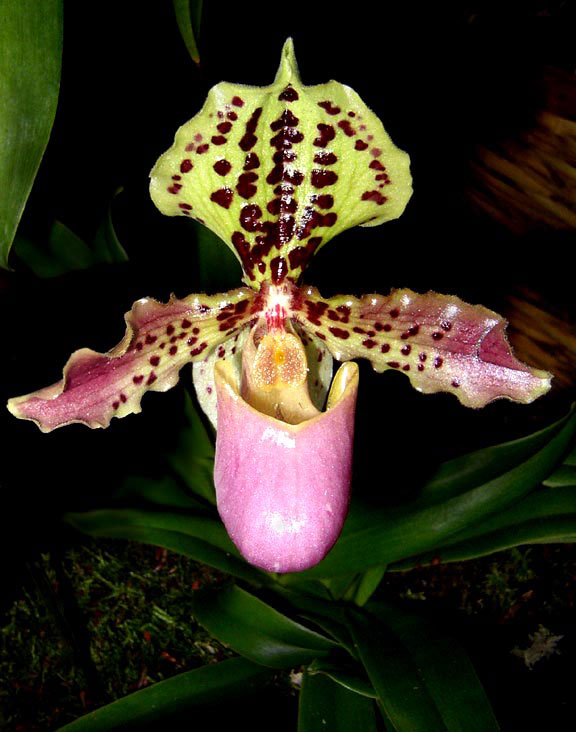
Leaves are oblong-elliptic, acute, with a three-toothed apex, pale green with a dark marbled pattern. The scape is brownish-purple, densely pubescent with white hairs. Flowers about 12 cm in diameter. The dorsal sepal is broadly ovate, slightly concave, with a boat-shaped long-acuminate apex, white with numerous longitudinal green veins. Petals are yellowish-green, with numerous brownish spots and dots over the entire surface, with long cilia along the edge. The labellum is brownish-maroon above, pale green beneath. The staminode is horseshoe-shaped. Blooms in September–July. Native to Phu Lang mountain (NE Thailand). Grows at 1000 m above sea level, in humid tropical forests, along stream banks, in shaded places on loose rich soil.
Location: for warm-loving species the daytime temperature range varies from 20 to 32 °C, at night +16+18 °C, not below +15 °C. Optimal temperature +25+28 °C. For species with plain leaves daytime +16+20 °C, at night +8+10 °C. Almost all species can tolerate a short-term drop in temperature to +5 °C, below which they perish.
Lighting: bright diffused light without direct sunlight. In general Paphiopedilums can be classified as shade-loving orchids with a relatively low light intensity requirement. Optimal day length is 14 hours.
Watering: since they do not have specialized storage organs, the substrate should remain constantly moist, but excessive waterlogging should be avoided. During the growth period abundant watering is required; after growth of the shoots ends, watering is reduced. When watering, water should not get on the base of the stem, otherwise rot may start.
Air humidity: prefer increased air humidity, optimal – 60%. The overall range varies from a lower limit of 40% to 80%.
Care: in coarse substrates less frequent feeding is recommended than on bark. In summer during the growth period feed with a weak solution of a complete mineral fertilizer. Note: to regulate an excess of salts in the substrate a one-time watering with distilled water can be recommended, after which it is advisable to fertilize at the next regular watering. Paphiopedilums respond well to foliar feeding.
Propagation: by division at transplanting. It is desirable to leave at least three growths in a division, but for intensive propagation one can divide by single growths, which will affect later flowering.
Repotting: slippers are sensitive to excess salts in the substrate, so repotting is necessary as the substrate decomposes. It should be carried out carefully so as not to damage the fragile roots, on average every 1–3 years.
Substrate: prefer mixed substrates of bark, sphagnum, charcoal with the addition of chalk or dolomite flour, but can be kept on bark alone. In indoor culture, to increase moisture retention one can increase the proportion of sphagnum moss. Coarser substrate is placed at the bottom, while finer, more moisture-retentive material is placed nearer the surface.
Tip: Paphiopedilum roots grow horizontally, so wide pots and shallow dishes are more suitable for them.
Possible problems: susceptible to scale insects and spider mites.