
Flowering shrubs
Tree peony
Paeonia suffruticosa
Synonyms: Paeonia moutan Sims, Paeonia × arborea C.C.Gmel., Paeonia × chinensis Oken, Paeonia × fruticosa Dum.Cours., Paeonia × moutan Sims, Paeonia × moutan var. anneslei Sabine, Paeonia × moutan var. papaveracea (Andrews) DC., Paeonia × papaveracea Andrews, Paeonia × suffruticosa f. anneslei (Sabine) Rehder, Paeonia × suffruticosa f. maculata Hong C.Zheng, Paeonia × suffruticosa var. papaveracea (Andrews) Kern., Paeonia × suffruticosa var. purpurea Andrews, Paeonia × suffruticosa f. rubida Hong C.Zheng, Paeonia × yunnanensis W.P.Fang, пион полукустарниковый.
Peony (Paeonia × suffruticosa Andrews) is a species (group) of peonies in the genus Paeonia of the family Paeoniaceae. Natural or artificial hybrids and cultivars united into one group. The group was first described by the British botanist Henry Charles Andrews in his scientific work "Botanists' Repository, for New, and Rare Plants" in 1804.
The first mentions of tree peonies date back to the Han dynasty (around 200 BCE). The first description of peonies was created by Ouyang Xiu, in which the first 24 cultivars were described. The oldest tree peonies grow in the city of Yancheng and were planted in 960–1279 CE during the Song dynasty.
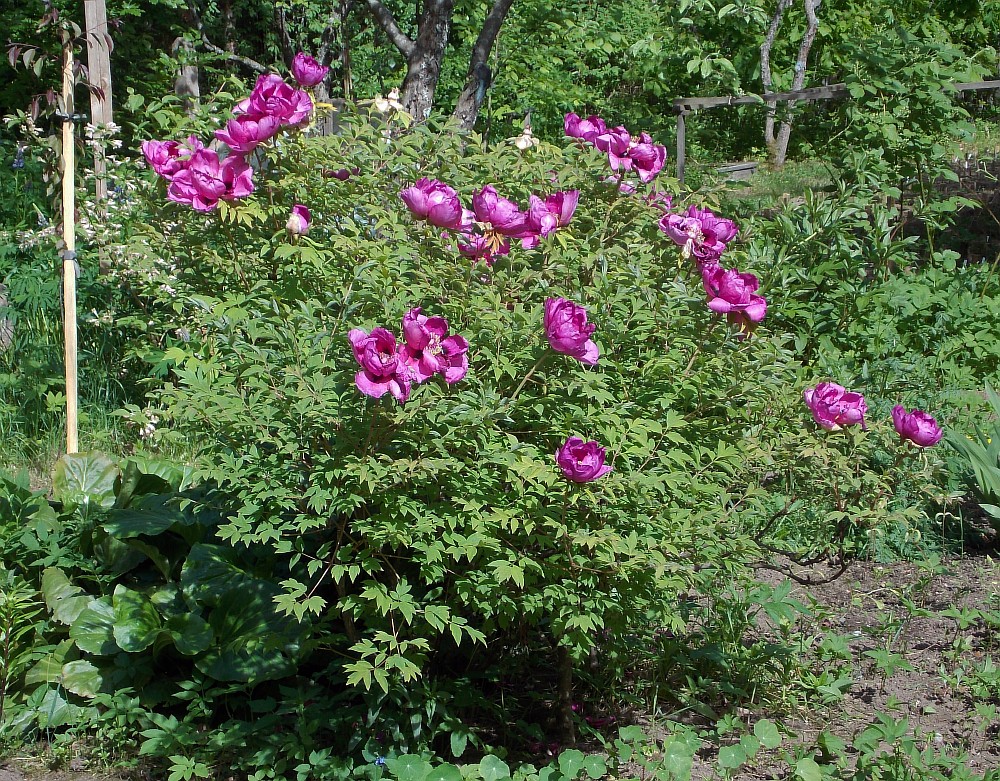
Photo L. Trofimuk
Natural hybrids are found in China in Anhui and Henan provinces. They are quite common in cultivation, especially in China. They grow on cliffs and in open forests, occurring at altitudes up to 300 m above sea level.
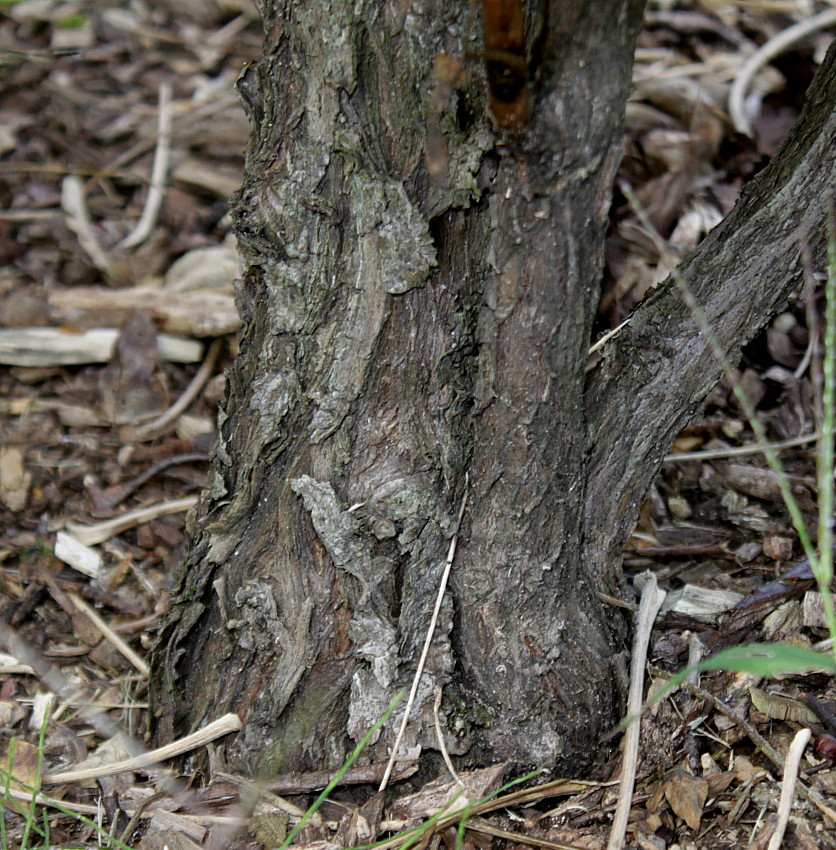
Photo V. Kudelya
They are deciduous shrubs up to 1.5 m in height and 2–3 m in diameter. Stems thick, erect, sparingly branched, dark brown. Young shoots green, later becoming light brown.
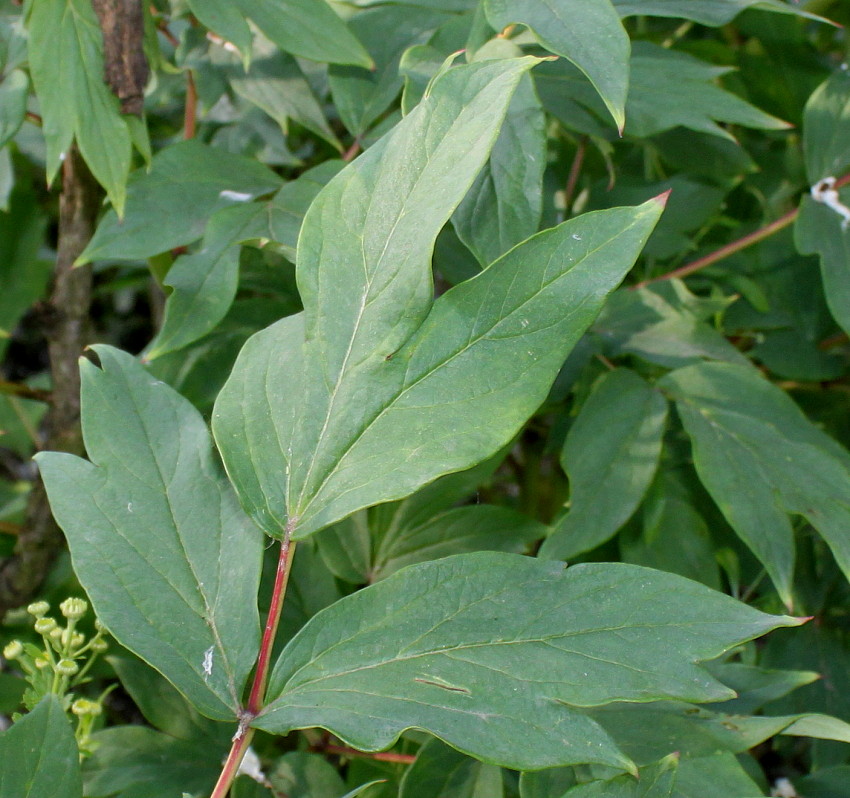
Cultivar 'Kokamon' (Photo V. Kudelya)
Leaves 10–25 cm long, bipinnate, green. Leaf segments from broadly ovate to oblong-ovate, sessile or petiolulate, often 3–5 lobed, less often entire, hairy beneath, dull above, glabrous or sparsely hairy.
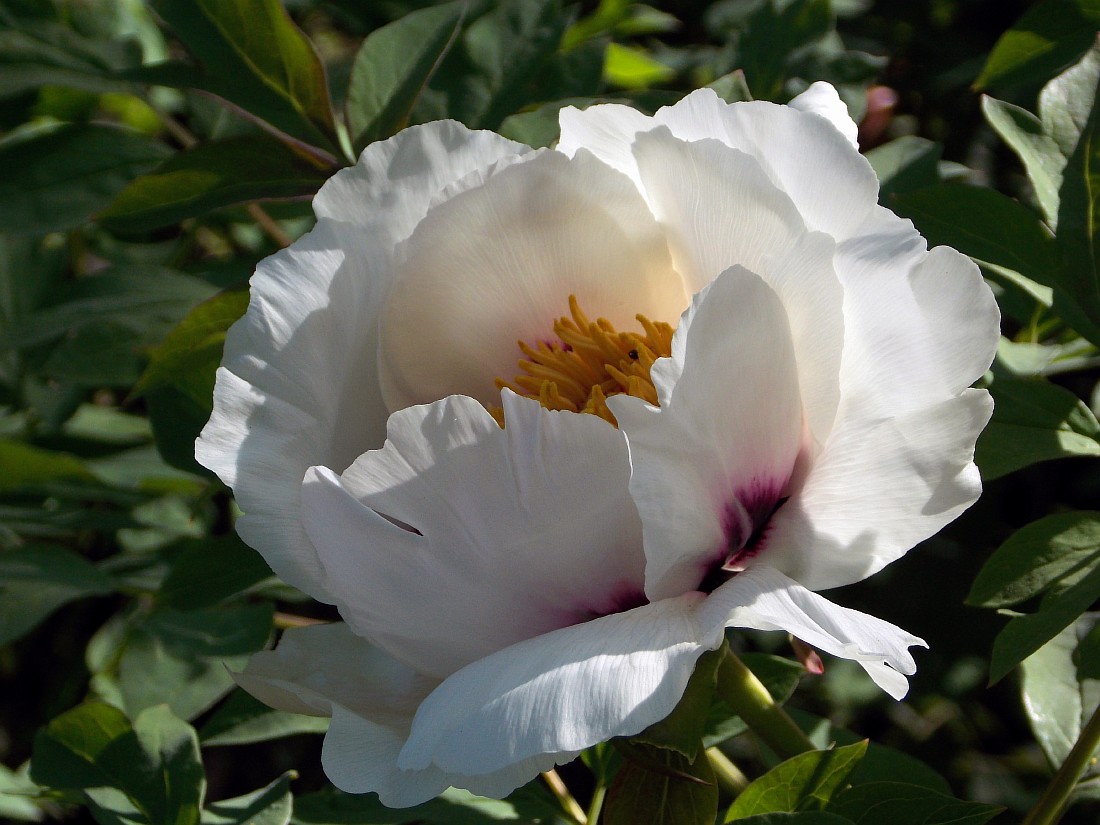
Photo L. Trofimuk
Flowers borne at the ends of shoots, reaching 10–20 cm in diameter, simple, semi-double or double, white, pink, red or bicolored, often with a dark base to the petals, fragrant. Peduncle straight, sturdy. Bracts 5 in number, elliptic, unequal. Sepals 5, green, broadly ovate. Petals 5–11, obovate, 5–8 cm long and 4.2–6 cm wide, apex irregularly notched. Filaments pink or purple, white in the distal part, up to 1.3 cm long. Anthers about 4 mm. Carpels 5, less often more, densely woolly. Blooms in May–June.
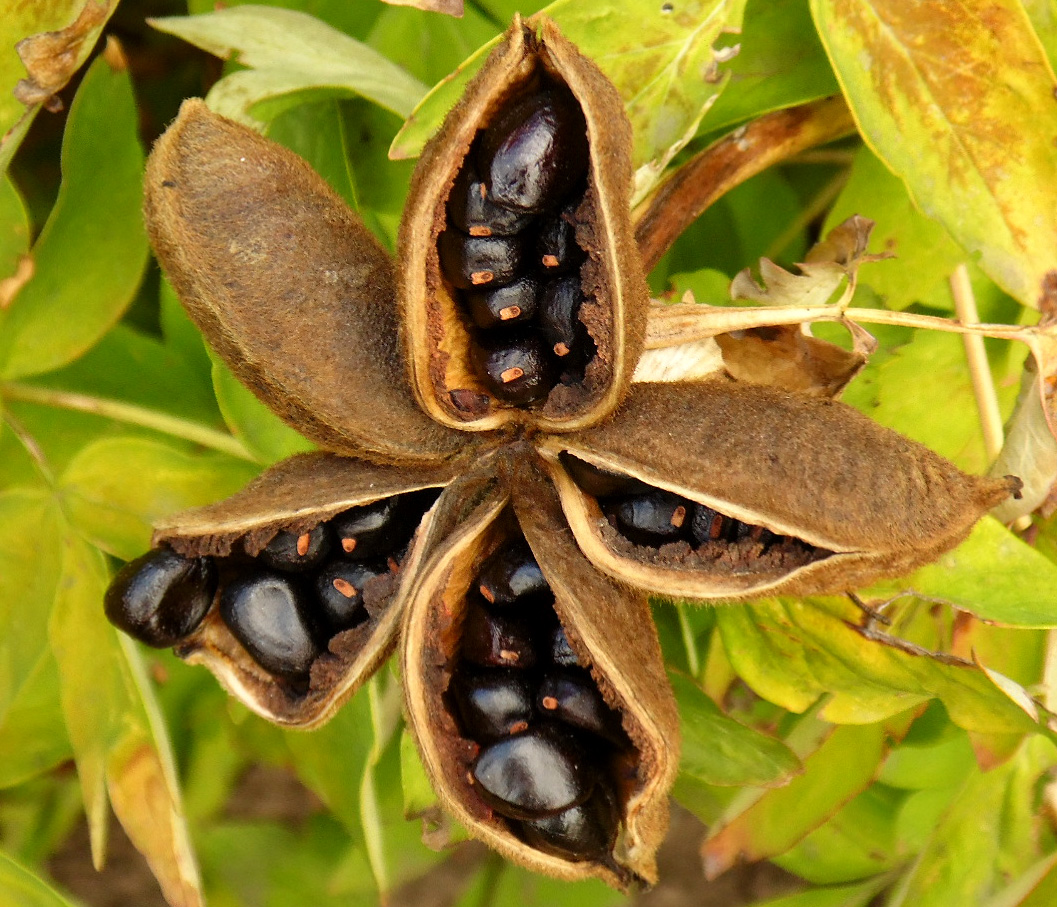
Photo O. Krasova.
Fruits – oblong follicles, woolly, densely brown-yellow. Fruits in July–August.
Subspecies:
- Paeonia suffruticosa subsp. suffruticosa
- Paeonia suffruticosa subsp. yinpingmudan D.Y.Hong et al.
- Paeonia suffruticosa subsp. spontanea (Render) S.G.Haw et L.A. Lauener
- Paeonia suffruticosa var. papaveracea (Andrews) Kerner
Cultivars: more than 5000 cultivars registered. Cultivars are divided into 3 groups (according to Wikipedia):
- Chinese-European — with double flowers
- Japanese — with single and semi-double flowers
- hybrids of Paeonia delavayi and Paeonia delavayi-derived peonies (with yellow flower coloration)
Ito-hybrids are named after the Japanese breeder Toichi Ito, who first crossed herbaceous and woody peonies. Popular Chinese-bred cultivars include Paeonia 'Feng Dan Bai', Paeonia 'Hu Hong', Paeonia 'Ni Hong Huan Cai', Paeonia 'Hai Huang'.
Subgroups: the taxonomy of the Paeonia suffruticosa group is not settled, as many species are insufficiently studied and rarely occur in the wild.
- Paeonia delavayi — Delavay's peony
- Paeonia ludlowii
- Paeonia qiui
- Paeonia ×suffruticosa — tree or shrub peony.
- Paeonia ×suffruticosa — tree or shrub peony.
- Paeonia jishanensis
- Paeonia rockii — Rock's peony
- Paeonia ostii
- Paeonia spontanea
- Paeonia ×papaveracea Andrews
- Paeonia ×baokangensis Z. L. Dai et T. Hong.
Hardiness zone: 4b (-23°C)
Location: Requires a sunny site sheltered from strong winds. The best location is a plot that receives sun in the morning and evening. Does not flower in full shade. In places with strong midday sun the flowering period is significantly shortened. Does not like being near large trees.
Soil: prefers cultivated loamy and slightly acidic soils with pH 6–6.5. On clay soils add sand; on sandy soils add 1.5 buckets of clay. On acidic soils it is recommended to apply 200–400 g of lime.
Planting: does not like transplanting, so choose the best site for the plant immediately. Planting is carried out in mid-August to late September. Distance between plants should be at least 1.5–2 m.
Care: after planting and for 2 more years foliar feeding is recommended. From mid-May once a month spray the leaves with a solution of a complete mineral fertilizer. To improve wetting of the surface, soap or laundry detergent (1 tablespoon per 10 L of solution) can be added. Foliar feeding should be done in the evening or on cloudy days. Mature plants are fed 3 times at the beginning of the growing season, starting in mid-May. The first time give a urea solution (50 g per 10 L water), the 2nd time add micronutrient tablets to the urea solution (1 tablet per 10 L), the 3rd time feed only micronutrients – 2 tablets per 10 L water. Also, for abundant flowering, in late March–early April apply fertilizers containing nitrogen and potassium (10–15 g broadcast over the snow around an adult bush). During bud formation in late May–early June apply a complete mineral (NPK — 10:20:10) or organic fertilizer (cow manure 1:10, poultry manure 1:25). A week after flowering apply 15 g phosphorus and potassium. For the second and third feedings fertilizers are evenly spread in a ring furrow around the bush, watered in and covered with soil. In dry weather, in early spring, during bud formation and flowering, water with 2–3 buckets per adult bush. After watering loosen the soil.
Pruning: in autumn before frosts cut herbaceous peonies at ground level. Cover stem remnants with ash — 2–3 handfuls per bush. In the first year after planting it is recommended to pinch out buds to stimulate root system development. In the second year one bud may be left.
Propagation: propagated by seeds, layering, grafting and division of 5–6 year-old bushes. Cutting rooting is 2–3%. Seeds are recommended to be sown immediately after collection for maximum germination. If seeds dry out, germination falls to 1%. Freshly collected seeds sown immediately after ripening germinate at 80–85% and begin to flower in the 4th year. To accelerate germination, seeds can be stratified. For this, immediately after collection the seeds are sown into moist sand and kept in a room with alternating temperatures — for 6–7 hours at +18 °C and the rest of the time at +30 °C. Seeds germinate in January–February. After that the containers with sand are moved to a cellar or any dark place until the first leaf appears (approximately in May). In early May the plants can be exposed to open air. In late August they are planted in their permanent place.
Layering propagation is done in May before flowers open. On a shoot growing low to the ground make a cut and treat with root forming stimulants. Then peg it to the ground and cover with 10–15 cm of soil. Water the layer regularly. In September the rooted layer is cut from the mother plant and planted in a permanent place. Air layering is also used before flowering, but it is less effective. On the shoot make incisions, treat them with root stimulants, wrap with sphagnum and film and tie. Roots usually appear by late August.
The most effective propagation method is grafting, which can be done onto roots of woody and herbaceous peonies. Grafting is carried out in mid-August. Scions from the current year’s shoots are used. The most popular grafting method is a wedge cut, using a root segment 10–15 cm long as the stock, with thickness matching the scion. A scion with 2 eyes is best. The surfaces of stock and scion must be perfectly smooth. Insert the scion into the stock and bind tightly with insulating tape with the sticky side out. Another common method is side grafting. Cut the scion diagonally at an angle and cut the root at the same angle. Match stock and scion, coat with grafting wax and remove all leaves. For better union of scion and stock two techniques can be used: laying the grafted material horizontally in 2–3 layers for 3–4 weeks and covering with moist sawdust, or planting in a shaded protected greenhouse and regular watering for 3–4 weeks. In September grafts can already be planted in open ground on high, well-drained beds so that the bud is 6–8 cm deep, which allows development of a good root system. In spring the scion will shoot and switch to its own roots.
Division of the bush is done at age not less than 4–5 years. In the first year they hill to 10 cm, in the second to 20–25 cm. New shoots appear on the bush, which by autumn form roots. Divide the bush during dormancy — in early spring after soil thaw. You can also dig up a 6–7 year-old plant at the end of August, wash soil from the roots with a hose and divide the bush into several parts, sealing wounds with grafting wax.
Diseases: Botrytis blight (for prevention treat the plant 3 times with Bordeaux mixture at 50 g per 10 L water or cuprous oxide - 50 g per 10 L, applying 2–3 L of solution per adult bush), rust (spray leaves after flowering with cuprous oxide (60–70 g per 10 L), Bordeaux mixture (100 g per 10 L) or wettable sulfur (100 g per 10 L)). To improve adhesion to leaves add soap or 1 spoon of washing powder to the spray. Also common are leaf ring mosaic (ring spot), tobacco mosaic virus (TMV), tobacco rattle virus (TRV), cucumber mosaic virus (CMV), alfalfa mosaic virus (AMV), strawberry latent ringspot virus (SLRSV), raspberry ringspot virus (RRSV), carnation mottle virus (CarMV), Arabis mosaic virus (ArMV), variegated petals, bean yellow mosaic virus (BYMV), narcissus mosaic virus, tomato aspermy virus, barley yellow dwarf virus (BYDV), Cladosporiosis or brown spot (Cladosporium paeoniae), Phyllostictosis (Phyllosticta paeoniae), Septoria or brown spot (Septoria macrospora), powdery mildew (Sphaerotheca fuliginea f. paeoniae, Erysiphe communis f. paeoniae), root rots (Fusarium, Botrytis, Rhizoctonia, Sclerotinia) (dust roots with crushed charcoal mixed with fundazole (2:1) or with sulfur (2:1); disinfect rhizomes for 30 minutes in a copper sulfate solution (1%), or with Maxim (0.2–0.4%), fundazole (0.2%), TMTD (1%) or a mixture of fundazole (0.2%) with TMTD (0.6%). When planting water with a mixture of fundazole (0.2%) and zineb or TMTD (0.6%). During the growing season you can use fundazole, Fitosporin-M, Baktofit, Alirin-B, Gamair). For control of leaf spots, treatments are applied before bud formation — Bordeaux mixture (up to 1%), cuprous oxide (0.5%), zineb (0.5%), Abiga-Peak (0.4–0.5%), Chistotsvet (4 ml per 5 L water) or Fitosporin-M (6 ml per 10 L water). For septoria use the same products as for leaf spots + Gamair (2 tablets per 1 L water), applied immediately after flowering and then every 10–12 days if necessary. To combat powdery mildew during the growing season treat at 10–14 day intervals with: fundazole (0.2%), Topaz (0.05–0.1%), Topsin-M (0.1–0.2%), Chistotsvet (4 ml per 5 L water), solution of caustic soda with soap or copper-soap liquid, Fitosporin-M (6 ml per 10 L water or 2 g per 10 L), Baktofit (0.7% or 10 g per 10 L), Alirin-B (2 tablets per 1 L). For comprehensive protection against diseases use copper sulfate (3–4%) or Bordeaux mixture (2–3%).
Pests: rose chafer beetles, root-knot nematodes, turf ants, caterpillars of owlet moths, caterpillars of the hop-lappet moth.
Companions: garden geraniums (including Geranium magnificum for dark and brightly colored peonies, scented geranium for pale and light ones), Nepeta with purple flowers. As a backdrop, lilies are ideal (lily blooms should be smaller than peony flowers). By leaf texture companions can be phloxes, daylilies, sedums, irises and Phytolacca. For vertical structure neighbors can be foxglove, Veronica, miscanthus, globe thistle or delphinium. On flowerbeds for edging violets, lady's mantle, asters, primulas, heucheras may be suitable.
Uses: used in solitary and group plantings on lawns and forest edges,