
Deciduous shrubs
Cranberry
Oxycoccus
Synonyms: Vaccinium sect. Oxycoccus (Hill) W.D.J.Koch
Cranberry (Oxycoccus) – a group of flowering plants in the family Ericaceae. The international botanical name - Vaccinium subgen. Oxycoccus (Hill) A.Gray. The group was first described by the well-known American botanist Asa Gray in 1837. The Latin word oxycoccos derives from Greek ὀξύς («sour») and κόκκος («berry»), referring to the taste of the fruits. Some scientists separate cranberry into the independent genus Oxycoccus Hill (1756), others place it in the subgenus Vaccinium subgen. Oxycoccus (Hill) A.Gray (1848) or as the section Vaccinium sect. Oxycoccus (Hill) W.D.J.Koch (1837).
In nature they occur in transitional and raised bogs, in sphagnum coniferous forests, sometimes along marshy lake shores.
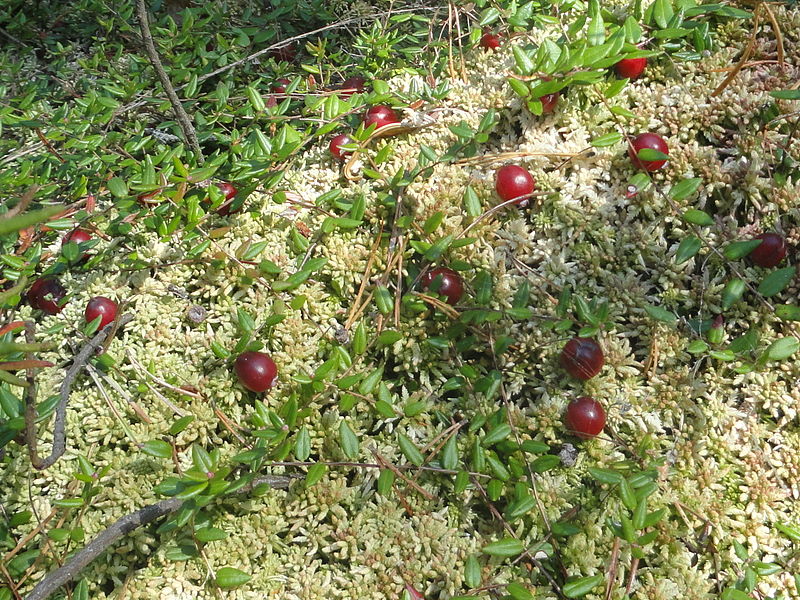
Common cranberry. Author: A. Pertsev.
They are creeping evergreen shrubs with flexible threadlike rooting stems 15 to 30 cm long.
The root system is of the taproot type. A fungus lives on cranberry roots, whose hyphae closely connect with root cells and form a mycorrhiza. The fungal hyphae take up nutrient solutions from the soil and supply them to the roots.
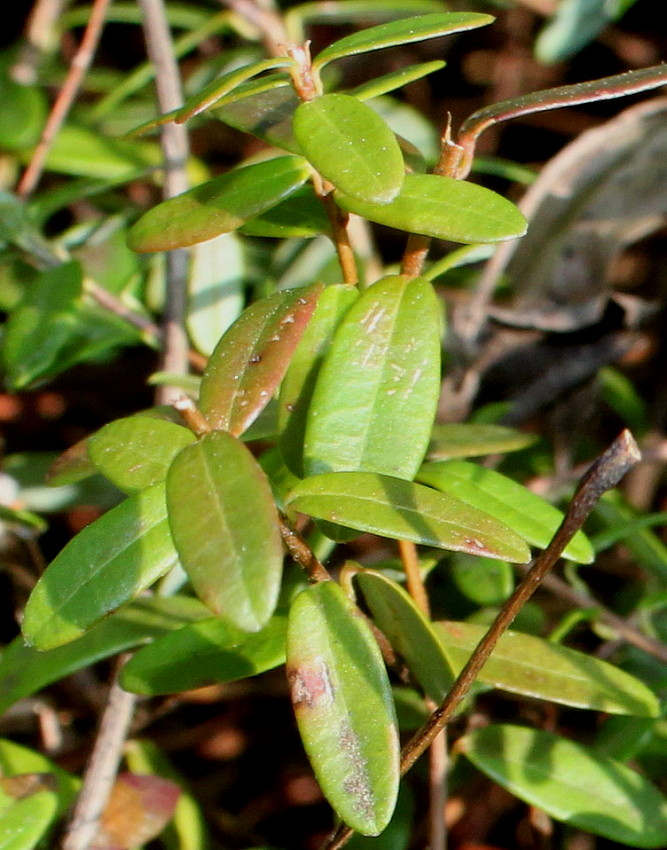
Large-fruited cranberry. Author: V. Kudelya
Leaves alternate, 3 to 15 mm long, 1 to 6 mm wide, ovate or oblong with a short petiole. The leaf blade is dark green above, ash-colored (white) beneath, and persistent through winter. On the lower surface of the leaf there is a wax that prevents water from flooding the stomata and thereby protects the plant from disruption of its normal functions.
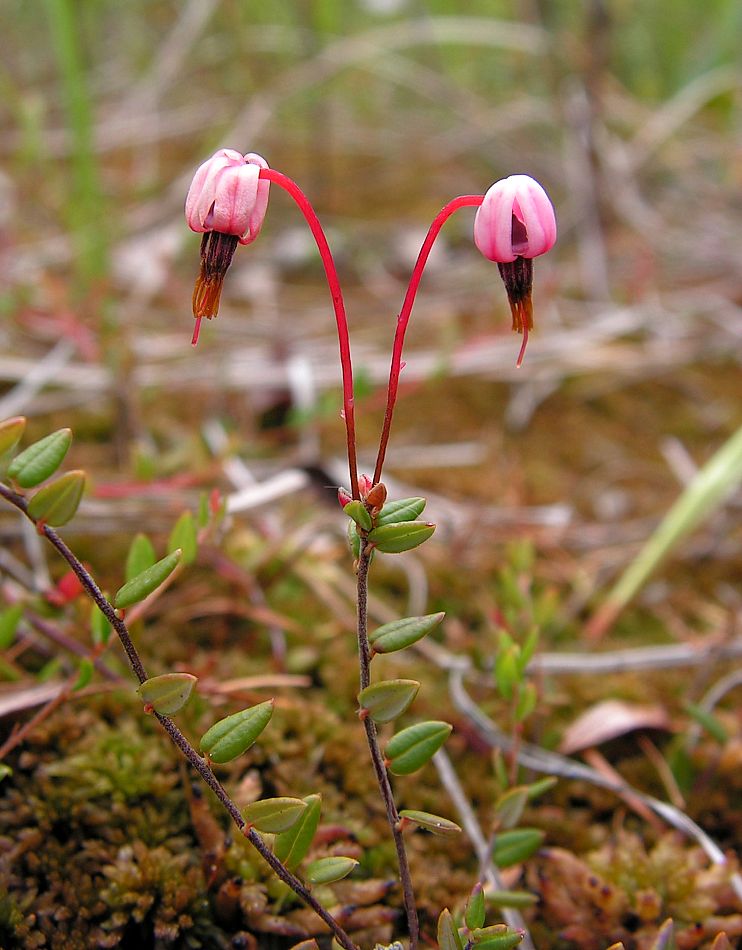
Small-fruited cranberry. Author: A. Baryshenko
Flowers light purple or pink, actinomorphic, with the stigma turned downward (nodding). On a pedicel that can be quite long (in Vaccinium oxycoccos its length may be almost up to 5 cm). Calyx lobes four. Corolla deeply four-parted (but flowers with five petals also occur); petals reflexed. Stamens eight. Pistil one. Ovary inferior. In the conditions of the European part of Russia it flowers in May-June. The lifespan of a single flower of Vaccinium oxycoccos is 18 days.
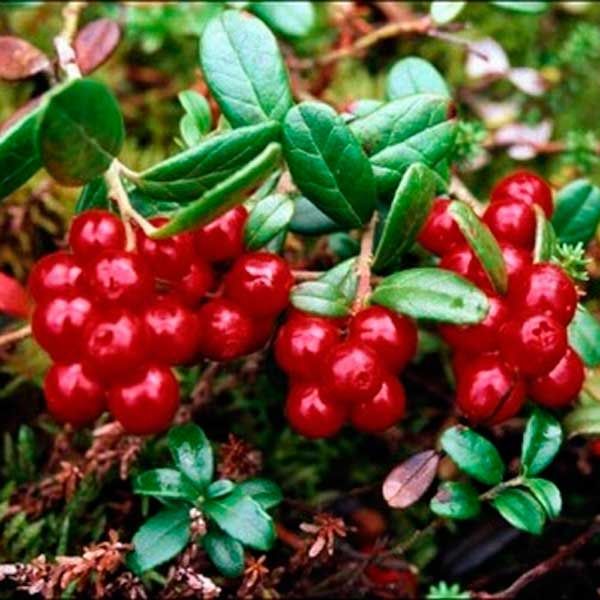
Common cranberry 'Pilgrim'
Fruits are spherical, ellipsoid or ovoid red berries, 8-20 mm in diameter. The size of a berry grown on a bog reaches 16 mm. Cranberry is characterized by ornithochory: fruits are eaten by birds, which disperse its seeds over long distances. Each plant produces several hundred berries annually.
Species:
- Vaccinium macrocarpon Ait. (1789) — Large-fruited cranberry or American cranberry.
- Vaccinium oxycoccos L. (1753) — Cranberry, or common cranberry
- Vaccinium microcarpum (Turcz. ex Rupr.) Schmalh. (1871) — Small-fruited cranberry
- Vaccinium erythrocarpum Michx. (1803) - Vaccinium erythrocarpum (red-fruited Vaccinium)
Hardiness zone: 5-8 (-29°C).

Location: light-loving, but not demanding in mineral nutrition. The site for cranberries should be level and located in a well-lit place. It is recommended to avoid enclosed depressions and hollows where cold air can accumulate and water can stagnate during snowmelt or heavy rains.
Soil: prefers acidic, water- and air-permeable (peat, sand, sandy loam) soil with pH 3.5-4.5 and moderate soil moisture, but under no circumstances excessive, despite the fact that it grows on bogs. The top layer of soil should be moist.
Planting: for planting it is recommended to make beds based on raised peat. To do this, remove the top layer of soil (to a depth of 20-25 cm) and fill the resulting depression with raised peat. Pure raised peat can be replaced with a mixture consisting of any type of peat, sawdust, fallen needles and well-rotted forest litter in any proportions. A little sand can be added to this mixture. The surface of the bed is sprinkled with sulfur (40-60 g per 1 m² area), the substrate is mixed, compacted and mulched with sand (a layer of 4-5 cm). To acidify the soil, water the prepared bed with acidified water (10 l of water per 1 m²). For acidification use citric or oxalic acid (1 teaspoon per 3 l of water), acetic or apple vinegar (9% vinegar 100 g per 10 l of water). Seedlings are best used with a closed root system. They are planted with a soil ball into holes up to 10 cm deep and 8-10 cm in diameter at a distance of 20-30 cm from each other. After planting the area should be well watered and sprinkled with sand (a layer of 1.0-1.5 cm). For a week monitor to prevent the topsoil from drying out.
Care: In hot weather it requires watering. The water used for irrigation should also be very acidic (pH 4), otherwise plants will first show signs of chlorosis on the leaves, then growth will stop and plants may die. In cultivation cranberry responds actively to relatively small amounts of fertilizer, and only mineral fertilizers should be used (the complex fertilizer "Universal" is well suited). In the first year of cultivation the fertilization schedule is as follows: the first feed is carried out three weeks after planting. On 1 m² apply half a tablespoon of fertilizer. Then continue applying the same fertilizer in the same amount every 2 weeks until the end of July. In mid-August apply about a third of a tablespoon of the fertilizer "Autumn" per 1 m². The last fertilization is applied in October (as in August). In the second and third years of cultivation, from the end of April until the end of July, every 2 weeks apply half a tablespoon per 1 m² of the fertilizer "Universal". In mid-August and October apply a third of a tablespoon of the fertilizer "Autumn". Starting from the fourth year and in subsequent years the amount of fertilizer applied to large-fruited cranberry is sharply reduced. During the growing season carry out 6 feedings. In mid-April, May, June and July apply a third of a tablespoon of the fertilizer "Universal" per 1 m². In mid-August and mid-October apply a third of a tablespoon of the fertilizer "Autumn" per 1 m². Cranberry plantings are periodically mulched with sand, which provides favorable conditions for the growth and development of the root system and the plant as a whole. Sand dressing is carried out once every two to three years, in early spring, before the start of cranberry growth, spreading sand in a layer of 2-3 cm over the entire surface of the plot. In winter cranberry needs protection from freezing. The simplest and most convenient means is a snow cover, which has good thermal insulation properties. But snow cover is not a sufficiently reliable means (it can melt during a thaw, and during a snowstorm it can be blown off the bed). Therefore, in late autumn cover the plantings with any available material: spunbond, burlap, fir branches, etc. In spring, after soil thawing, remove the cover. Protection is needed not only from freezing. In winter, in dry windy weather, unprotected cranberry shoots die, even though the temperature remains significantly above the critical point. This is because in frozen soil the root system does not function and water does not reach the aboveground parts of the plant. As a result, shoots die from desiccation, although in mid-winter they can withstand short-term temperature drops to -28 to -30°C. Under no circumstances should straw or fallen leaves be used for covering. Mice may settle in them and for nesting will use not only the scattered straw but also the cranberry shoots beneath it. In spring and autumn take measures to protect plantings from frosts. The most reliable method of protection in this case is overhead irrigation. At night, when the temperature drops to 0°C, turn on the irrigation. If this is not possible, in the evening before a frost, water the cranberry beds abundantly with water, or cover them with spunbond, burlap, foam rubber, polyethylene film or any other available material (even straw).
Pruning: in early spring (before the start of vegetation) or in autumn (after berry harvest) prune the creeping shoots that protrude above the tops of the upright shoots. Cut shoots using a pruning shear, scissors or a knife. The frequency of pruning is determined visually, by the density of the cranberry canopy and the degree of development of creeping shoots. Shoots can be cut in strips 2-3 cm wide, leaving an adjacent strip of uncut shoots of the same width.
Diseases: affected by Phomopsis, gray and snow mold, red leaf spot, monilial blight, gibberella leaf spot, Pestalotia, Ascochyta, Botrytis, and shoot overgrowth.
Pests: black-headed cowberry leafroller, heath geometer, gypsy moth, cabbage moth and apple-shaped scale insect
Propagation: propagated by seeds and cuttings. Cuttings are taken and planted in mulch-covered moist sandy soil. To maintain sufficient humidity the planting is covered with film and watered regularly. After 20-25 days the cuttings will root and produce lateral shoots.
Uses: fruits are consumed fresh, used to make fruit drinks, juices, kvass, extracts, and jellies, and are good sources of vitamins. Leaves can be used as tea.