
Indoor plants
Cambria Orchid
Orchidaceae Cambria
Synonyms: star orchid
Cambria orchid (Orchidaceae Cambria) – a group of hybrid orchids from the Orchid family. The first hybrid was created by crossing Odontoglossum crispum x Miltonia x Cochlioda in 1911 by Charles Vuylsteke (Charles Vuylsteke) and was named Vuylstekeara Cambria in his honor. Ten years later Vuylstekeara was crossed with Odontoglossum Clonius and named Vuylstekeara Cambria Plush, which immediately received awards from the Royal Horticultural Society and by the American Orchid Society.
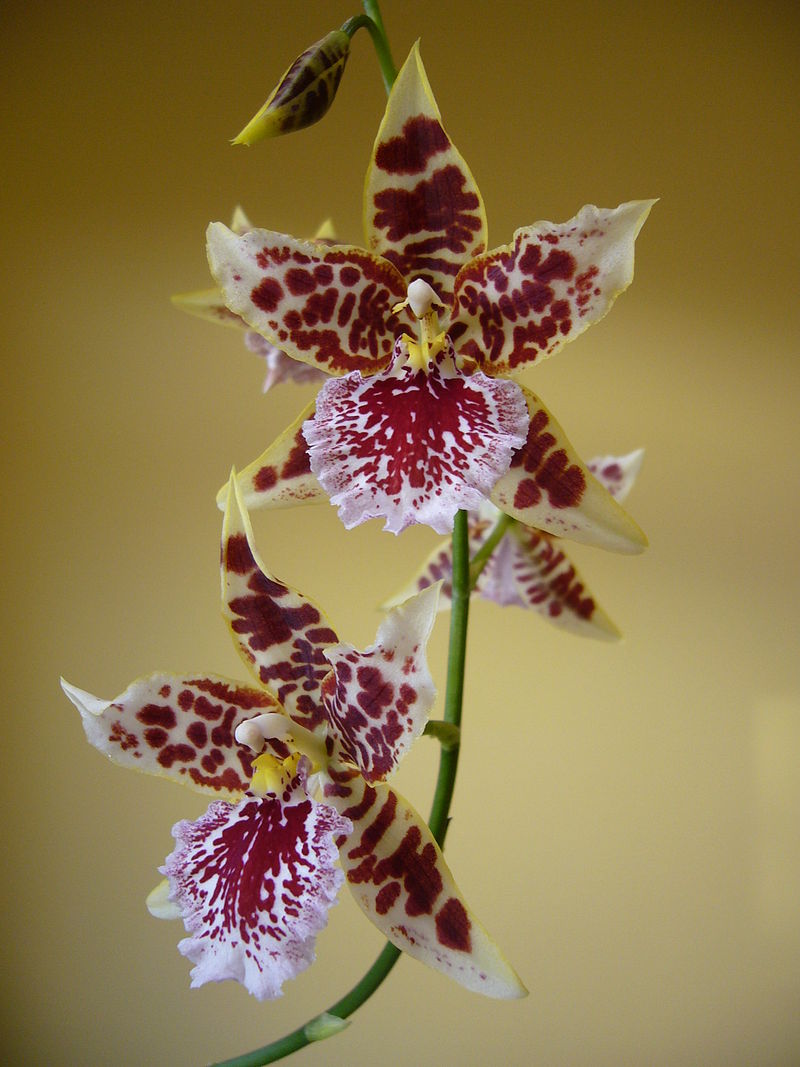
Cambria orchids are epiphytic herbaceous plants with pseudobulbs (round, oval, or elongated-ovoid in shape). Growth is sympodial (shoot-forming). Bulbs bloom once, producing 1-2 flower spikes.
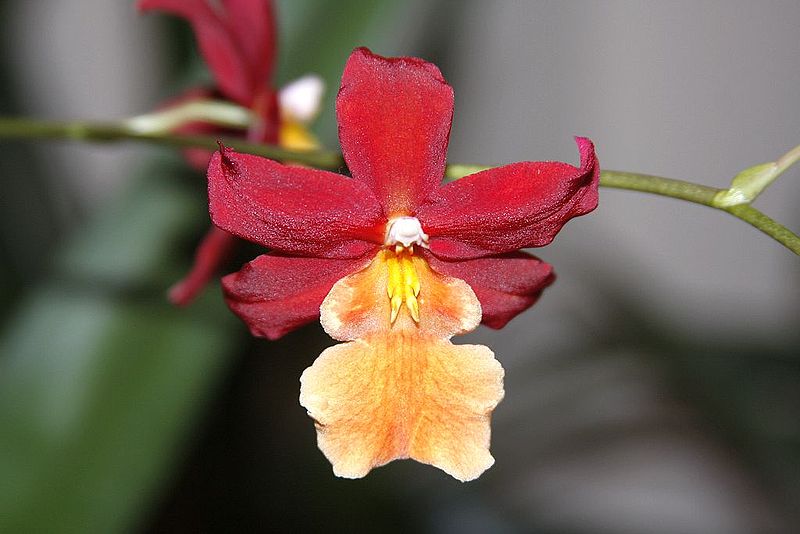
Leaves are narrow, long, broadly lanceolate, leathery, up to 50 cm long, dark green with a well-defined central vein.
Flowers range from red to deep burgundy with white speckles, star-shaped or rounded, from 50 mm to 10 cm in diameter. The lip is broad, red at the base and white from the middle with red spots. Blooms in summer, spring and autumn, lasting 4-6 weeks.
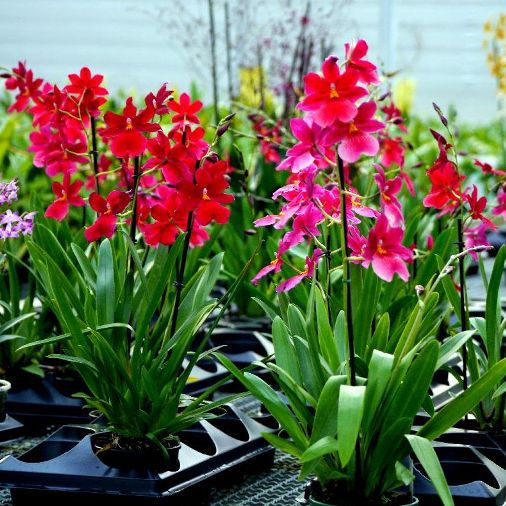
Subgroups:
- Beallara (Beallara) = Brassia x Miltonia x Cochlioda x Odontoglossum.
- Burrageara (Burrageara) = Cochlioda x Miltonia x Odontoglossum x Oncidium.
- Colmanara (Colmanara) = Miltonia x Odontoglossum x Oncidium.
- Miltonidium (Miltonidium) = Miltonia x Oncidium.
- Miltassia (Miltassia) = Miltonia x Brassia.
Hardiness zone: 10a-11 (14°C).
Temperature: a warmth-loving plant; it is recommended to maintain a temperature of 22-23°C, in winter not below +14-16°C.
Lighting: in winter it needs bright light; from spring to autumn it should be shaded from direct sunlight; an east or west window is ideal in summer.
Watering: abundant watering is necessary during the growth of the pseudobulbs; after they have formed, watering is reduced for about 2-3 weeks. After a new flower spike appears, watering is resumed. The watering method is standard – immersing the pot up to 2/3 of its height in a container of water for about 20-30 minutes. The substrate should dry well before the next watering. In warm weather water approximately once a week; in cool weather or rainy periods – once every 2 weeks. It is recommended to use filtered, settled, or boiled water – this species strongly reacts to water quality. Water should not get on the pseudobulbs. It is better to let a Cambria dry out a bit than to overwater it.
Fertilization: feed Cambria from the beginning of new shoot development until the flowering period – 1-2 times a month. The concentration of the solution should be reduced by half, as this orchid type has very delicate roots. When fertilizing, immerse the pot completely in water with fertilizer. During and after flowering, until the start of new pseudobulb growth, do not fertilize Cambria.
Humidity: does not play an important role in cultivating this group of orchids. If Cambria is kept in a hot and dry room or close to heating devices, it is recommended to increase humidity. For example, place a container with water or moist expanded clay near the pot, or perform daily leaf misting.
Repotting: repot every 2-3 years. Main reasons for repotting are substrate compaction and insufficient pot volume. Ideally repot when the young roots on the new bulb have not yet appeared but their growth is expected. Potting mix - regular orchid/epiphyte substrate of medium and small fraction. If the room air is very dry, you can add a little agroperlite or vermiculite to the substrate to retain moisture. Drainage or large pieces of bark can be placed at the bottom of the pot; do not cover the bulbs with substrate from above. Plastic or ceramic pots are suitable. The root system of Cambria dislikes light (unlike phalaenopsis), so it is better not to repot it into glass pots or cachepots. After repotting it is recommended not to water, fertilize, or move the orchid to another place for a week.
Propagation: by division of the clump so that each half has an equal number of bulbs. When dividing, it is very important not to damage the fragile roots; if a root breaks, dust the cuts and breaks with crushed activated charcoal. After repotting, do not fertilize or water the divisions for a week.
Diseases: may be affected by fungal and bacterial diseases.
Pests: orchid aphids, red spider mite, thrips. Control method - use specialized products.