
Indoor plants
Ophiopogon (Lilyturf)
Ophiopogon
The genus name comes from Greek ophis - snake and pogon - beard: it corresponds to the meaning of its Japanese name. About 20 species are distributed from the Himalayas to Japan and the Philippines.
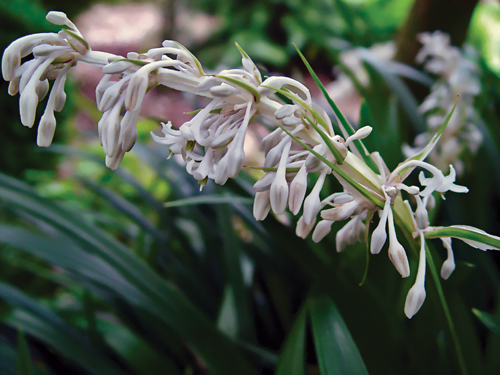
A low evergreen herbaceous plant with a rhizome and tufts of narrow linear leaves that together form a dense turf. It blooms in July–August, producing erect shoots bearing white or lilac flowers gathered into a narrow spike-like inflorescence. After flowering, fruits develop — blue berries.
Indoors, Ophiopogon jaburan and Ophiopogon japonicus are usually cultivated. Variegated forms have been developed with very attractive golden-yellow and silvery-white stripes on the leaves.
The plant is undemanding. In its native range it grows in shade under the forest canopy, making it one of the most shade-tolerant plants. It tolerates dry indoor air well and can grow in both cool and warm rooms, though in winter it prefers cool conditions. In summer it requires abundant watering. In winter water moderately, avoiding drying out the soil ball.
Ophiopogon is suitable for cultivation in low-light rooms. It is an excellent groundcover plant, forming dense turfs, and can therefore be widely used for creating lawns and borders in winter gardens and green corners of public interiors.
Ophiopogon jaburan - Ophiopogon jaburan Lodd. (Mondo jaburan Bailey). A perennial herbaceous plant with short rhizomes. Leaves in basal rosettes up to 80 cm long and 0.6–1.2 cm wide, linear, dark green, forming a dense turf. Flowers numerous, small, white, sessile, gathered in clusters of 3–8 in dense racemose inflorescences on leafless scapes up to 60 cm high. The perianth is salverform with a very short tube. Native to Japan and the Korean peninsula. Grows in subtropical forests. In cultivation there are garden forms with purple flowers and forms with a yellow margin on the leaf edge - `Aureivariegatum`.
Ophiopogon japonicus - Ophiopogon japonicum Ker-Gawl. (Mondo japonicum Farw.). A species similar to the previous one. It differs by having shorter leaves (up to 20 cm), a lower inflorescence (up to 15 cm), longer rhizomes and tuberous thickened roots. Flowers usually lilac, the perianth limb star-shaped. Native to Japan and the Korean peninsula. Grows in subtropical and temperate forests. In cultivation since the early 19th century.
Location: partial shade or shade, except for variegated forms. In winter the temperature should be 5–10 °C. If the plant is frequently misted, it can tolerate typical heated-room temperatures.
Light: partial shade.
Watering: in summer the soil should be slightly moist. In winter, limit watering according to the temperature.
Air humidity: moderate.
Propagation: by dividing the clump when repotting. Seed propagation is possible, but usually unnecessary because Ophiopogon produces many offsets.
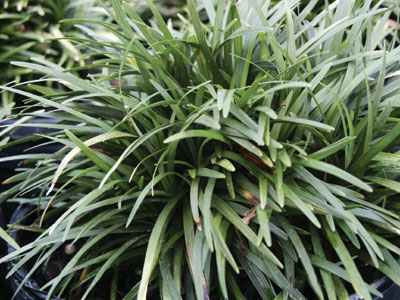
Repotting: repot in spring every 2–3 years into a low, wide container. The growing mix is composed of equal parts turf soil, leaf mold, humus soil and sand.