
Indoor plants
Oncidium
Oncidium
Described by the Swedish botanist Peter Olof Swartz as Oncidium altissimum in 1800.
The Latin name of the genus comes from the Greek words "onkos" - lump, mass, bulk, swelling, tumor and "eidos" – form, likeness, type. The name is related to the features of the Oncidium lip.
The skirt-like lip makes the plant easily recognizable, which is why they were named «dancing dolls». Yellow tones dominate the flower coloration, although pink and brown shades also occur. Most Oncidiums are epiphytes with a sympodial growth habit, extremely diverse in structure and size, which is explained by their growing conditions. Leaves are long and narrow; a tall inflorescence appears in winter from the leaf axil of a newly matured pseudobulb. Inflorescences are erect or arching and often contain many flowers, sometimes hundreds!
About 750 species, distributed in the tropics of Central and South America – from Mexico to Uruguay and in the Antilles.
They grow epiphytically in forests – from lowland tropical to montane cloud forests, at altitudes up to 4000 m above sea level. They are exceptionally light-loving plants and require moderately warm conditions. Species with short rhizomes and closely spaced pseudobulbs are grown in pots in a substrate for epiphytic orchids, while species with long creeping rhizomes and more widely spaced pseudobulbs are better planted in boxes or on pieces of bark or blocks made from compressed fern roots.
When light is insufficient, buds dry out and drop.
Lance's Oncidium - (Oncidium lanceanum)
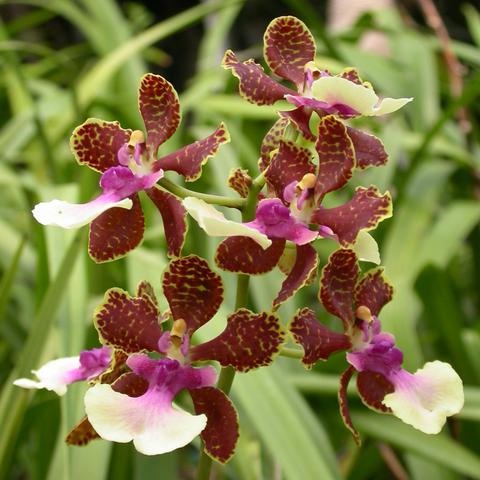
One of the most ornamental species of the genus Oncidium, named after John Henry Lance, who first discovered and collected this species in the wild in 1834.
Grows epiphytically in forests in the northeastern regions of South America – Guyana and Suriname.
A large rhizomatous plant lacking pseudobulbs, with stiff leathery oblong bright green leaves, speckled with reddish-brown or purple. A robust, sometimes slightly branched inflorescence bears up to 20 large fleshy brightly colored fragrant flowers, with tones not entirely typical for Oncidiums. The sepals and petals are yellowish or greenish-brown, dotted with reddish-brown or chocolate-colored spots. The lip is broad with a constriction in the middle, purple at the base, in front pink to white or pink-red.
Blooms in May – September. Flowering duration in greenhouse conditions is about a month, sometimes it flowers twice a year. The flowers retain their fragrance even after wilting, although it takes on a somewhat spicy note.
Lance's Oncidium is cultivated in a warm greenhouse. The plant does not have a pronounced dormancy period. Therefore it is kept fairly moist year-round, increasing watering during the growth period. Due to its demand for higher temperatures, it is difficult to grow under room conditions. However, hobbyists with indoor greenhouses can successfully cultivate this beautiful plant at home.
Shining Oncidium, or tiger Oncidium - (Oncidium splendidum, Oncidium tigrinum var. splendidum)
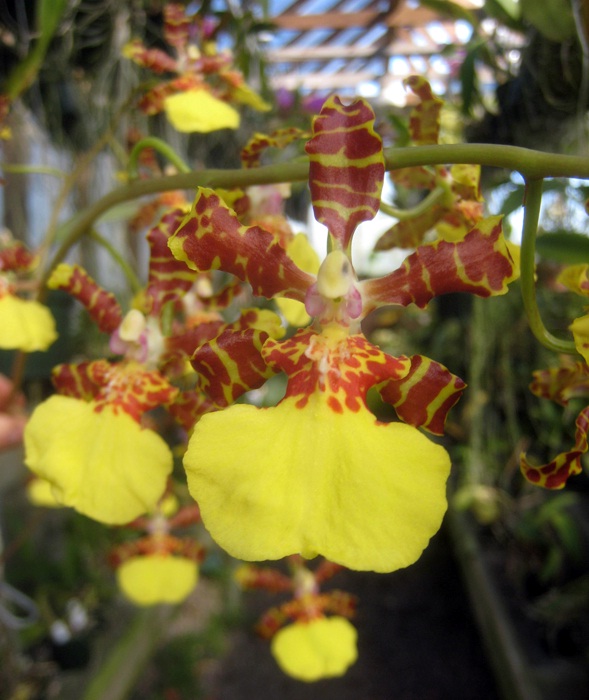
An epiphyte or epilith with tightly spaced flattened bulbs bearing a single leaf. The leaves, folded lengthwise with a strong keel underneath, are thick and leathery; in youth they are grayish-green with purple speckles, later taking on a purple-brown hue. From the base of the bulb develops a long (60-80 cm) sparsely branched inflorescence bearing up to 20 flowers 5-7.5 cm in diameter. The sepals and petals are elongated, wavy, with reflexed tips, bright yellow with brown spots that merge into transverse bands. The lip is very large, kidney-shaped, lemon-yellow. Flowers in December – February.
Butterfly Oncidium, butterfly orchid - (Oncidium papilio)
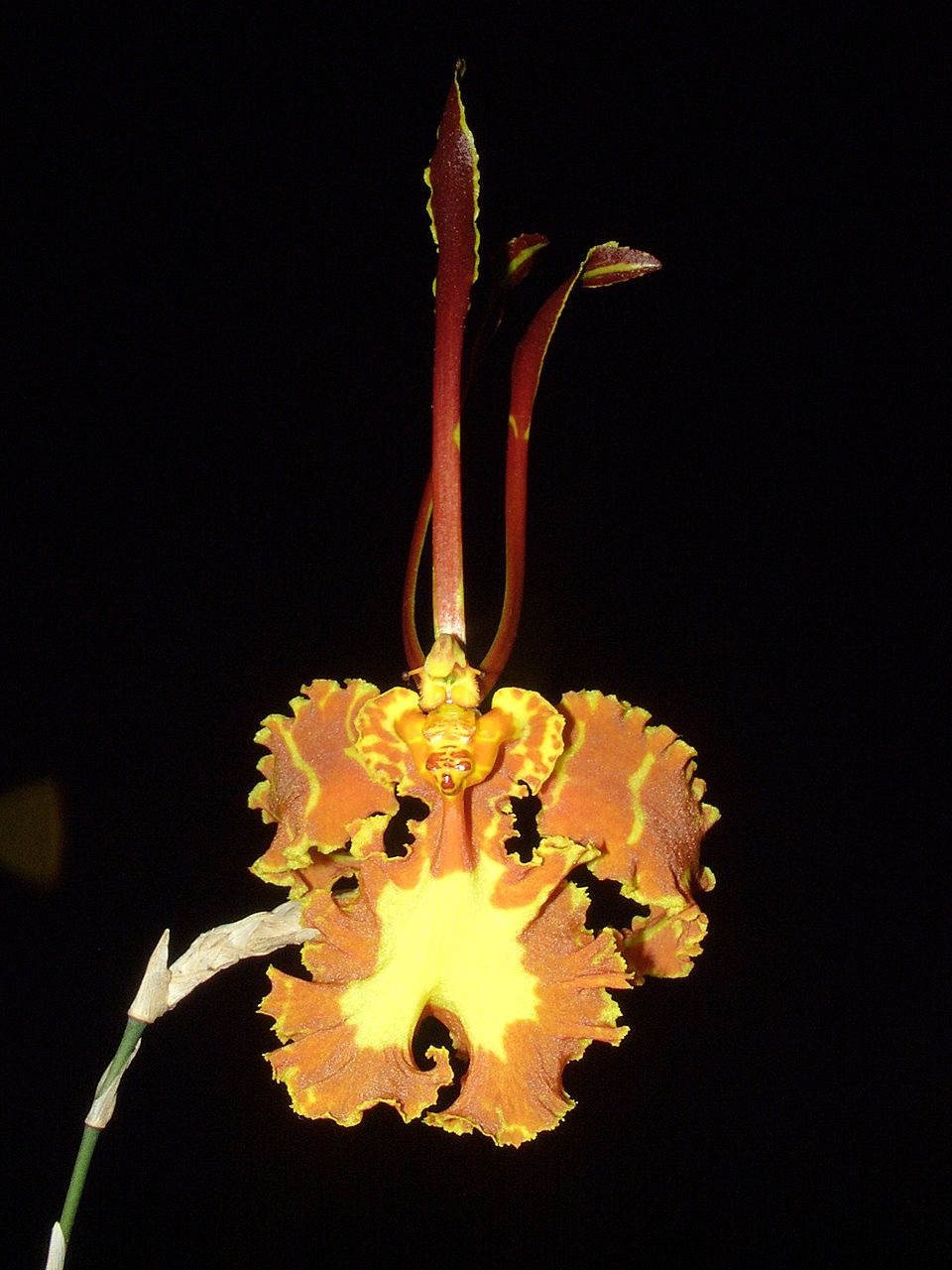
An epiphyte with closely spaced, strongly flattened, rounded in outline, single-leaved, often reddish pseudobulbs. Leaves are rigid, olive-green with a red marbling pattern, underside with red speckles. A jointed inflorescence 60-80 cm long (sometimes up to 150 cm) bears a single, unusually large flower for this genus. Some time after it fades a second flower opens, then a third, etc. Thus a single inflorescence blooms intermittently over one, two or more years. The flower has a fanciful shape resembling a butterfly: the upward-pointing sepal and petals are very narrow, almost filamentous, up to 8-12 cm long, dark red-brown with sparse yellow spots; the lateral sepals are broad, with a strongly wavy margin, sickle-shaped and bent back, chestnut-brown with large transverse yellow spots or bands. The lip is lobed with tiny lateral lobes. The middle lobe is very large, almost rounded, bright yellow with a wide chestnut or reddish-brown border along the ruffled edge.
Oncidium flexuosum - (Oncidium flexuosum)
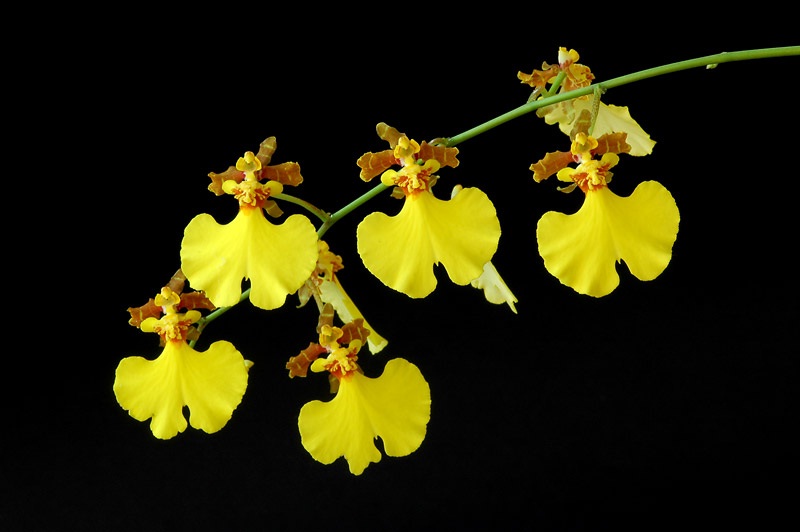
A plant with a long ascending rhizome bearing spaced flattened pseudobulbs with 1-2 leaves at the top and 2-4 basal leaves enveloping the pseudobulb from below. Leaves oblong, 10-12 cm long, 2.5-3 cm wide, soft, bright green. The inflorescence is a loose many-flowered panicle with thin resilient sinuous branches, on a long (60-80 cm) scape. Flowers 1.5-3 cm in diameter, bright yellow with red-brown spots at the base of each segment. Sepals and petals are small; the lateral sepals are fused into a single two-lobed structure directed downward. The lip is large, significantly exceeding the other perianth segments, with small triangular lateral lobes and a flat kidney-shaped, indistinctly 4-lobed middle lobe. The keel at the base of the lip is in two parts: a posterior soft velvety part and an anterior 3-5-tuberculate part. In cultivation since 1820. Native to southeastern Brazil.
Temperature: overall temperature range from 15 to 25 °C. In summer daytime around +25 °C, at night +15–17 °C, in winter on average 5 °C lower.
Lighting: species with hard leathery leaves will do well in bright sun; however, all species should be shaded from direct midday rays in summer and during flowering.
Watering: water generously, especially during flowering and growth, but avoid waterlogging the substrate. In winter water moderately, but do not allow the substrate to dry out completely.
Humidity: air humidity should preferably be maintained around 50%, on hotter days not below 70%.
Fertilization: during growth and flowering feed at least twice a month with a balanced flowering fertilizer.
Features: many species can be grown on blocks, but this requires creating increased air humidity. In indoor culture they are fairly resistant to diseases and pests.
Propagation: by division of the clump and separation of pseudobulbs.
Repotting: Oncidiums are repotted infrequently, but it should be borne in mind that they tolerate decomposed substrate poorly – which is the main reason for repotting.
Substrate: shredded bark mixed with fern roots and peat. Moss may be added.