
Fruit trees
Olive tree
Olea europaea
Synonyms: European olive, cultivated olive, olive (European).
Olive tree – a species of evergreen subtropical trees of the genus Olea (Olea) in the family Oleaceae (Oleaceae). It is found only in cultivation, as it has been grown for a very long time for obtaining olive oil. Its native range is considered to be Central and Tropical Asia and Greece. Cultivated forms are grown in almost all Mediterranean countries – Abkhazia, the Black Sea coast of Russia, southern Crimea, Georgia, Azerbaijan, Turkmenistan, Iraq, Iran, Pakistan, northern India. In 1560 the tree was brought to the Americas, where it is grown mainly in Mexico and Peru. It is widely cultivated in Greece. It has been known to people for more than 4,000 years. In Crimea, olive trees are presumably grown since the 13th century. The tree is long-lived; specimens older than 500 years are encountered.
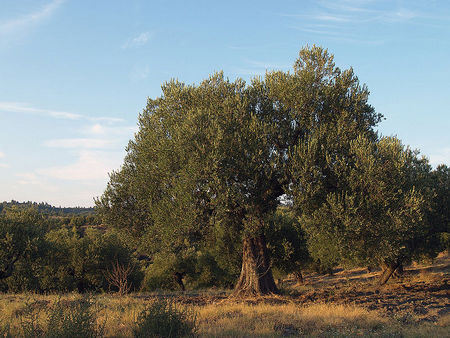
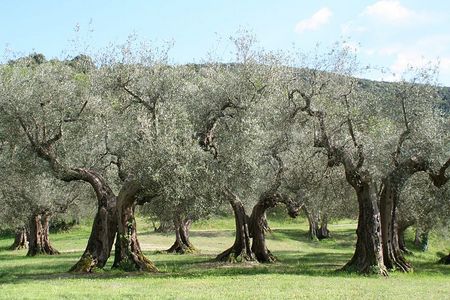
It appears as a shrub (1-3 m) or a tree (4-5 (10-12) m) with a twisted, in old age hollow, trunk covered with gray bark. Branches are long, knobby, less often pendulous.
Leaves almost sessile, simple, narrow-lanceolate, leathery, entire. The leaf blade is dark green above and silvery beneath. Leaves do not fall for the winter, they are renewed gradually over the course of two years.
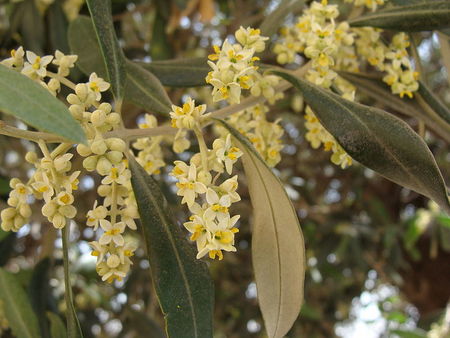
Flowering times depend on the climate, from late April to early July. In the climate of Ukraine flowering occurs in May (at a daytime temperature of 18°C) and continues until early June. Flowers are very small, 2-4 cm in diameter, fragrant, white with a slight creamy tint, gathered in paniculate racemes that are located in the leaf axils. There are 2 stamens. The plant is dioecious.
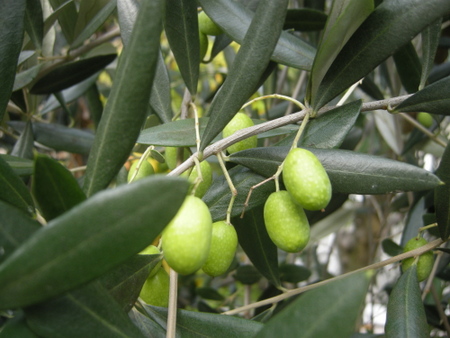
Fruits – elongated-oval drupes, 0.7-4 cm long and 1-2 cm in diameter, with an acute or blunt beak, the pericarp is fleshy and contains oil.
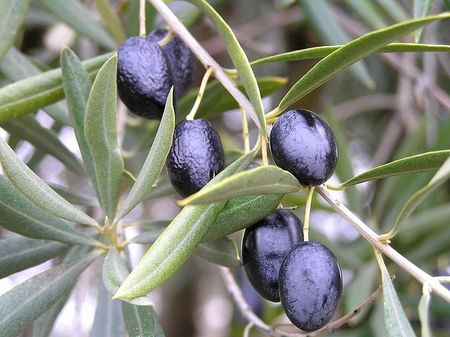
Fruit color depends on the cultivar; it can be green, dark purple or black, often with an intense waxy bloom. The stone is dense, grooved. Fruits ripen 4-5 months after flowering. The tree becomes productive after 20 years. It bears fruit once every two years.
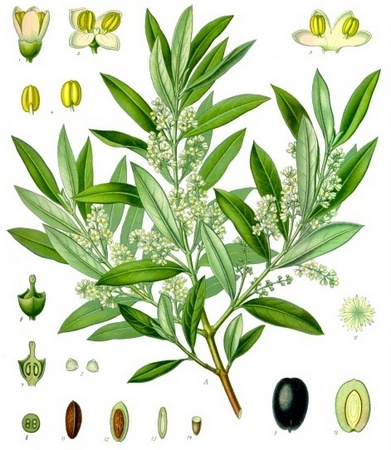
Illustration from the book «Köhler’s Medizinal-Pflanzen», 1887
Subspecies:
- Olea europaea subsp. Europaea
- Olea europaea subsp. cerasiformis G.Kunkel & Sunding (syn. Olea europaea var. cerasiformis Webb & Berthel, Olea europaea var. maderensis Lowe
- Olea europaea subsp. cuspidata (Wall. ex G.Don) Cif. (syn. Olea africana Mill. — African olive, Olea europaea subsp. africana (Mill.) P.S.Green, Olea chrysophylla Lam., Olea cuspidata Wall. ex G.Don, Olea ferruginea Royle, Olea verrucosa (Willd.) Link, Olea sativa var. verrucosa (Willd.) Roem. & Schult.)
- Olea europaea subsp. guanchica P.Vargas et al.
- Olea europaea subsp. laperrinei (Batt. & Trab.) Cif. (syn. Olea laperrinei Batt. & Trab.)
- Olea europaea subsp. maroccana (Greuter & Burdet) P.Vargas et al (Olea maroccana Greuter & Burdet)
Cultivars: there are a large number of olive cultivars, which are often named after their place of origin. The most popular are Kalamata (Kalamata) (Greece), Chalkidiki (Chalkidiki) (Greece), Conservolea (Conservolea) (Greece), Alfonso (Alfonso) (Chile and Peru) (Peloponnese), Bella di Cerignola (Bella di Cerignola) (Italy), Megara-Nafplion (Megara-Nafplion), Nyons (Nyons) (France), Throumbes Thasos (Throumbes Thasos) (Thasos Island and some Aegean islands), Gold (Gold) (Peloponnese).
Hardiness zone: zone 9a (−15 to −10 °C)
Location: for fruit ripening it requires a prolonged warm period. As a houseplant in spring it is recommended to keep it in a greenhouse, where in February they "wake up" and begin to grow. After the onset of hot days and warm nights the pot with the plant can be taken outdoors. They need sunny locations. They grow in any air- and water-permeable soil. Drainage is necessary. The plant is drought-tolerant, therefore when grown indoors the soil should be allowed to dry out between waterings.
Care: about 6 weeks before flowering it is recommended to fertilize the tree and also to avoid water deficiency, since lack of moisture sharply worsens flowering and fruiting. In this case cross-pollination can be used, which may improve yield. When grown indoors, the plant has a dormancy period from December to the end of January. During this time fertilization is not recommended. In February, feedings can be applied every 15 days at low concentration and gradually increased to the normal rate. Fertilizers with increased nitrogen content promote earlier formation of flower buds.
Planting: when planting, a male and a female specimen are planted in each hole for pollination. Up to 4 years of age it is recommended to transplant annually. Later it can be transplanted once every 3 years or simply remove and replace the top layer of soil with fresh, fertile soil.
Pruning: when grown in containers, during the growing season the plant gives good growth, so rejuvenating pruning is recommended. Long branches are shortened, leaving 4-5 pairs of leaves.
Propagation: seed and vegetative propagation methods are used (grafting, cuttings).
For seed propagation the optimal temperature for seed germination is +18°C to +20°C. Seedlings emerge in 2-3 months. With seed propagation cultivar traits are not inherited and plants come into fruiting late.
For cuttings, one-year-old and lignified (2-4 year-old) shoots are suitable. Before planting they are recommended to be treated with a rooting solution and placed in washed moist sand, which is poured over drainage made of shells or small gravel. Cuttings are planted to a depth of 4-5 cm. It is important to maintain a temperature of +18°C to +20°C during rooting. Cuttings root in about 3 months.
Uses: can be used for growing in bonsai style. Found in decorative front gardens, patios, greenhouses. In Ukraine it is grown as a houseplant. Fruits are used for making oil and for canning green and black fruits.