
Flowers for the garden
Evening primrose or Oslinnik
Oenothera
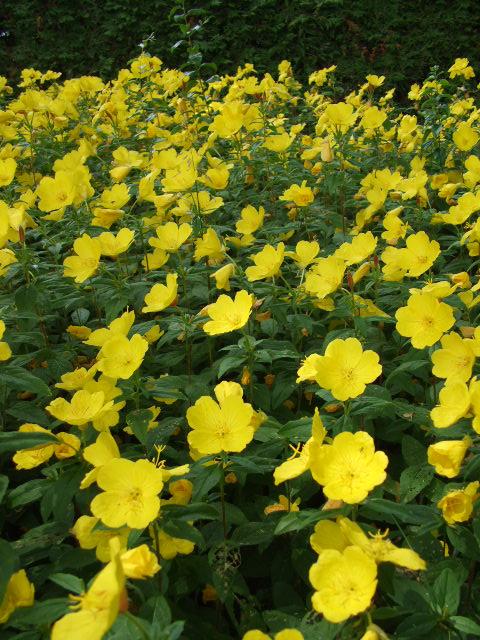
Oslinnik, or Enothera (lat. Oenothéra) — a genus of plants in the evening-primrose family (Onagraceae). It is a fairly large genus (up to 100 species), including plants of very diverse appearance: herbs and subshrubs, branched or unbranched, with simple, entire-margined, toothed, lobed or pinnately divided leaves. The plant is also known as an ornamental; many showy-flowering cultivars have been developed; in horticulture the plant is known under the transliteration of the Latin name «enothera».
The name derives from the Greek words 'oinos' — wine and 'ther' — wild beast. In olden times it was believed that wild animals, after smelling a plant moistened with wine infused with the root of oslinnik, would become tame.
The genus comprises 125 species, distributed mainly in the Americas and Europe.
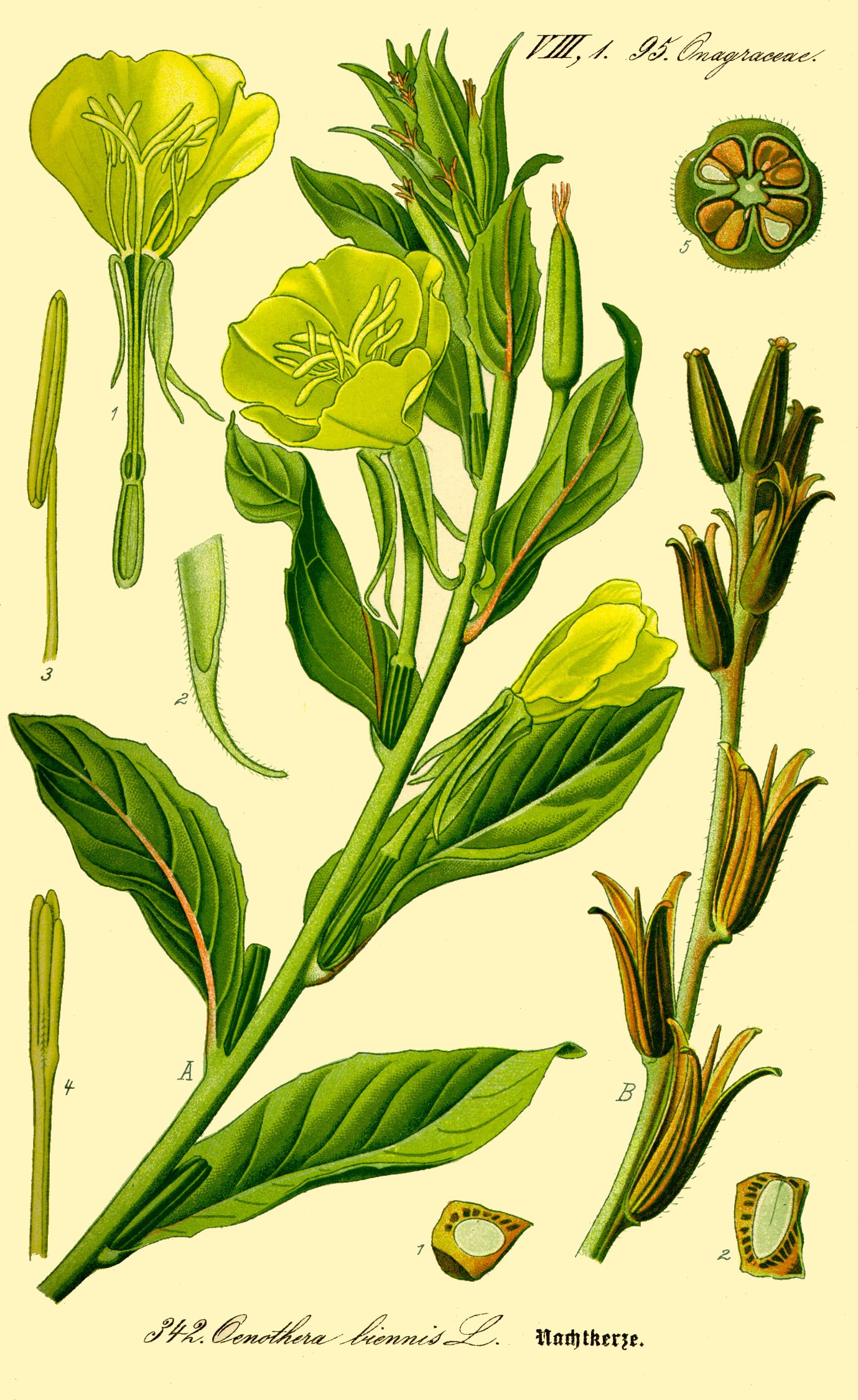
Annual, biennial and perennial rhizomatous herbaceous plants 30–120 cm tall. Stems erect, sometimes trailing, stiffly pubescent. Leaves simple, ovate-lanceolate, toothed or pinnately divided, arranged alternately. Flowers large, often fragrant, purple, yellow, white or pink, gathered in long racemose inflorescences, rarely solitary or in pairs. Open in the evening and at night; during the day they open only in overcast weather. Flowering from June to September. Fruit a many-seeded capsule.
Oenothera biennis — Oenothera biennis L.
A biennial plant. Stems erect, shortly hairy, up to 120 cm tall. Leaves lanceolate, entire, sparsely toothed or almost entire, up to 20 cm long. Flowers regular, sessile, in terminal racemose inflorescences, lemon-yellow, large, 4.5–5 cm in diameter, fragrant, opening in the evening and at night, or on overcast days. Flowers from June to October, in the second year after sowing. Seeds retain viability for 3–4 years.
Particularly notable is the cultivar 'Vechernyaya Zarya' — a plant up to 90 cm tall with golden flowers with a red tinge and a pleasant fragrance.
Oenothera speciosa — Oenothera speciosa
Native to the southern United States.
This is a biennial, less often a perennial, producing several flowering stems 25–40 cm high in the year of sowing. Leaves are oblong, sparsely toothed at the margin. Flowers are cup-shaped, pink or white, fragrant, up to 5 cm in diameter, collected in a few-flowered terminal spike-like inflorescence. Flowering from late June to mid-August. Seeds are oval, light brown.
Oenothera versicolor — Oenothera versicolor Lehm.
Grown as a biennial up to 120 cm tall. Flowers yellowish-reddish.
In cultivation usually the cultivar 'Sunset Boulevard'. A plant with reddish stems 35–40 cm high forms a mound 15–25 cm in diameter. Brick-orange flowers appear in late summer.
Blooms in the year of sowing. Spreads poorly, but produces many seeds. Prefers well-drained soil in a sunny position, where it self-sows to persist. Greatly damaged in very cold winters. Hardiness zones: 5–9; in colder climates grown as an annual.
Location: winter- and drought-resistant. Grow well in sunny locations. In shade their flowers are open during the day as well.
Soil: light, well-drained, neutral, fresh, rich in nutrients.
Care: responds well to regular fertilization. Remove faded inflorescences.
Propagation: by seed, sown in late May — early June directly outdoors or in cold frames, with seeds covered by 5–10 mm of soil. Do not allow the substrate to dry out, otherwise seed germination decreases. Seedlings are pricked out at 5–10 cm spacing. Cover for winter with dry leaves and spruce boughs. Can also be propagated by young shoots formed around the mother plant, or by dividing the clump in May or September — October.