
Indoor plants
Odontoglossum
Odontoglossum
The genus name comes from the Greek words «odonto» — tooth and «glossa» — tongue and indicates the presence of tooth-like projections at the base of the lip. Described in 1816 by the German botanist Karl Kunth. About 200 species are known, which are similar in appearance. Native to the mountainous regions of Central America. Ovoid flattened pseudobulbs bear rather thin leathery leaves. Inflorescences are long, bearing several, as a rule large and showy flowers, and arise from the base of the pseudobulb from the axil of an underdeveloped leaf. They are characterized by a sympodial type of growth. Flowering can occur at any time, and a rest period occurs every eight months.
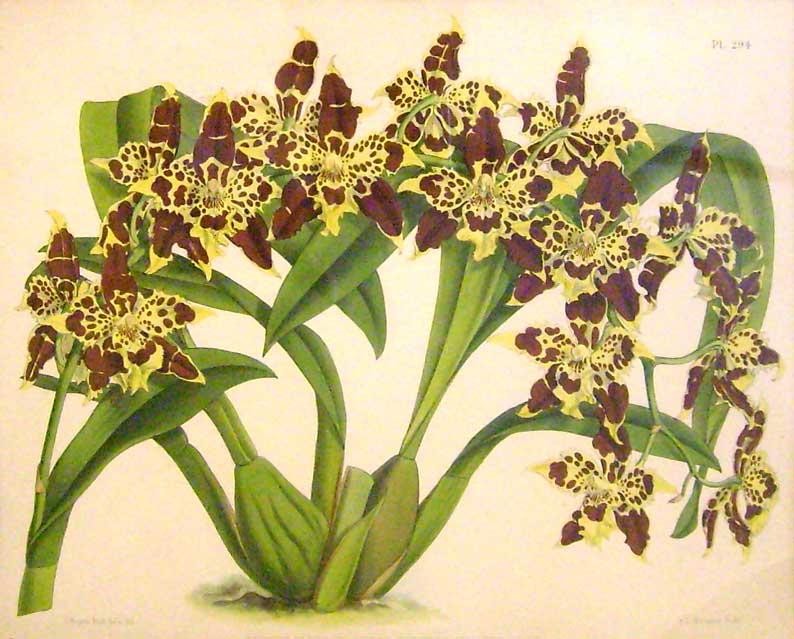
All species of the genus Odontoglossum are listed in Appendix II of the CITES Convention. The purpose of the Convention is to ensure that international trade in wild animals and plants does not threaten their survival.
Odontoglossum bictoniense - Odontoglossum bictoniense Lindl
An epiphyte with closely crowded flattened bulbs up to 18 cm high. At the base they are surrounded by 4–6 distichous basal leaves, above with 2–3 long linear leaves. Flowers 4–5 cm in diameter, produced in numbers in an erect loose raceme 30–80 cm long. Sepals and petals narrow, yellowish-green, with a chestnut-brown spotted pattern. The lip heart-shaped or kidney-shaped with a short broad claw and a finely undulate margin, white or lilac, at the base with two yellow hairy keels. Flowers in October–December. Flowers in the inflorescence open gradually; flowering of one raceme lasts 2–2.5 months.
Odontoglossum grande, the large or tiger orchid - Odontoglossum grande Lindl
The largest-flowered species of the large American genus Odontoglossum and one of the most beautiful orchids of Central America. Because of the distinctive coloration of its flowers it is sometimes called the “tiger orchid”. The genus name (odontos – tooth and glossa – tongue, in orchids – the lip) is due to the presence of callous toothed outgrowths at the base of the lip.
Odontoglossum grande inhabits mountain forests that cover high plateaus and the steep eastern slopes of the mountains of Guatemala and Costa Rica, occurring at altitudes of 2000 – 2500 m above sea level. It prefers bright, well-ventilated sites – forest edges, clearings, banks of mountain streams and rivers where more light and air penetrate. Constant airborne moisture, night mists and morning dews resulting from significant day-night temperature fluctuations supply this epiphytic plant with ample moisture even in the dry season.
The species was first collected in 1839 by the collector Ure Skinner in one of the mountain ravines near the capital of Guatemala.
Odontoglossum grande is a rhizomatous plant, although the rhizome is usually hidden beneath the closely crowded bluish flattened 2–3-leaved pseudobulbs. From the axils of the basal leaves that surround the pseudobulb below, one or two slightly pendent racemes develop, composed of 3–7, rarely 9, very large flowers 12–15 cm in diameter. Sepals are bright yellow with broad transverse light-brown bands; petals are wavy, light brown with a yellow margin on the lower half, bright yellow above. The lip small, rounded, pale yellow or whitish with a few reddish-brown spots and streaks. Flowers in September–January. Flowering lasts about a month.
It is considered the easiest Odontoglossum species for indoor cultivation. When grown in rooms it often suffers from excess heat.
Odontoglossum pulchellum - Odontoglossum pulchellum Batem.
In more recent literature it is placed in the separate genus Osmoglossum Schltr. Closely spaced flattened bulbs bearing two narrow linear keeled leaves often form large dense groups. Thin curved inflorescences arising from the axils of basal leaves bear graceful loose racemes of 6–10 pure white fragrant flowers. At the base of the upward-directed lip there is a bright yellow callous ridge with red speckles. Two partially fused lateral sepals are partly hidden beneath the guitar-shaped lip. Flowers in January–February.
Characteristics: ideally suited for a cool room or an unheated greenhouse. Hybrids that are the result of crosses with more warmth-loving genera are better grown in a room.
Location: summer temperatures should not exceed +24–+26 °C, ideally daytime +19 °C, nighttime +16 °C, in winter about 2 °C lower. In nature the tree crowns protect them from the sun, so they prefer bright diffused light without direct sunlight year-round.
Lighting: bright diffused light.
Watering: from the appearance of new shoots the plants are watered regularly, preventing the substrate from drying out. Also avoid wrinkling of the pseudobulbs.
Humidity: prefer high air humidity – about 70%, with good ventilation and airing, especially during the winter period.
Feeding: during the growth period feed weekly with a very weak solution of a complete mineral fertilizer; during flowering – every three weeks.
Notes: the root system does not tolerate substrate desiccation or salinization; to avoid this it is recommended to thoroughly flush the substrate once a month (for example with distilled water).
Propagation: by division of the plant; each divided part should have at least three pseudobulbs.
Repotting: carried out depending on the condition of the substrate and the plant every 2–3 years at the start of new growth, when the young shoot reaches 5–10 cm in height and new roots have not yet appeared.
Substrate: a moisture-retentive epiphytic substrate of fine bark and moss; addition of charcoal and fern roots is possible.
Diseases and pests: susceptible to spider mites.