
Flowers for the garden
Nomocharis
Nomocharis
Nomocharis (lat. Nomocharis) - perennial bulbous plants of the family Liliaceae (Liliaceae) . This genus includes 7 species distributed in China, Burma, northern India and Tibet. There they grow on rocky mountain slopes, meadows and in forests. From there the plants reached Europe, and they can often be seen in English parks.
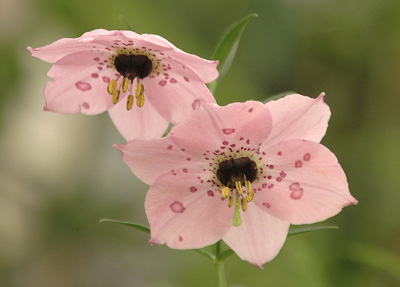
Leaves of these close relatives of lilies are narrow or sword-shaped. They are gathered in a dense tuft or form the lower part of the stem. In summer stems bearing large flat flowers appear among them. Their segments often have crinkled edges. Nomocharis look magnificent in combination with rhododendrons.
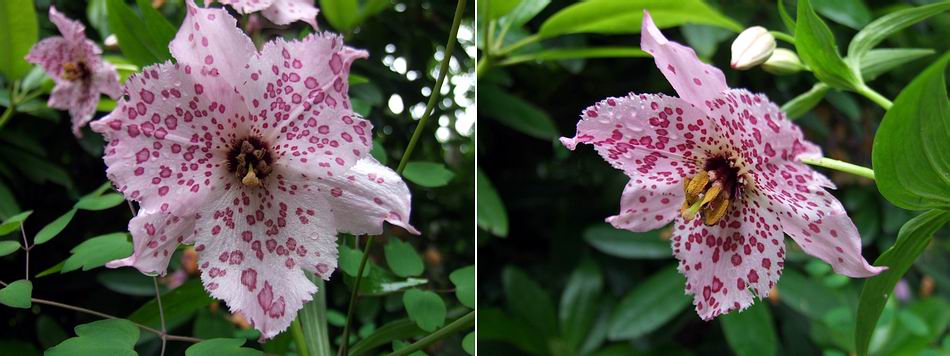
According to Dr. D. G. Hessayon Nomocharis is a difficult plant. But despite that, in the Moscow suburbs it grows well and requires no more care than lilies. The only problem is wintering. Nomocharis absolutely need a cold period for normal flowering and vegetative growth. In the West they are usually listed for zones 6 or even 7; in zone 5 they overwinter under a 10 cm layer of mulch. So it is very likely that in our zone 4 they will overwinter under protection. However, obtaining Nomocharis bulbs is not so easy. There is a lot of confusion in the nomenclature and some cultivated species are actually interspecific hybrids.
In cultivation:
Nomocharis aperta — Nomocharis aperta
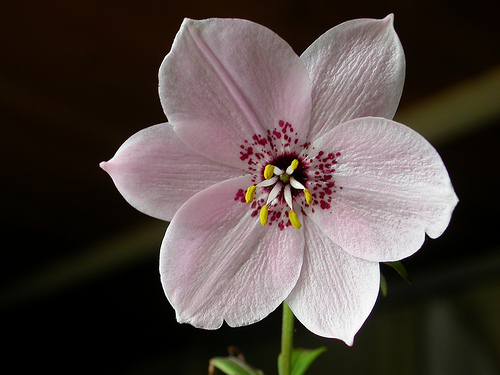
This species originates from China and is the most widespread. Thin leaves 6—10 cm long are oppositely arranged on stems 30–80 cm tall. At the tops of the stems there are 3–6 light-pink nodding flowers with a darker, speckled center, opening in June. The flat perianth has a diameter of 5–15 cm.
Nomocharis saluenensis — Nomocharis saluenensis
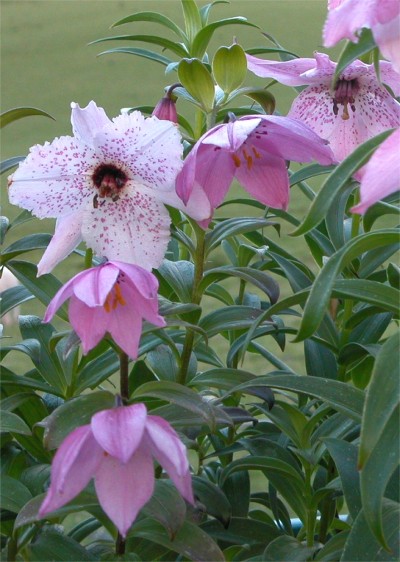
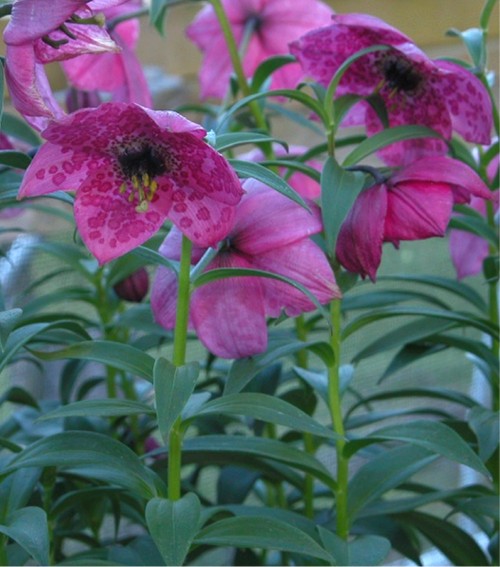
The species comes from Burma and adjoining regions of China. The rather broad leaves are only 2–4 cm long. In early summer it forms inflorescences of 1–5 nodding saucer-shaped flowers, the diameter of which can reach 9 cm. The perianth is pink or white with red-brown spots and a dark purple center. Flower stem height — about 90 cm. The most striking and easiest to grow of the Nomocharis.
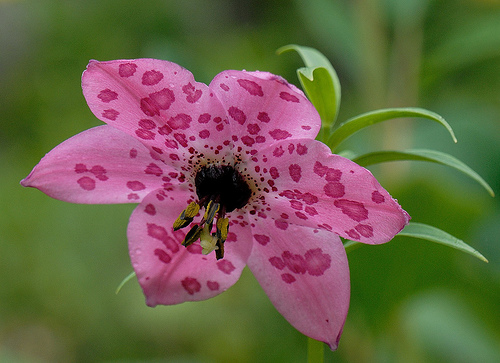
Location: can grow in partial shade or in full sun - leaf scorch or loss of turgor on an exposed site is not observed even in thirty-degree heat; plants should be watered once a week. In partial shade plants vegetate longer and will be slightly taller, they flower about a week later and set seed better.
Soil: well-drained, humus-rich peat soil that should not dry out.
Planting: plant in November to a depth of 10-15 cm at 30 cm spacing.
Propagation: usually new bulbs are purchased. Nomocharis produce very little pollen and it dries quickly - pollination must be done on the first or second day after the pollen grains split. Without hand pollination there are few seeds, and if several species are planted nearby you can get hybrids. All species manage to fit into our short growing season and set seed, which bloom in the 5th-7th year. The plants do not like being transplanted, so do not disturb or divide overcrowded clumps of bulbs.