
Indoor plants
Nolina or Beaucarnea
Nolina , Beaucarnea
Nolina (lat. Nolina) — a genus of perennial tropical plants of the family Ruscaceae, the genus was previously placed in the family Agavaceae (Agavaceae).
The natural range of this plant is in southern Mexico, extending into the southern regions of the United States.
Some species are cultivated as ornamentals because of their unusual appearance.
Among enthusiasts nolina is often called «Beaucarnea». This is because some taxonomists include the genus Beaucarnea of the same family within the genus Nolina. Some widespread ornamental species are known under different names, and different sources consider different names to be correct: for example, the species Beaucarnea recurvata is also widely known as Nolina recurvata (usually the former name is regarded as the valid one).
Because of its unusual appearance nolina also has other names — «Elephant's Foot», «Horse's Tail». The trunk of nolina resembles a bottle, hence it also has a third name — «Bottle Tree». The swelling at the lower part of the trunk serves to store moisture. Nolina's leaves are narrow, long, with pointed tips.
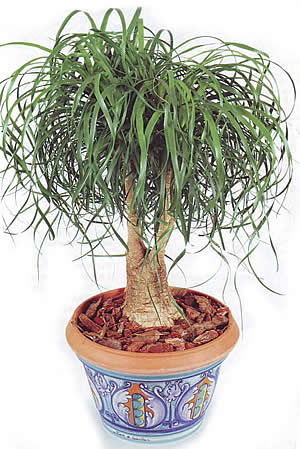
Accustomed to natural conditions, this plant develops rather slowly and usually reaches only one meter in height with leaves up to 60 cm long. But in good conditions it can be grown up to 2.5 meters. Nolina is very easy to care for.
Location: the plant is quite light-loving; it is best kept in a sunny place. In summer and during vigorous growth the plant needs plenty of heat. In winter the optimal temperature should not be below 10°С.
Watering: water year-round once every 5-7 days, however in the winter period the frequency should be reduced. For this plant excess moisture is much more dangerous than its lack. The plant should be misted so that the tips of the leaves do not dry out. Misting and watering should be done only with settled water (at least 12 hours) or boiled water.
Repotting: usually repotted no more than once every three years. Use a snug pot and quality potting soil. There must be a drainage hole at the bottom of the pot. Over the outlet place a drainage layer of expanded clay and small stones to avoid water stagnation, which leads to root rot.
Propagation: side shoots are rooted, which are grown at a soil temperature of about 25° С.