
Indoor plants
Oleander
Nerium
Synonyms: golden tree, sausage tree, Japanese laurel, Aucuba vivicans W.Bull
Oleander (Nerium L.) – a monotypic genus of flowering plants of the family Apocynaceae. It was first described in 1753 by Carl Linnaeus in his Sp. Pl. 1: 209. The name comes from the Greek (neros) — wet (the plant's habitat). The specific epithet oleander possibly derives from Latin olea — olive and ancient Greek Aner or andros — man.
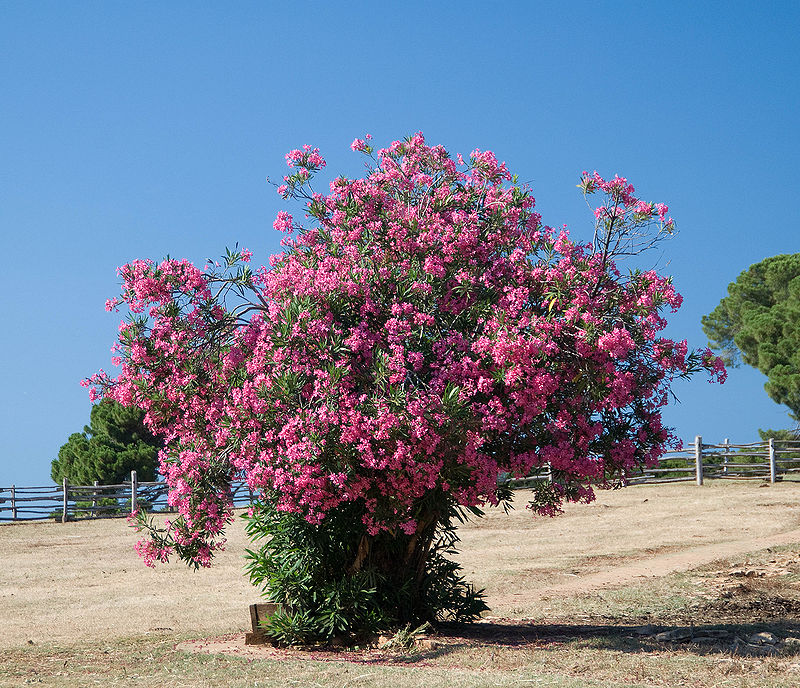
Author Ranko
In the wild it occurs in dry and semi-dry tropics from Morocco and Portugal in the west to southern China in the east. It is found on the beds of drying rivers.
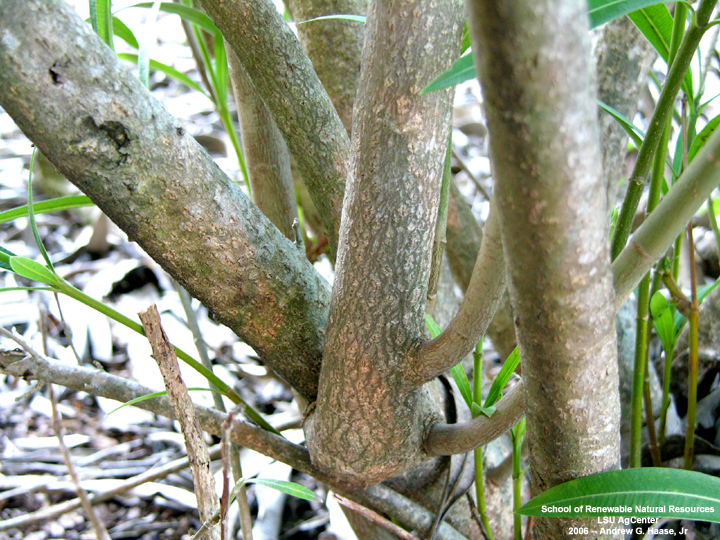
It is a large evergreen shrub 2-6 m in height. Stems are branched, brownish, covered with rounded lenticels. Young shoots are covered with a glaucous bloom. Bark is grey.
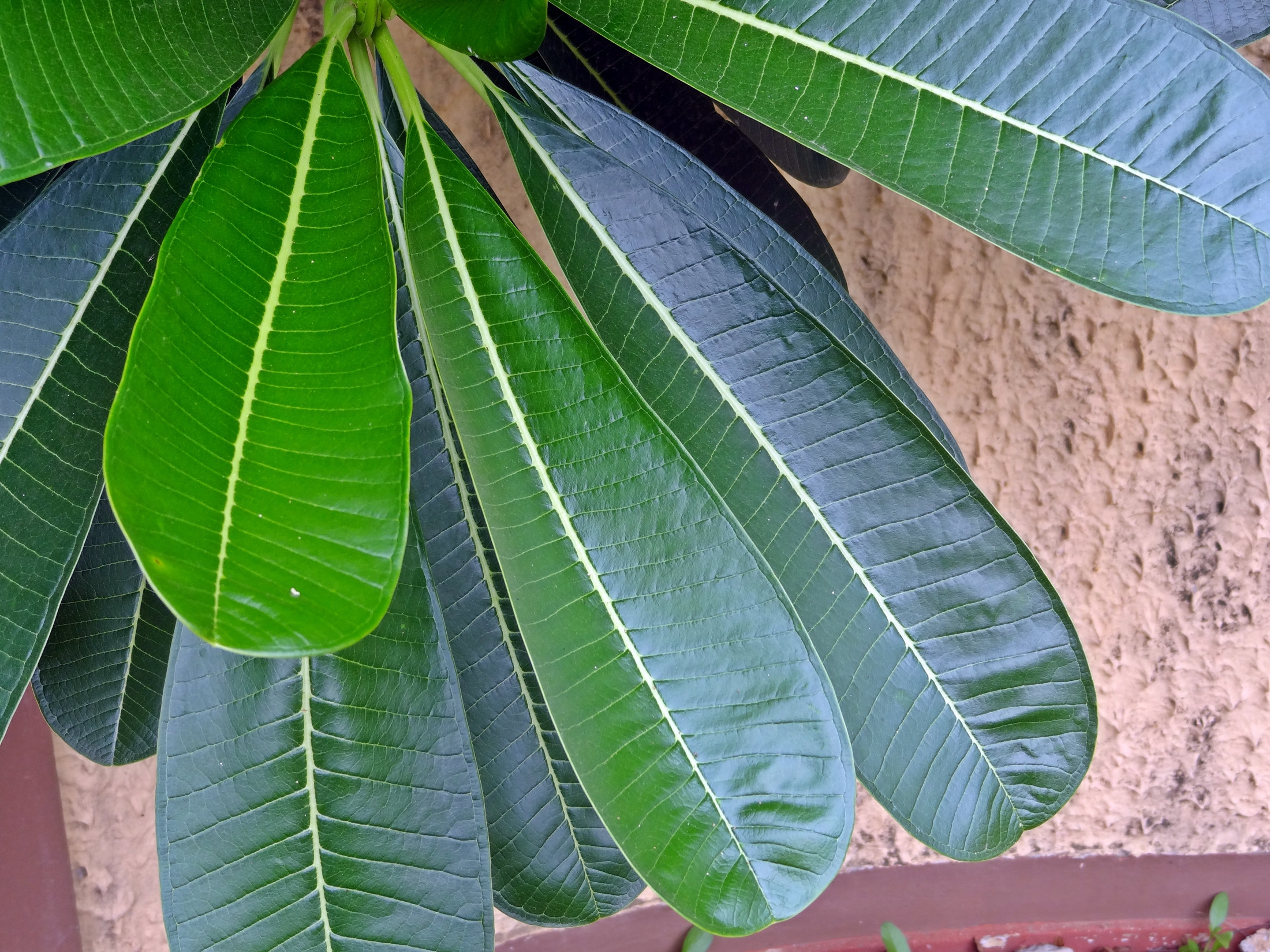
Leaves are opposite or in whorls of 3 or 4, narrow, 10-15 cm long and 3 cm wide, lanceolate or linear-lanceolate, entire or with indistinct crenation, on short petioles, glabrous, leathery, with a light midrib.
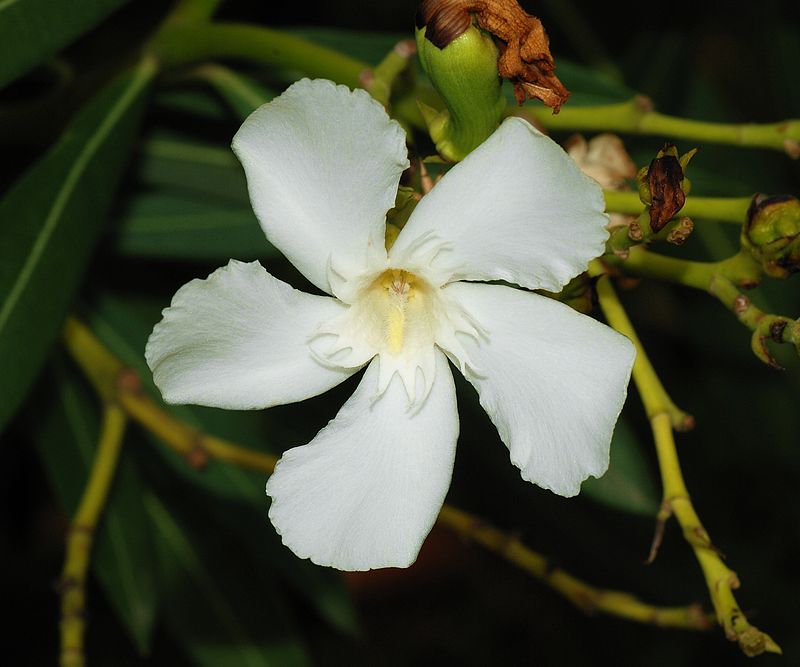
Author Alvesgaspar
Flowers are large, showy, 5-parted, 2.5-5 cm in diameter, arranged in corymbose inflorescences at the ends of shoots. The corolla can be of various colors; the most common are white or pink, more rarely red or yellow. Flowering time depends on the climate where the plant grows.
Author Dileepcyriac
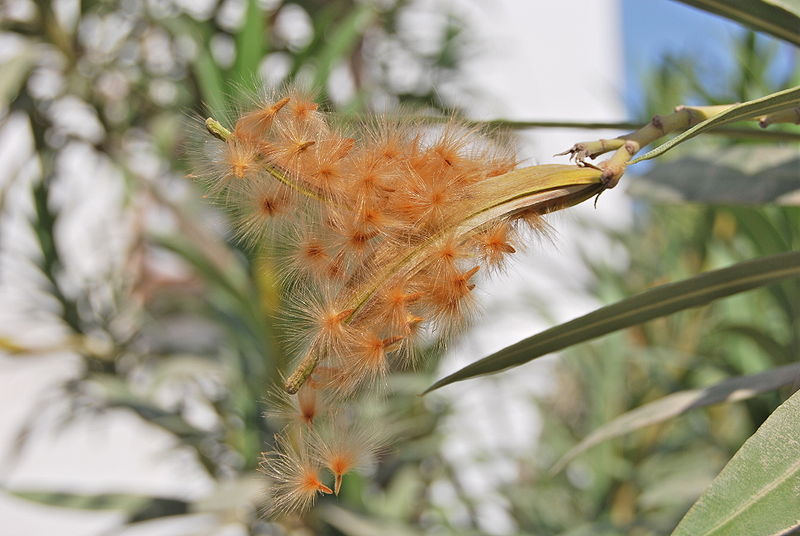
Fruits are many-seeded follicles up to 10 cm long. Seeds are 0.9-1.2 cm long, with feathery comas.
All parts of the plant are poisonous.
Species: the genus includes only one species Nerium oleander L.
Hardiness zone: 8b (-10°C)
Temperature: in the spring-summer period the recommended temperature is 20 - 28°C. At higher indoor temperatures it should be ventilated. In winter the temperature is reduced if possible to 8 - 15°C, but not below 5°C. It tolerates central heating poorly.
Humidity: In spring and summer you can avoid spraying; it is sufficient to place the pot in a tray filled with water and gravel. In winter the plant should be misted with warm water, otherwise the tips of the leaves may dry out due to excessively dry air from central heating.
Light: enjoys bright sunlight, grows well on a south-facing windowsill. With insufficient light the plant becomes leggy and loses ornamental value. In summer it can be placed outdoors or on a balcony. In winter it is recommended to provide the plant with enough light, as leaves may drop and the plant may not flower.
Soil: soil mix: 2 parts heavy garden loam, 1 part leaf mold, 1 part humus, peat and sand. Drainage is essential.
Repotting: young plants are repotted every year; later repotting can be done once every 2-3 years. When repotting, old roots should be shortened and the root ball reduced for better flowering. It is desirable that the new pot is not too large. Large oleanders can be left un-repotted and only the top layer of soil changed. The best time for repotting is late May - early June. Ensure good drainage when repotting.
Watering: in spring-summer requires abundant watering, which is carried out as soon as the substrate dries. On hot days the pot can be placed in a tray filled with water and gravel. In autumn-winter the oleander is watered moderately, 2 - 3 days after the surface has dried. However, the soil ball must not be allowed to dry out completely. Use soft, settled and always warm water, otherwise flowers may not open.
Fertilizer: From April to August you can feed every two weeks with a special complete fertilizer for flowering houseplants or an organic fertilizer. Apply feeding half an hour after watering.
Pruning: Prune oleander after flowering, cutting branches in half or slightly more. When pruning, remember that the plant is poisonous and handle with care.
Propagation: propagated by seeds, cuttings and air layering. Most often propagated by cuttings in spring or autumn. For this, cut cuttings 10 - 15 cm long, treat the cuts with charcoal and dry them. Root cuttings in perlite, crushed expanded clay, or a mixture of sand with charcoal. Place clean sand or pieces of charcoal around the root collar to prevent the stem base from rotting. Maintain a temperature of 18-20°C and good lighting. Avoid excessive substrate moisture to prevent rotting of cuttings. Cuttings can also be rooted in a vessel of water, having first thrown in pieces of charcoal. Roots appear on cuttings after about 3-4 weeks under favorable conditions. Once rooted, cuttings are planted into a specially prepared soil mix consisting of equal parts garden loam, peat and humus soil with the addition of sand.
Pests: mealybug, scale insects, red spider mite.
Diseases: Sooty mold
Uses: In Ukraine it is grown as a houseplant.