Encyclopedia - Plants for ponds
Nut-bearing lotus
Nelumbo nucifera
Family: Lotus family Native range: nut-bearing lotus - India, China, Japan, Malay Archipelago.
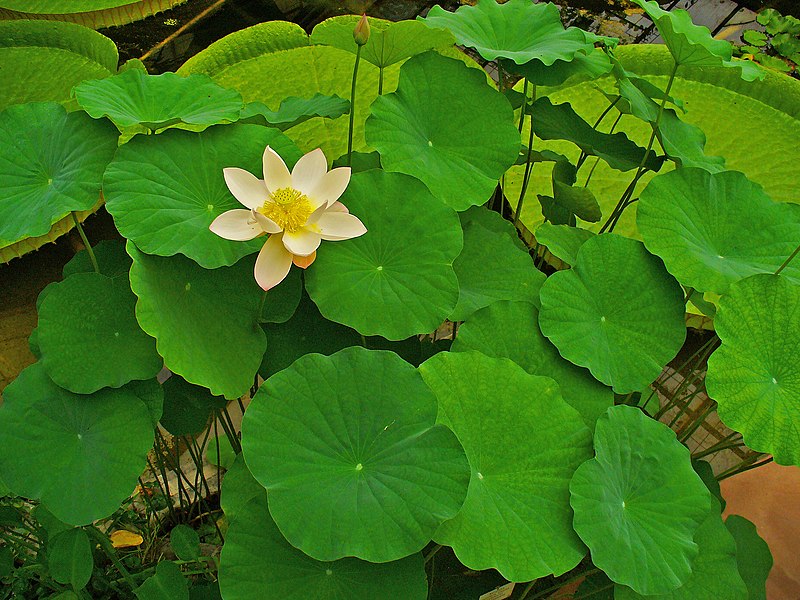
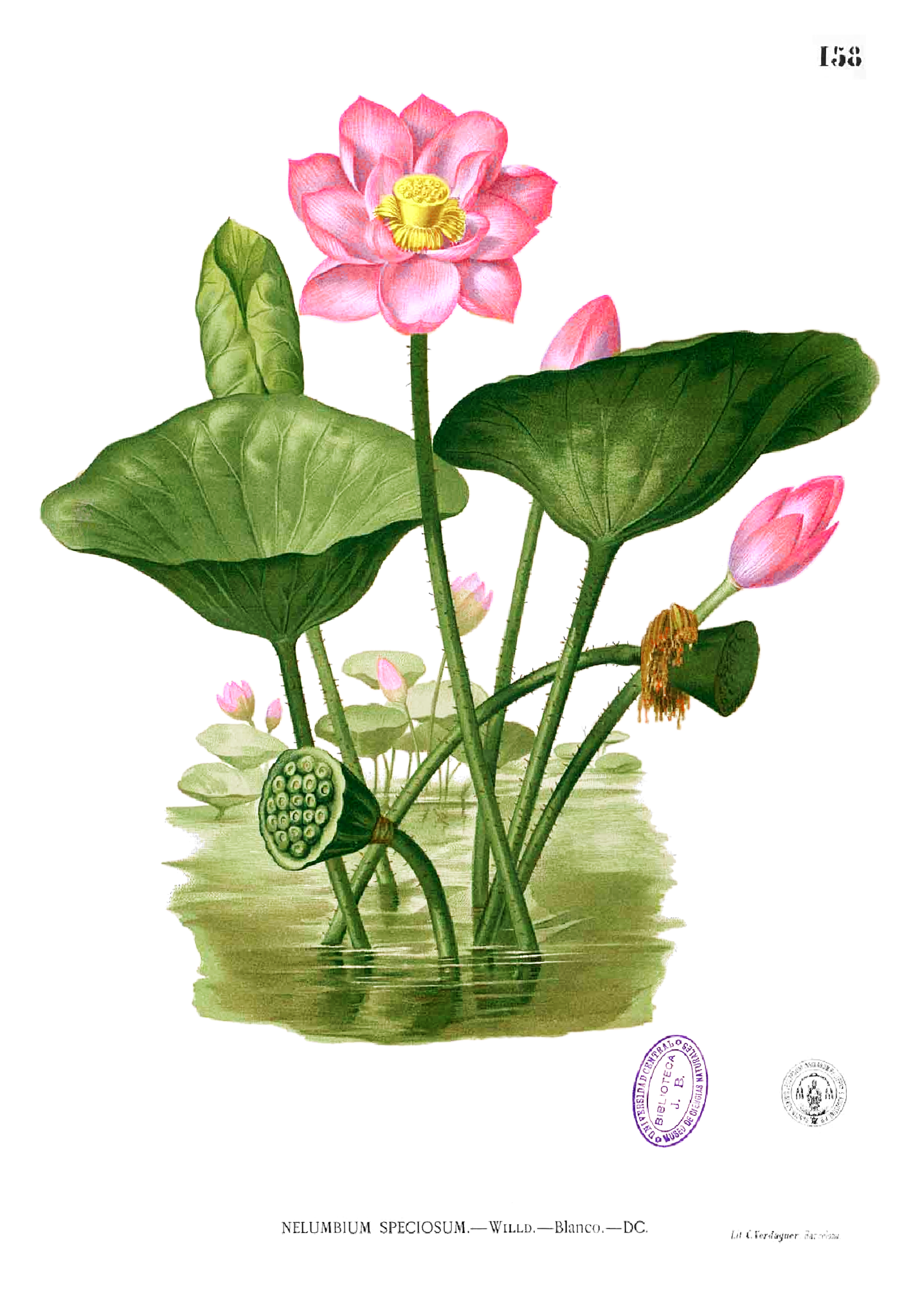
The lotus is an amphibious herbaceous perennial. The stems of the lotus, transformed into a powerful thick rhizome, are buried in the underwater soil. Some leaves are submerged, scaly; others are emergent, floating or raised high above the water. Floating leaves are on long flexible petioles, flat and rounded in shape. Emergent leaves are on erect petioles; they are larger and have a funnel shape with a diameter of 50–70 cm.

The flowers are large, up to 30 cm in diameter, with numerous pink or white petals; they rise high above the water on a straight peduncle. Slightly below the point of attachment of the flower there is the so-called response zone, in which the lotus changes its position following the sun. The center of the flower consists of numerous bright yellow stamens and a broad inverse-conical receptacle. The flowers have a mild but pleasant fragrance. The fruit is an aggregate of achenes of inverse-conical shape — it resembles the spout of a garden watering can, with large chambers, each containing a single seed. The seeds are dark brown, the size of a small acorn; there may be up to 30 in a fruit. In dry conditions they retain viability for a very long time, sometimes for centuries. There are known cases when seeds kept in museum collections germinated 150 and even 200 years after collection.
Leaves and flowers are covered with a very thin wax coating. In sunlight they glow and shimmer like mother-of-pearl. Drops of water, like beads of mercury, roll over the leaves. On a hot sunny day you can observe a very interesting phenomenon — a "living laboratory" in action — the "boiling" of water. In the depression of a leaf, air coming out of the holes in the petiole throws the water out in fine sprays.