
Flowers for the garden
Endymion or Hyacinthoide
Еndymion (Hyacinthoides)
The name of this plant was changed four times by botanists, assigning it to three related genera - to the hyacinth (Hyacinthus hispanica), to the squill (Scilla hispanica), to Endymion (Endymion hispanicus). However, significant differences revealed from the aforementioned genera led the French botanist P. Chouard in 1931 to give it a new generic name - Hyacinthoide. In horticultural literature the species of Hyacinthoide can still be found under one of its three old names, most often as Endymion.
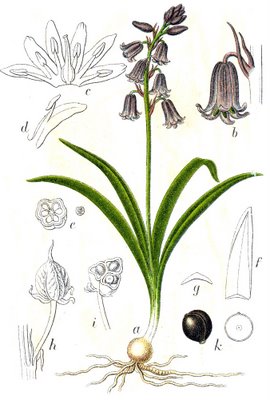
The genus comprises 2 species growing in Southwestern Europe and Northwestern Africa.
Endymion Spanish — Еndymion hispanicus (Mill.) Chouard = Hyacinthoides hispanicus = Scilia hispanka mill.
The native range of the Spanish Hyacinthoide is Western European countries: Spain, Portugal, and southern France; the plant is found in forests and meadows.
A low-growing bulbous plant. Flowering stem solitary, 20 – 30 cm tall. Flowers bell-shaped, 1.5 – 2 cm in diameter, arranged 4 – 10 together in an erect racemose inflorescence. Perianth segments bluish-lilac, slightly pinkish, about 1.5 cm long. Leaves basal, 20-30 cm long, numbering 2-7. Bulbs white, ovoid, 3 – 4 cm long and 2 – 2.5 cm in diameter. Fruit a capsule, seeds rounded. Flowers at the end of May — beginning of June for 10 – 12 days. Winter protection is recommended as a preventive measure.
This elegant bulbous plant is loved and valued in European gardens. In many European countries it has naturalized and is often seen flowering along roadsides, in fields, among shrubs. Cultivated plants differ from wild ones by considerably larger size and a greater number of flowers.
Endymion undescribed — Еndymion non-scriptus (L.) Garcke = Scilla non-scripta (L.) Hoffm. et Link
Occurs in shady broad-leaved forests and shrubs in Great Britain and western Europe.
A species very close to Еndymion hispanicus. Bulb white, cylindrical, 2 cm in diameter, 4 cm high. Flowers in a one-sided racemose inflorescence, blue or lilac-blue, unlike the Spanish Endymion tubular rather than bell-shaped and smaller. Large bulbs produce 12 – 15 flowers per inflorescence, which open at the end of May. Hardy to winter, does not require shelter. Blooms in late spring - early summer.
Location: sun-loving, but tolerate light shade. The site must be moist.
Soil: humus-rich with added old peat is suitable. They tolerate significant (up to 30 cm) planting depth and swarding.
Care: replanting is required every 3-4 years, otherwise flowering will decline. Large bulbs can be stored after lifting at temperatures up to 22 °C for up to a month; offsets, if necessary, are stored in moist sawdust or moss also no longer than a month. Seed capsules are recommended to be removed to prevent self-seeding and loss of cultivar traits. They need a large amount of moisture during the period of active growth. Transplanting is possible only after the leaves have yellowed.
Propagation: by bulbs and seeds, the latter sown into the ground immediately after collection. Seed capsules set in early June. Young plants flower in the 4th – 5th year. Bulbs are planted at a depth of 8 – 10 cm in early September. In one season a large bulb produces 5 – 6 offsets.