
Flowers for the garden
Narcissus
Narcissus
Narcissus (lat. Narcissus) — a genus of perennial bulbous plants in the family Amaryllidaceae (Amaryllidaceae). The genus includes more than 20 species distributed in Europe, predominantly in Mediterranean countries, especially the western ones; one species occurs in Asia as far as Japan and China. Several graceful species of narcissus have long formed a spring ornament of gardens and are forced in winter for indoor cultivation.
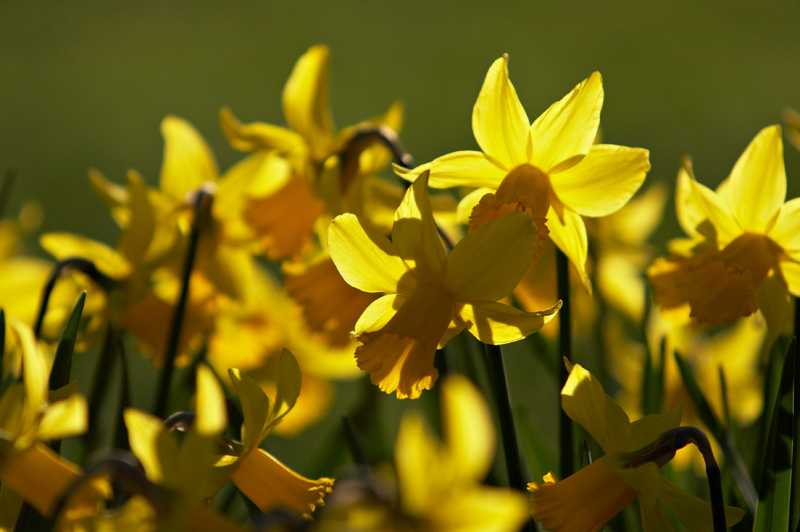
The name derives from the Greek word 'narkao' — to stupefy or to numb, which is probably related to the bulbs, the poisonous properties of which have been known since ancient times, or may be connected with the intoxicating scent of the flowers.
Perennial bulbous plants. The bulb is perennial, flask-shaped, ovoid or rounded, composed of basal scales and leaf bases. A characteristic feature of the narcissus bulb structure is the presence of two renewal buds at different stages of development. The scales are brown, membranous. Roots are annual, unbranched, wiry. Leaves are basal, linear, numbering 2–4.
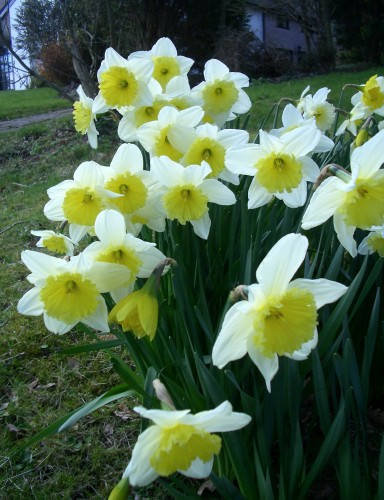
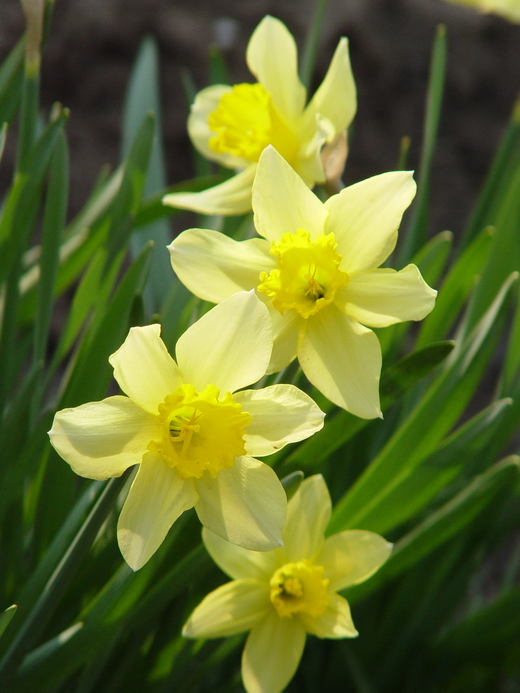
The scape is leafless, round or flattened, up to 50 cm long, with membranous bracts. Flowers are large, solitary or in clusters, often fragrant, somewhat nodding, single or double, 2–8 cm in diameter. They bloom in May–June. The perianth has six segments and a tubular, bell-shaped or cup-shaped corona of varying length. The fruit is a fleshy, three-valved capsule. Seeds are numerous, rounded or angular, and lose viability very quickly.
In cultivation:
Common narcissus, or poetic narcissus - Narcissus poeticus
The plant is 20–30 cm high. The bulb is globose-ovoid. Leaves flat, narrow, glaucous-green, numbering 2–4. Scape two-angled. Flowers solitary, rarely paired, fragrant, pure white; their corona is saucer-shaped, yellowish with a red edge or without it. It grows well outdoors and even becomes naturalized. Bulbs are planted in autumn, from September to early November; bulbs planted at other times do not succeed. Narcissi generally tolerate any fresh soil. They are propagated by separating young bulbs (bulblets) from the old bulb annually; however, this can be done by lifting the bulbs only every 4 years. Growing narcissi from seed is inconvenient because seeds are very difficult to germinate—sometimes in 2–3 years—and then one must wait until the plant strengthens before flowering, which requires 5 to 12 years depending on the species.
Bunch narcissus, or Tazetta - Narcissus tazetta
A wild species in Southern Europe. A perennial bulbous plant 30–50 cm high. Bulb with numerous scales, 2–5 cm in diameter. Leaves 4–6 in number, flat, gray-green, almost as long as the leafless scape, enveloped at the base by a membranous sheath. Flowers on unequal pedicels, grouped 3–15 in an umbel-like inflorescence, yellowish-white, with a small saucer-shaped corona of the same color and very fragrant. They do not withstand the climate of northern Ukraine outdoors, but do well in greenhouses and indoors. The bulb should be planted in October or early November. There are several varieties, including double forms.
Narcissus bulbocodium, or Corbularia bulbocodium — Narcissus bulbocodium = Corbularia bulbocodium
In the wild this miniature narcissus with pear-shaped bulbs is found in southern France, Spain, Portugal and Algeria, where it can be seen on mountain meadows. The lovely, slightly fragrant flowers have tiny yellow perianth segments and a large bright yellow tube with stamens protruding beyond it. Slightly concave leaves are the same length as the scapes — 10–15 cm. Plants require not too wet, humus-rich soil and bright sunlight. In the first year after planting it usually flowers little, but from the second year, in March–April, it forms a mass of flowers. Although this species is winter-hardy, plants should still be carefully covered for the winter. To make the flowering more effective, several bulbs are usually planted in one hole about 3 cm deep. This narcissus is ideal for growing in a rock garden or for creating a bright spot of color in front of evergreen shrubs.
Narcissus cyclamineus — Narcissus cyclamineus
Occurs in Portugal and Spain. Named for its resemblance to cyclamen because of the strongly reflexed perianth segments. Plants 15–25 cm high. Bulb small, about 2 cm in diameter, rounded. Leaves up to 15 cm long, narrow-linear, keeled. Flowers nodding, 2.5–3.5 cm long, bright yellow, with a long cylindrical tube. In cultivation since 1633, grown mainly in rock gardens. As a result of hybridization with trumpet narcissi, very early cultivars have been obtained that are more hardy than the original species.
Narcissus hybrid — Narcissus х hybridus hort.
Under this name numerous cultivars obtained by repeated hybridization of wild species and garden forms are grouped. Currently, more than 12,000 narcissus cultivars are known, which according to the International Classification are subdivided into:
Group 1. Tubular narcissi (Trupet Daffodils).
Varieties in this group are characterized by having a single flower on a sturdy medium-height or tall scape. Main feature: the tube is equal to or longer than the perianth segments. White and yellow flower colors predominate in the group.
Group 2. Large-cupped narcissi (Trumpet Daffodils)
This group includes cultivars with a single flower per scape; the corona of this flower is shorter than the perianth segments, but comprises more than 1/3 of their length. The color of the perianth segments in this group is varied: white, yellow, cream, greenish-white, orange. The coronas are also diverse in both color and shape.
Group 3. Short-cupped narcissi (Short-Cupped Daffodils)
In cultivars of this group there is one not-large flower per scape, whose corona does not exceed 1/3 of the length of the perianth segment. Most cultivars in this group are of medium plant size, have abundant flowering and a delicate fragrance inherited from the ancestor N. poeticus L (poetic narcissus). Recently there have appeared cultivars with various corona colors: pink, green, red, orange, etc.
Group 4. Double narcissi (Double Daffodils).
This group includes cultivars with double flowers, selected from various groups, so they differ from each other in morphological characteristics. Double flowers can vary in color, size and shape.
Group 5. Cyclamineus narcissi (Cуclamineus Daffodils).
This group of cultivars was obtained by crossing garden forms with the species narcissus cyclamineus. The cultivars inherited its characteristics: perianth segments strongly reflexed backwards, a narrow and very long tube, the length of which sometimes exceeds the length of the perianth segments. Flowers are usually solitary and nodding. Plant height 15 — 20 cm.
and others.
Location: Narcissi are a more shade-tolerant crop compared, for example, to tulips, but in well-lit locations the "yield" of their flowers and bulbs is significantly higher than in shade. Narcissi adapt well to local conditions. They can grow on flowerbeds, on turf or in a garden under tree canopies.
Soil: they tolerate any soil provided it is well drained and fertile. Narcissi do not tolerate the application of fresh manure to the soil, therefore it should be applied under the preceding crop. They can remain in one place for 3–5 years.
Care: the crop primarily requires nitrogen-potassium nutrition. In the initial period they need intensive nitrogen feeding, while during scape formation their demand for potassium increases sharply. The peak uptake of all nutrients by narcissi occurs at the full bud stage. Under no circumstances should narcissi be fertilized with fresh manure, because it attracts the most dangerous pest of this crop — the narcissus fly, or the onion hoverfly. Narcissi are a rather moisture-loving crop, so during flowering and for 4–5 weeks after it they should be watered if there is no rain. Other care consists of weeding and removing diseased plants. To improve bulb quality and prevent the spread of diseases, faded flowers are removed before seed formation, since plants spend a lot of nutrients on seed ripening.
Propagation: the most effective method of propagating wild species is sowing freshly collected seeds in July or before winter. Hybrid cultivars and forms are usually propagated by bulbs and offsets.