
Deciduous trees
Nandina domestica (heavenly bamboo)
Nandina domestica
Synonyms: Sacred bamboo
Nandina (Nandina Thunb.) – a monotypic genus of evergreen plants in the birch family (Betulaceae). The genus was first described and named (from the Japanese «nan-ten») by Carl Peter Thunberg in 1781 in Nov. Gen. Pl. 1: 14. It was introduced to Europe in 1804 by the Scottish gardener and plant collector William Kerr. Introduced into cultivation in the Nikitsky Botanical Garden in 1846.
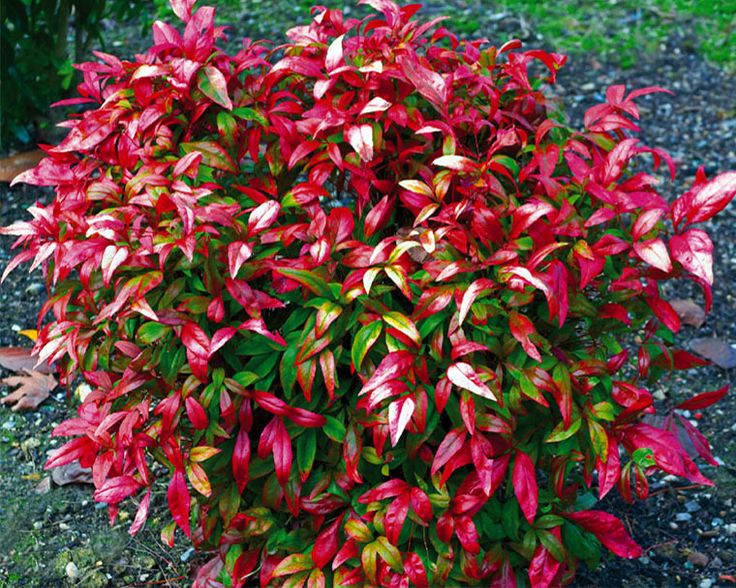
Nandina domestica 'Fire Power'
Occurs naturally in China and Japan, naturalized in North America. Grows on mountain slopes.
It is an evergreen tree 5-6 m tall, often growing in a shrubby form. Crown open, cylindrical. Lateral shoots sparsely branched. Growth slow. Shoots light brown-violet, later becoming gray-brown, longitudinally grooved. Root system shallow. Buds up to 1 cm long, acute, laterally flattened, scales herbaceous, greenish-brown or reddish, with parallel veins.
Автор Г.Окатов
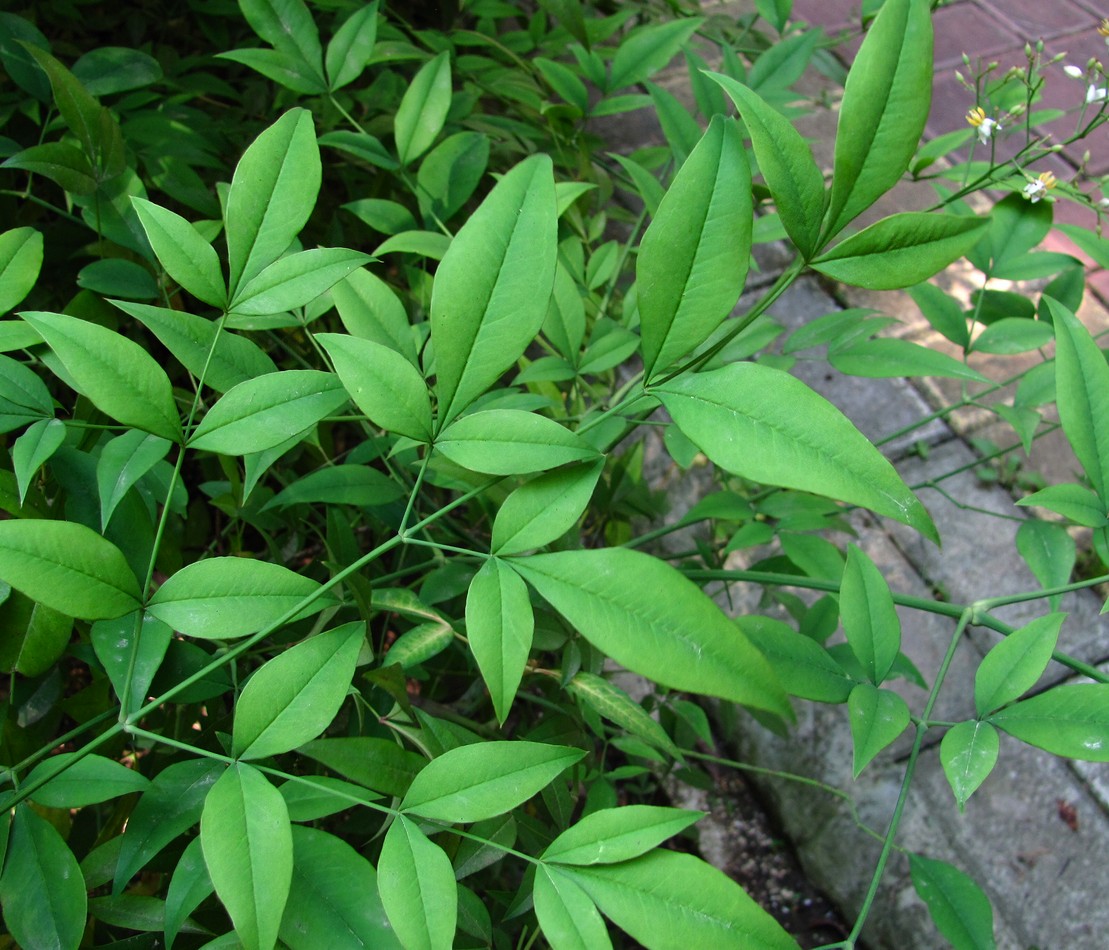
Leaves compound, clustered at the tips of branches, triply imparipinnate (triangular in overall outline), 30-40 cm long. Leaflets glossy, thick, rhombic-lanceolate, apex acute, base cuneate, up to 10 cm long and 2.5 cm wide, entire, glabrous, dark green; in autumn they turn red-brown and red, retaining this color until spring, by spring browning and by summer becoming green. When unfolding, leaflets are glaucous with a pink tint and may be bright red. Petioles keeled beneath, 10-15 cm long, with an expanded stem-clasping sheath-like base. Petiolules 1-3 cm long.
Автор Г.Окатов
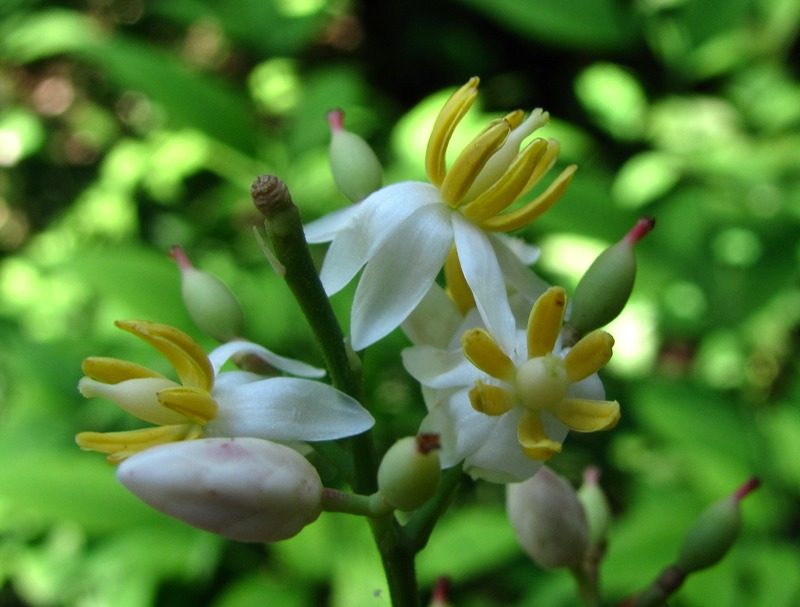
Flowers numerous, with three yellowish-white sepals arranged spirally that transition into white petals, up to 6 mm in diameter, rounded, gathered in terminal panicles 20-40 cm long. Nectaries number 3 or 6. Sepals numerous, arranged in whorls of three in a very tightly compressed spiral and gradually passing into somewhat larger white petals in a set of 6. Stamens 6, anthers elongated. Flowers in June.
Автор Н.Голубев
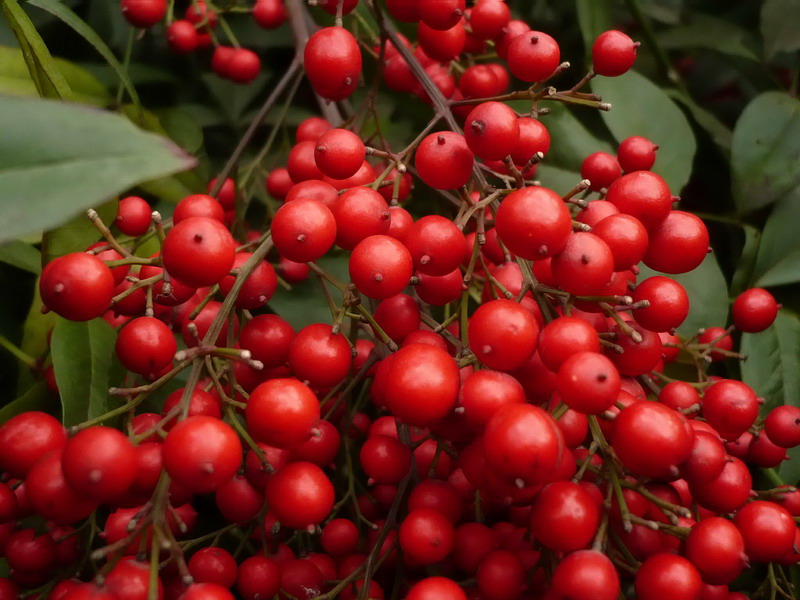
Fruits bright red, purplish-red, less often white, up to 8 mm in diameter, with a pointed apex, borne on terminal panicles. Fruiting in September-October.
Forms:
- var. leucocarpa
- var. capillus
Cultivars: 'Atomic Fireball', 'Blush', 'Colerno', 'Compacta', 'Filamentosa', 'Fire Power', 'Firehouse', 'Flirt', 'Gulf Stream', 'Harbor Belle', 'Harbour Dwarf', 'Lowboy', 'Monfar', 'Monum', 'Moon Bay', 'Moyers Red', 'Nana Purpurea', 'Richmond', 'Robinet', 'Royal Princess', 'San Gabriel', 'Sassy Lady', 'Senbazuru' (var. capillus), 'Sunray', 'Tama Shishi', 'Umpqua Chief', 'Umpqua Princess', 'Umpqua Warrior', 'Woods Dwarf'.
Hardiness zone: 6-10 (-15-18°C)
Location: prefers bright, diffused light or partial shade. In most of Ukraine the plant is grown as a container specimen. In the garden it can be kept from May until the first frosts. In autumn the plant is kept at +18°C, placed one meter from a south-facing window or on a west/east-facing window. Dormancy period in indoor conditions is forced (from October to February) due to reduced light and air humidity.
Soil: loose and well-drained, consisting of equal parts topsoil, leaf mold and peat, with the addition of 1/2 part coarse sand.
Watering: in summer provide abundant watering combined with fertilizations every 2 weeks. In winter reduce watering as temperature decreases. Water the plant with soft, well-settled water. To further soften it, a little acetic or citric acid can be added.
Air humidity: should be high. Place the plant near a water source and add moist expanded clay to the saucer. Also spray morning and evening with water free of chlorine and lime.
Transplanting: Young plants require annual transplanting. Mature plants are repotted every 3-4 years, cutting part of the roots. It is desirable to renew the top layer of soil in pots annually.
Care: with complex mineral and organic fertilizers. Bonsai fertilizers can be used. In winter reduce fertilizations to once a month.
Pruning: to obtain good growth of young leafy shoots, in spring cut stems taller than 180 cm. Remove old dried leaves from the lower part. To obtain a compact, well-leafed bush, it is necessary to cut some stems around the perimeter, which allows new ones to grow. The plant tolerates electric shears poorly, so it is recommended to use regular secateurs.
Diseases and pests: aphids, nematodes, root rot.
Propagation: produces suckers from the stump and root collar. Propagated by semi-ripe cuttings using rooting stimulants at a soil temperature of 20-25°C; rooting is slow, taking 3 or more weeks; by root suckers; by grafting onto the shrub Mahonia; less often by seeds.
Companion plants: hostas, ferns, Japanese maples, rhododendrons.
Uses: an ornamental plant used in group and solitary plantings, on edges, and as a container specimen. Mainly grown in cool winter gardens and greenhouses; rarely kept in rooms, offices, halls. Also cultivated as bonsai.