
Flowers for the garden
Muscari
Muscari
Muscari (лат. Muscari) — a genus of bulbous plants in the family Hyacinthaceae (Hyacinthaceae). The genus includes about 60 species, and about 20 species in the countries of the former USSR. They occur in steppes, on open mountain slopes among shrubs, on forest edges and alpine meadows.
Most likely the Latin name was given because the scent of the flowers resembles musk. Other names of the plant: mouse hyacinth, viper's onion.
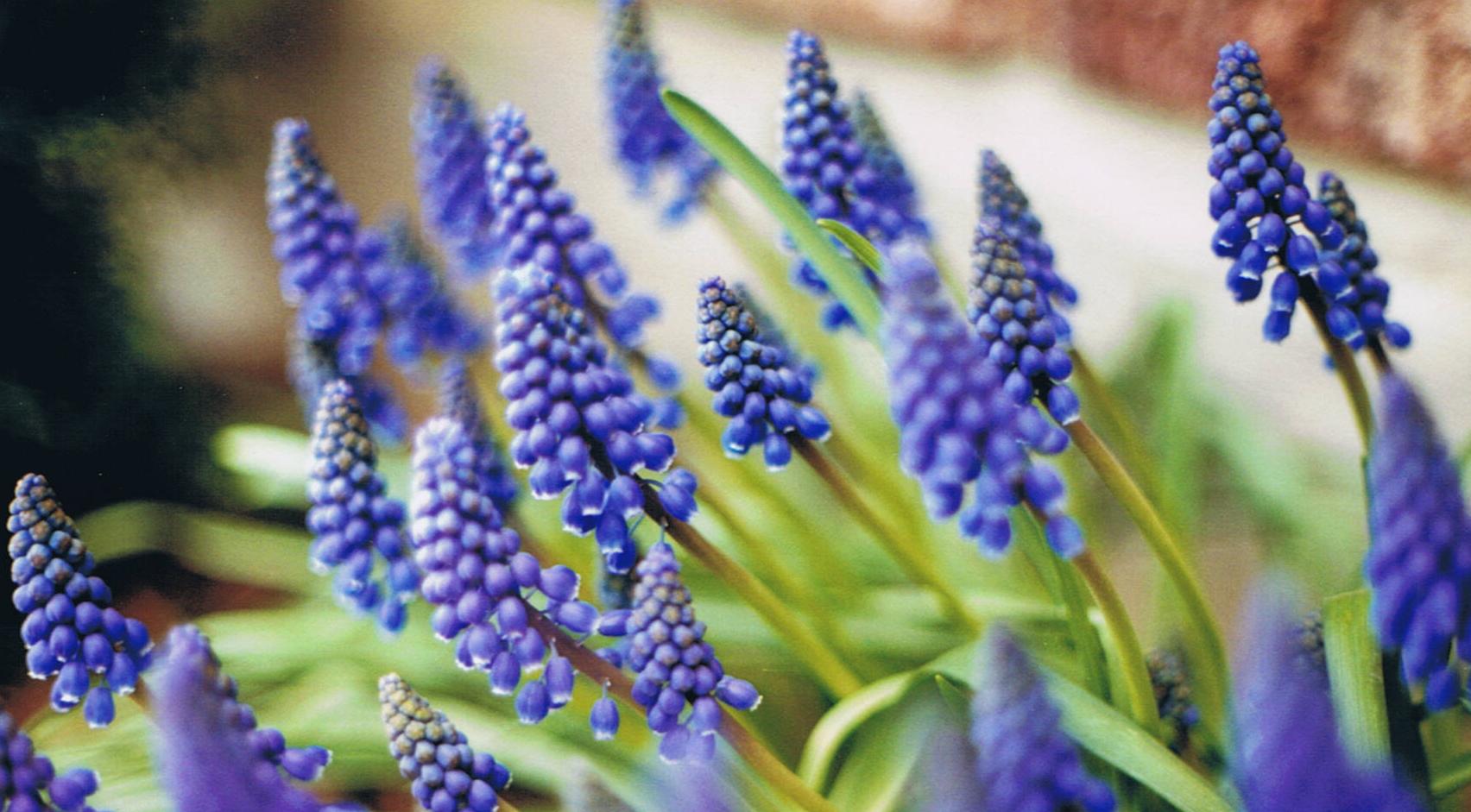
Perennial, herbaceous, bulbous plants 10 to 30 cm tall. Bulbs small, ovoid, with light outer scales. Leaves (2-6) basal, linear, about 10 cm long, appear in spring or autumn.
Flowers small, cylindrical, tubular or barrel-shaped, gathered in dense terminal racemose inflorescences 2-8 cm long, composed of six fused petals, color ranging from white to dark blue. They possess a pleasant, strong fragrance. Fruit — a three-celled, winged angular capsule. Seeds small, wrinkled, rounded, black, retain viability for up to a year.
Almost all species are ornamental. The bright purple, blue or sky-blue inflorescences of most species are very attractive and have a strong, pleasant scent.
In cultivation:
Muscari armeniacum — Мuscari armeniacum
Perennial, herbaceous, bulbous plant. Bulb up to 3 cm long. Leaves 3—7, 15—20 cm long, gradually narrowing toward the tip. Scape up to 20 cm long, with a many-flowered, almost spherical inflorescence, with several sterile flowers at the top. Flower color blue, fragrant. The upper flowers in the inflorescence are sterile, paler. Blooms in late spring for 20–25 days. Overwinters without leaves. Winter-hardy without shelter. Has several cultivars:
'Blue Spike' - racemose inflorescences bear 150-170 blue fragrant flowers. The many-flowered appearance of the raceme is created by double and triple branching of each pedicel. Sometimes flowers with a double perianth are formed. The complex raceme is borne on an erect, non-flopping scape up to 25 cm tall. The 'Blue Spike' cultivar is exceptionally beautiful, quite undemanding, and is used both for landscaping and for cutting.
'Cantab' - a low-growing and late-flowering form with bright blue flowers.

'Christmas Pearl' - a little-known garden form of mouse hyacinth with violet-blue flowers.

Muscari latifolium — Мuscari latifolium
Grows on forest edges in Asia Minor. Bulb small, ovoid, 2—3 cm long. Leaf lanceolate, 15—17 cm long and 2—2.5 cm wide. Scape 20 cm long, bears a many-flowered (up to 100 flowers) cylindrical inflorescence. Flowers dark purple, upper ones lighter. Flowers in mid-spring for 20—25 days. The species is warm-loving.
Muscari botryoides — Мuscari botryoides
Occurs on meadows and mountain slopes in the subalpine and alpine belts of Central and Southern Europe. One of the most widespread in cultivation. Small flowers are gathered in racemes, which are smaller and narrower than those of Muscari armeniacum (M. armeniacum).
Bulb up to 3 cm long. Leaves 2—6, 10—12 cm long. Scape low, about 10 cm long, bears a many-flowered inflorescence. Blooms in early May for 15-20 days. In cultivation since 1576. Has garden varieties with white flowers (var. album) — which blooms a week later than the main species, does not set seed; (var. carneum) — with pink flowers.
Muscari macrocarpum — Мuscari macrocarpum
The native range of this plant is Greece and Turkey. A perennial bulbous plant up to 20 cm tall. Blooms in May with fragrant yellow flowers with a brown margin, while the buds are bluish-violet or gray. This warm-loving species, which does not tolerate temperatures below 5°C, is better grown in pots that are brought indoors or into a greenhouse for the winter. Recommended for southern regions with good winter protection.
Location: grow well in partial shade and in sunny sites. Undemanding. Hardy. Muscari should not be planted in low-lying areas, as they do not tolerate prolonged waterlogging.
Soil: not demanding regarding soil, but with good care they form larger bulbs and more vigorous inflorescences. They respond well to the application of organic fertilizers.
Care: require quite a lot of moisture during flowering and, conversely, prefer a dry environment during dormancy. Since the plants require a lot of nutrients, fertilizers are added to the soil in autumn; high-quality compost is best.
Propagation: by numerous daughter bulbs. Collected seeds are sown immediately after harvest because they quickly lose viability, but muscari also propagate well by self-seeding. Seedlings flower in the 3rd year.