
Indoor plants
Muehlenbeckia
Muehlenbeckia
The genus was named after the Swedish physician H.G. Muehlenbeck (1798-1845). The genus comprises 15 species, distributed in New Guinea, Australia, New Zealand and the western part of South America.
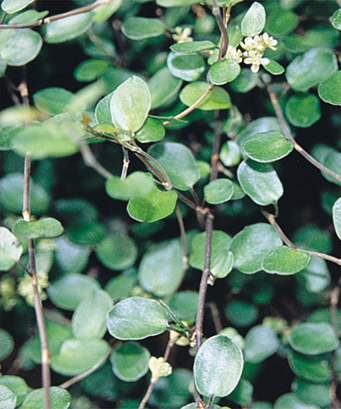
It is a perennial evergreen shrub with numerous twining shoots. Its branches are very thin, brown in color, and densely interlaced. Muehlenbeckia can be grown in hanging pots, as
Clasping Muehlenbeckia – (Muehlenbeckia. complexa Meissn.)
A woody vine with prostrate, climbing, or pendulous reddish or brownish thin, branching stems. Leaves small, up to 2 cm in diameter, alternate, petiolate, rounded or broadly ovate, sometimes lobed with a truncate or rounded base. Above the point of petiole attachment the stem clasps with a membranous sheath. Inflorescences axillary, few-flowered, racemose. Flowers unisexual or bisexual, white, up to 0.6 cm in diameter, five-parted. Native to New Zealand. In cultivation since 1842. A variety is known, var. tribolata Chees., with deeply lobed leaves.
Location: the plant is fairly shade-tolerant and does not tolerate strong sun. It grows well in both warm and cool interiors.
Lighting: it does not suffer from dry air in centrally heated rooms, but it is demanding with respect to soil moisture: if the soil in the pot dries out or becomes excessively wet, the plant will lose leaves and may die.
Air humidity: moderate.
Propagation: rooting of mature shoots in sand, perlite, or light soil, in a cold greenhouse. It is advisable to plant several cuttings in a pot, but a single cutting will also quickly spread; if young shoots are run along the soil and covered in several places, they will gradually root, giving rise to new vines.
Repotting: when transplanting with roots, handle them very carefully: Muehlenbeckia does not tolerate root damage. It is better to shift it into a larger container without shaking off the old soil.
Possible problems: does not tolerate root injury during transplanting. Hot midday sun can kill the plant.