
Deciduous trees
Black mulberry
Mórus nígra
Synonyms: black mulberry tree, black mulberry
Black mulberry – a species of the mulberry genus of the Moraceae family. Native to southwestern Asia, where it was cultivated for its fruits. Later it spread to Uzbekistan, Iran, Afghanistan, and northern India. In the 17th century it was introduced to Great Britain.
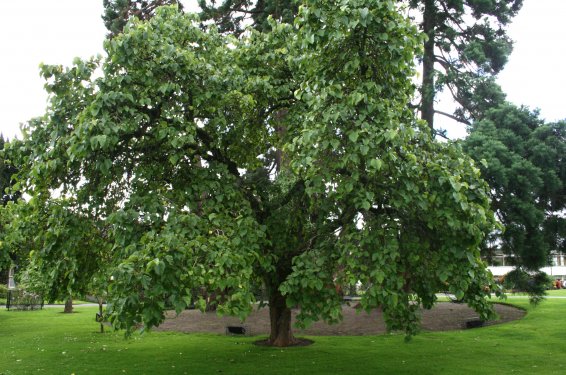
It is a deciduous tree up to 12 m in height and 155 m in width. The crown is broad and spreading. Branches of mature trees are numerous, wide, short, brownish-brown in color. The bark on the trunk is fissured, gray in color.
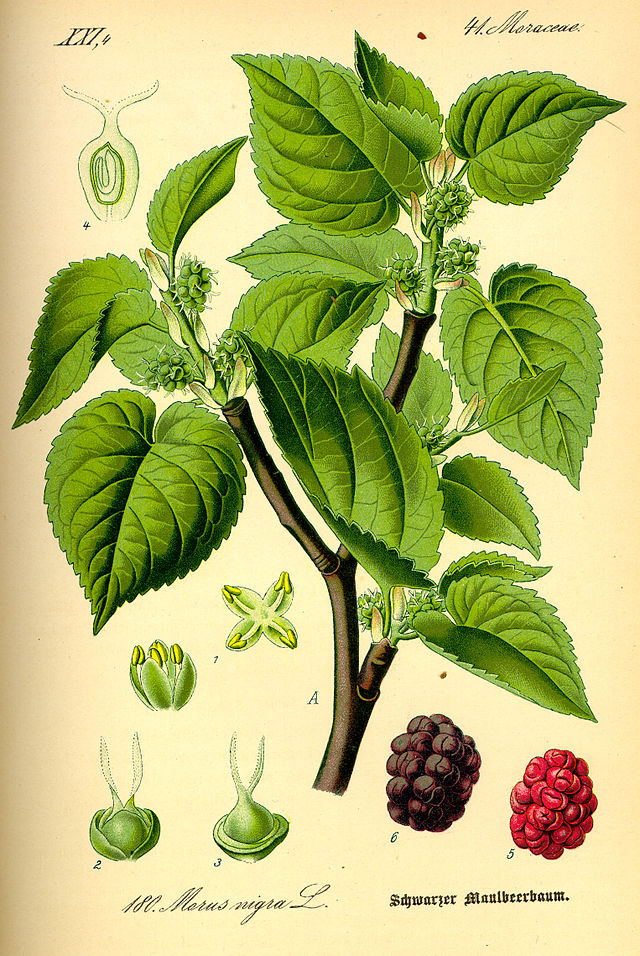
Botanical illustration from O.V. Tomme's book «Flora von Deutschland, Österreich und der Schweiz», 1885
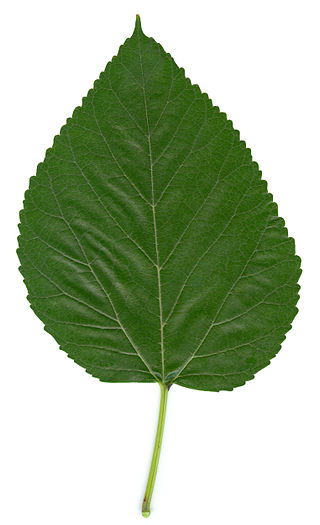
Leaves are large, 7-15 cm long and 6-10 cm wide, glossy, pubescent beneath, rough above, covered with very short and stiff hairs, dark green in color. Leaf shape broadly ovate, asymmetrical, deeply cordate at the base and shortly acuminate at the tip. Margins are bluntly toothed, palmately lobed or entire.
The plant is dioecious, wind-pollinated, unisexual. There are also monoecious plants in which male and female flowers grow on the same tree. Male flowers form pendent cylindrical catkins; female flowers form oval short catkins on short peduncles.
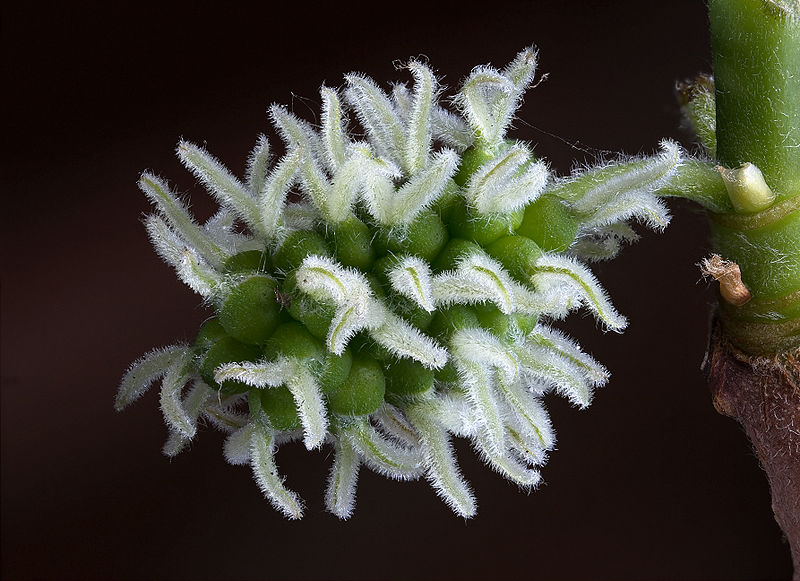
Female flower of black mulberry
Fruits are glossy dark-red or black-violet multiple drupes, edible and juicy. Taste sweet-sour.
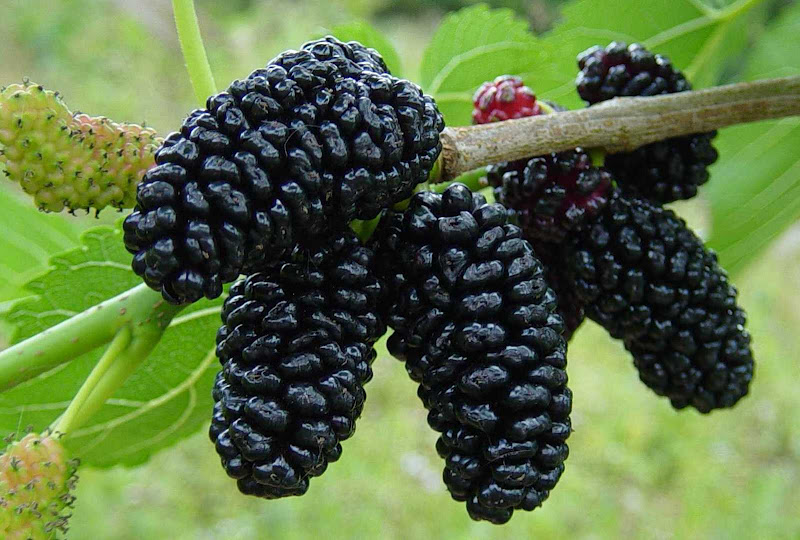
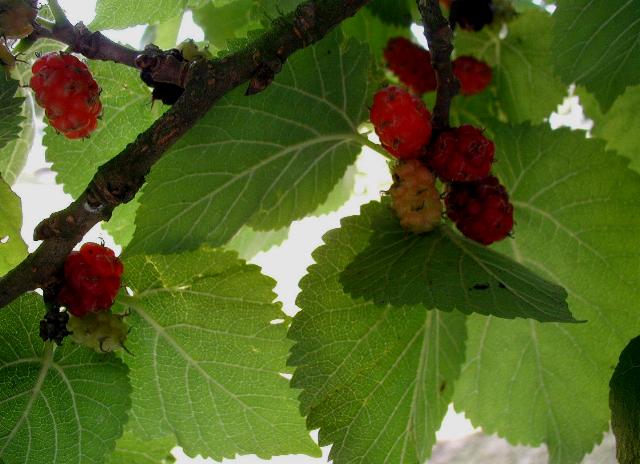
Cultivars: Shelly No. 150, Ostryakovskaya, breeding forms 3P and 4P, Nadiya, Kherson-2, black large-fruited.
Hardiness zone: zone 5b (-25°C)
Location: sun-loving, not demanding to soil, but prefers moderately moist fertile, well-drained soils. Tolerant of urban conditions. Recommended soil pH 5.5-7.0.
Pruning: sanitary pruning is recommended in late autumn, before the onset of frost.
Diseases: bacteriosis, powdery mildew, cylindrosporiosis, leaf curl/small-leaf disorder, root rot.
Pests: mealybug, chafer beetles, mole cricket, mulberry geometrid (looper), mulberry longhorn beetle, wireworm, spider mite.
Propagation: propagated by seed and vegetatively. Seeds can be sown immediately after extraction from the fruits.
Uses: fruits are consumed fresh, and used for making compotes, desserts, jams, juices, syrups, sherbets. Cultivated as a fruit tree.