
Deciduous trees
Weeping white mulberry
Morus álba f. pendula
Synonyms: white mulberry 'Pendula', weeping white mulberry
Weeping white mulberry – a decorative form of the white mulberry. It grows in many parks of Crimea, Ukraine, Central Asia and the Caucasus, Europe, and the USA. The form was developed in Italy. Propagated by grafting onto the trunk of white mulberry (Morus Alba). From the graft point a spreading wide crown develops.
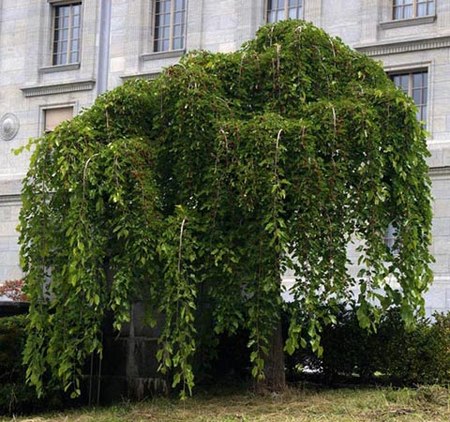
It is a medium-growing, low tree up to 3–5 m in height and 3–4 m in width. The tree height depends on the height of the trunk (stem) onto which it is grafted. The crown is umbrella-shaped, weeping, dense, becoming broader and more spreading with age. Branches are thin, long, pendulous, reaching the ground. Bark is gray-brown, fissured. Young shoots range from gray-green to reddish-brown-gray. The root system is strong and well-branched.
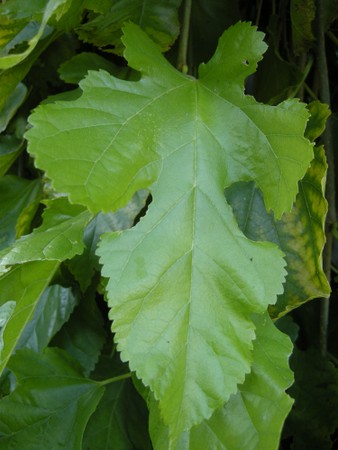
Leaves are glossy, bright green, up to 30 cm long, deeply lobed or rounded. On old trees they are usually cordate at the base and tapering toward the tip, up to 10 cm long, with toothed margins. In autumn they turn yellow or yellowish-green.
The tree is dioecious, separate-sexed, and wind-pollinated. Male flowers form pendulous cylindrical catkins up to 3 cm long; female flowers are oval short catkins up to 1–2 cm long. Flowers in April-May.
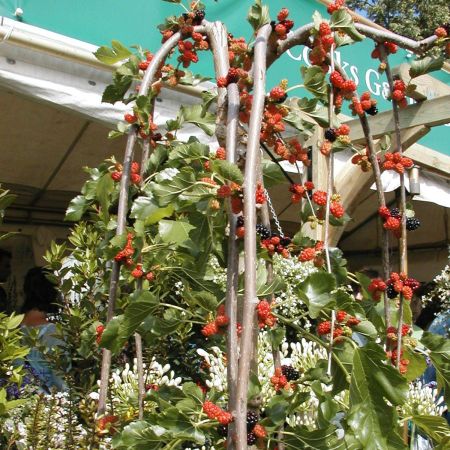
Fruits are small drupes of pink, red, or red-black color, edible. They appear in mid-summer.
Hardiness zone: zone 6a.
Location/exposure: sun-loving, not demanding to soil, but prefers medium-moisture fertile, well-drained soils. Tolerant of urban conditions.
Pruning: sanitary pruning is recommended in late autumn, before the onset of frosts.
Diseases: bacterial diseases, powdery mildew, cylindrosporiosis, leaf curl/small-leaf disorder, root rot.
Pests: scale insects, cockchafers, mole crickets, mulberry looper (geometer moth), mulberry longhorn beetle, wireworms, spider mites.
Propagation: propagated by grafting and by cuttings (in the latter case growth will be significantly slower).
Uses: used as a specimen tree on lawns, for creating arbors, and for urban landscaping. Fruits are consumed fresh, dried, and used for making desserts.