
Deciduous trees
Mulberry
Morus
Synonyms: mulberry tree, tutovnik, tutnik, tyutina, tutina, mulberry tree.
Mulberry (Morus) – a genus of deciduous plants in the family Moraceae. Distributed in the subtropical and warm temperate zones of Africa, Asia, and North America. It grows in Ukraine, Armenia, Bulgaria, Romania, Georgia, Belarus, Tajikistan, Uzbekistan, Russia, South Kazakhstan, Azerbaijan, Moldova, Kyrgyzstan, Turkmenistan. Lives 200-300 (500) years.
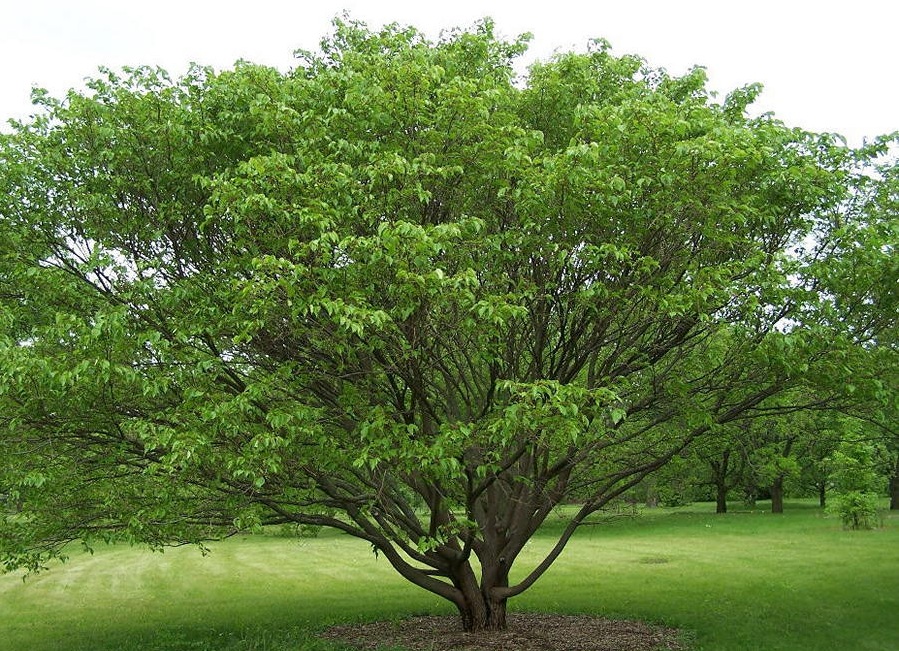
Japanese mulberry (Morus japonica)
It is a small tree up to 10-15 m in height. Fast-growing when young, growth slows at maturity. Crown dense, spherical or broadly ovoid, less often pyramidal. Bark fissured, brown. Leaves simple, alternate, often lobed (especially on young shoots), less often crenate, serrated at the margin, glabrous or pubescent.
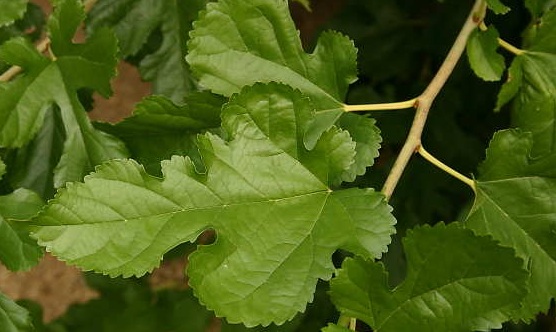
White mulberry (Morus alba)
Plants are usually dioecious, less often monoecious. Flowers unisexual, catkin-like. After flowering the perianths of the female flowers expand and cover the developing ovary with a layer of fleshy tissue. As a result, these ovaries take the form of a small fruit – a drupe. Later these fleshy coverings of the fruit fuse, forming an aggregate fruit that is commonly called a "berry", white, pink, dark purple or almost black in color, reaching 1-5 cm in length. Fruits are edible; in some species they have a sweet taste and pleasant aroma.
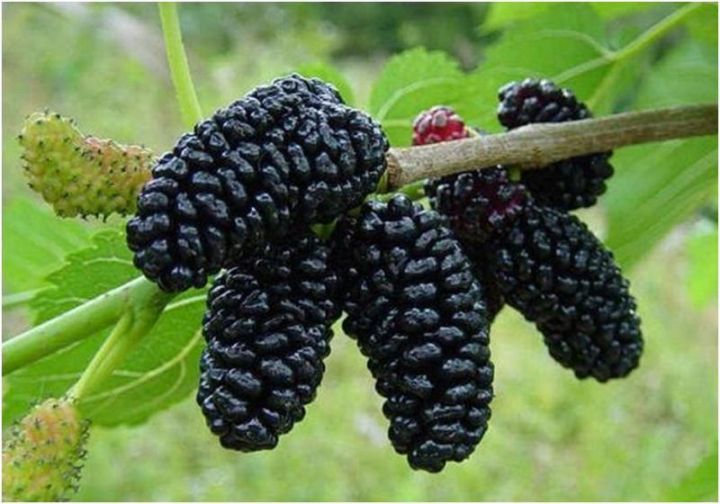
Black mulberry (Morus nigra)
Classification:
The classification of the genus is rather complicated. Some publications list about 200 species. Only 17 are generally recognized:
White mulberry (Morus álba) - eastern part of China
Australian mulberry (Morus australis, (Chinese mulberry)) – Southeast Asia
Morus cathayana
Morus celtidifolia
Morus indica
Morus insignis
Japanese mulberry (Morus japonica)
Morus liboensis
Morus macroura (M. alba var. laevigata)
Morus mongolica (M. alba var. mongolica)
Morus mesozygia – Central and Southern Africa
Morus notabilis
Black mulberry (Morus nigra) – Southwest Asia
Red mulberry (Morus rubra) – native to Eastern North America
Morus serrata (Himalayan Mulberry; M. alba var. serrata)
Morus trilobata (M. australis var. trilobata)
Morus wittiorum
Hardiness zone: some species can withstand temperatures down to -30 °C (zone 4b).
Site: most representatives are drought-tolerant, undemanding to soil, salt-tolerant, but do not tolerate waterlogging.
Diseases: bacterial disease, powdery mildew, cylindrosporiosis, leaf curl (small-leaf curl), root rot.
Pests: mealybug, chafer beetles, mole cricket, mulberry moth, mulberry longhorn beetle, wireworm, spider mite.
Propagation: propagated by seeds and vegetatively – by root suckers, layering, cuttings (green and hardwood cuttings) and grafting.
Uses: the wood is used for making household and decorative items. The bast is used to make ropes, cords, paper and cardboard. A yellow dye is obtained from the wood and leaves. Root bark and leaves are used in medicine. In landscape design some cultivars are used to ornament small gardens and parks. Due to its high tolerance to atmospheric pollution, it is often used for greening industrial areas. Thanks to its powerful root system, mulberry can be used for slope stabilization. Fruits are consumed fresh and are also processed.