
Indoor plants
Monstera
Monstera
Monstera (Latin Monstéra) — large tropical plants, vines; a genus of the family Aroid (Araceae).
Species of this genus are found in the humid tropical forests of the equatorial Americas. To the south the range covers almost the entire territory of Brazil, and to the north it includes the Yucatán Peninsula and much of Mexico. In the 19th century Monstera was introduced to Southeast Asia and was successfully naturalized there.
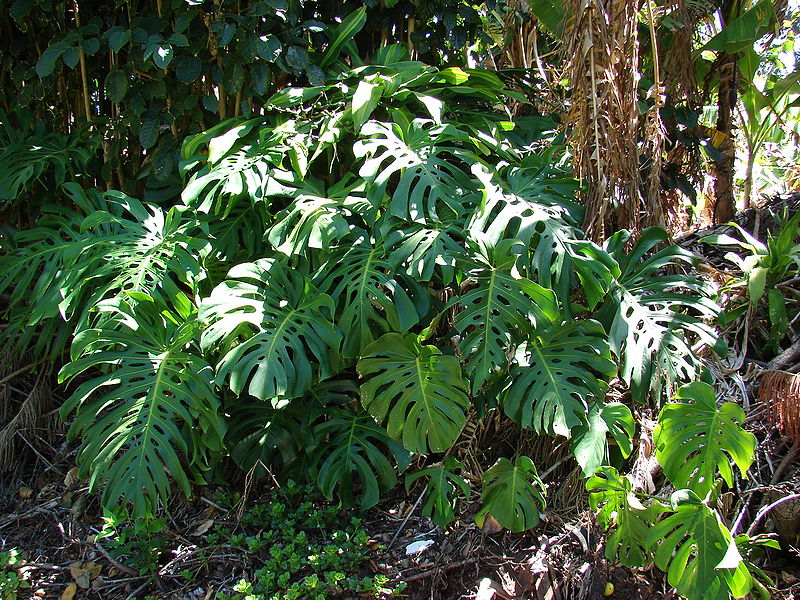
In 1492 Europeans discovered the continent later called South America. For a long time this mysterious land with impenetrable tropical forests was the source of legends and stories. In the early 18th century there were tales in Europe about giant man-eating plants found in the South American wilderness. Travelers reported that after attacks by these plants only skeletons remained, literally pierced by long shoots hanging from the trunk. There was some basis for such stories: travelers mistook the aerial roots of Monstera for treacherous tentacles. Hanging down, the roots could grow through the skeleton of a person lost in the jungle. Imaginative storytellers painted a very different picture of the victim's death. Because of such legends, Monstera received its name from the Latin monstrum — monster. It is even more likely that the word Monstera derives from the Latin monstrosus — strange, curious.
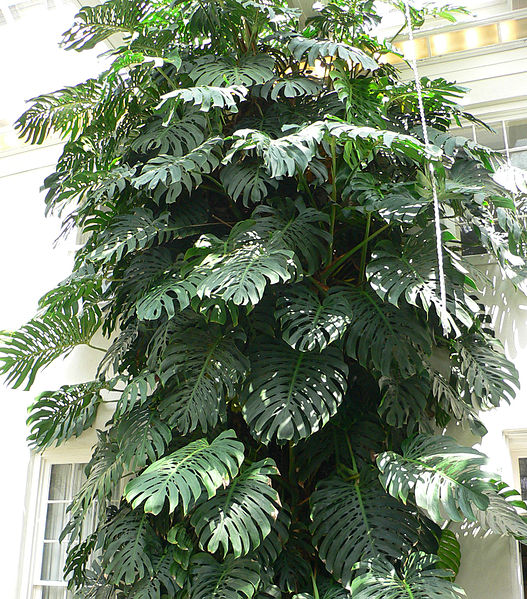
At first botanists classified Monstera within the genus Philodendron, but in 1763 Monstera was separated into its own genus. The first specimens of Monstera deliciosa, which was originally described as Philodendron pertusum, were brought to Britain in 1752. In its native South America this species was described in detail nearly a century later by the Danish botanist Frederik Michael Liebmann (1813—1856), who published a monograph on South American plants in 1849.
Monstera was later encountered in its natural habitat by Baron Wilhelm Friedrich Karwinsky, who led an expedition to South America organized by the St. Petersburg Academy of Sciences in 1841–43. Among the material from that expedition is a herbarium sheet dated April 1841 with a pair of Monstera leaves collected in the Mexican coastal region of Veracruz. Eighteen years later this Monstera species was described by Schott as Monstera karwinsky.
From the end of the 18th century Monstera became increasingly popular as a houseplant in Europe. Thanks to British colonial activities, the plant reached India in 1878 and spread further east. Today Monstera is one of the most popular and well-known houseplants, native to South America. Botanical research on this genus of tropical vines continues to this day. A leading specialist in the systematics of aroid plants is the American botanist, Professor Thomas Croat of the University of Missouri. In the late 20th century he described six new Monstera species.
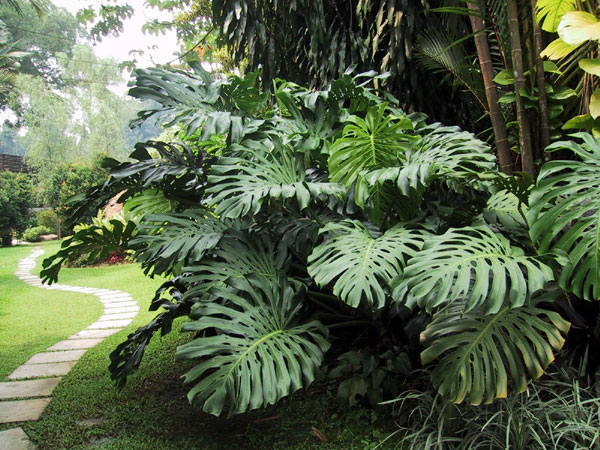
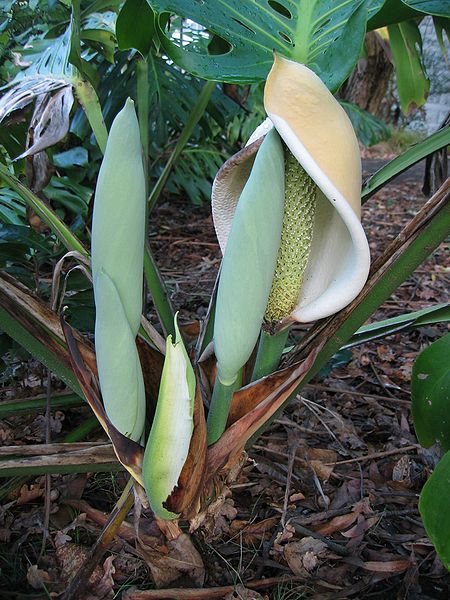
Monstera is an attractive evergreen plant. It is one of the most common houseplants. A fast-growing herbaceous vine capable of climbing trees to heights of 9 m and higher. Stems are cylindrical with coarse leaf scars and numerous long stiff aerial roots. Leaves are leathery, on long straight petioles, ovate-cordate in shape, 90 cm long and more. Young leaves are entire; with age they develop holes and later become fully divided. The fruit is a berry 20—30 cm long and 5—8 cm wide, with a thick rind and juicy aromatic flesh. With good care and proper conditions Monstera can flower and fruit. The inflorescence of Monstera is a spadix of small whitish flowers. Fruits are purple and form almost a year after flowering. Ripe fruits are edible and taste somewhat like pineapple, but an unripe fruit must not be tasted because it can cause a burn of the oral mucosa! The plant is very undemanding and quickly spreads, occupying almost half a room within 3–4 years.
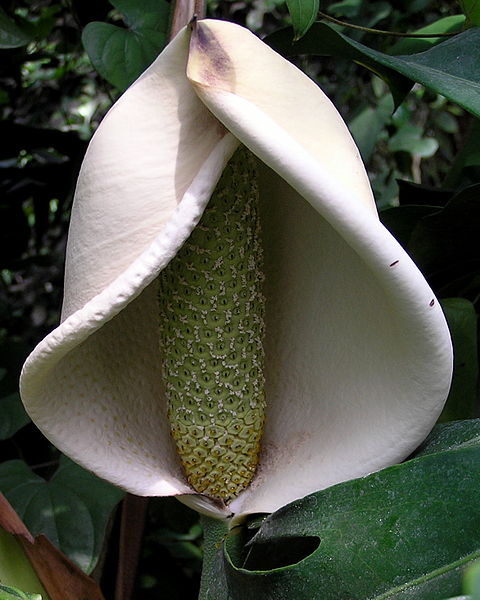
Because of its striking appearance, this plant is widely cultivated as an ornamental. Monstera is one of the most beautiful foliage ornamental plants, highly valued in indoor horticulture and suitable for decorating any interior. It is used to green medium- and large-sized residential, utility and industrial premises, to create winter gardens, and for shop windows, cinema and theater foyers. Large specimens can be used to decorate walls and staircases or stand alone. Medium specimens are placed in compositions with other houseplants. As it grows, Monstera needs a support; a moss pole is best for this. Numerous aerial roots should be tied, directed into the soil or toward the support, but not cut. Do not place Monstera in a walkway, as its fenestrated leaves can be damaged or torn when brushed against. Monstera also does not tolerate cold drafts — this causes brown spots on the leaves or yellowing.
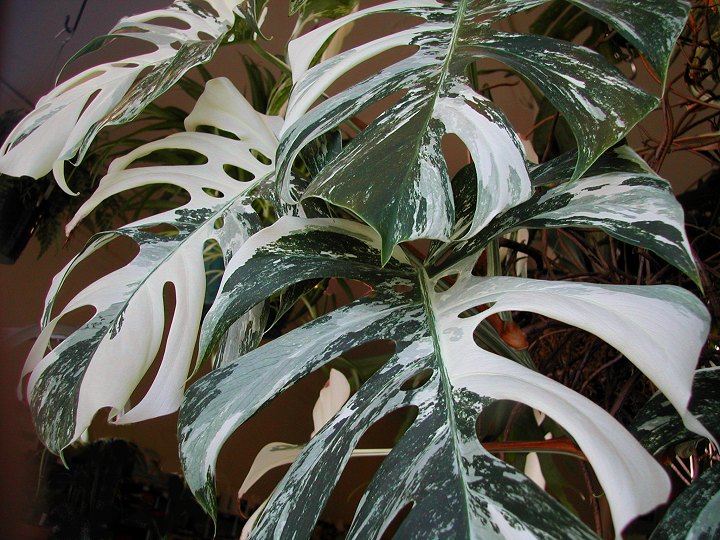
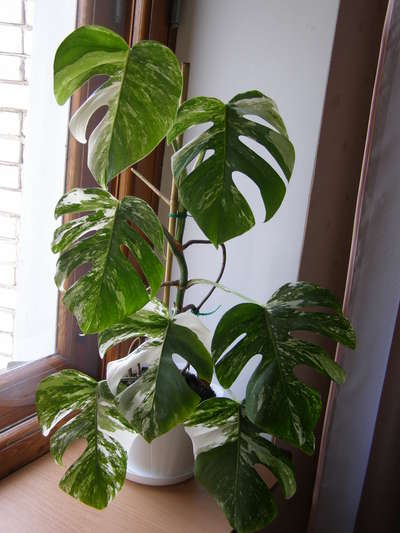
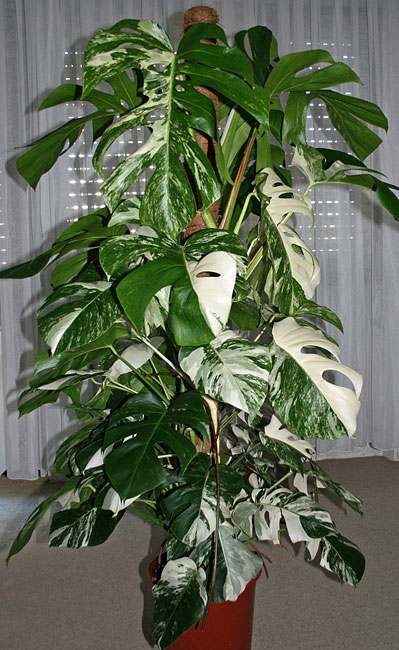
Monstera deliciosa "Variegata" - Monstera deliciosa variegata - has leaves with cream or white stripes or spots, sometimes marbled.
Temperature: Moderate; in winter the optimal temperature is 10–14°C. At higher temperatures Monstera grows more rapidly.
Light: Does not tolerate direct sunlight. Many believe Monstera is shade-loving and place it in the darkest corner — this is incorrect. Monstera is shade-tolerant, but the best place is where there is bright, diffuse light or light partial shade.
Watering: Plenty of water from spring to autumn; in winter water so that the soil does not dry out but is not waterlogged.
Fertilizer: From March to August feed Monstera with a balanced houseplant fertilizer. Feed every two weeks. Large plants can be given humus once in the summer into the top layer of soil when repotting or without repotting. Alternatively, one can water with a cow manure infusion, but this leaves an odor in the apartment.
Humidity: Regular misting. From time to time wash the leaves, wipe with a sponge and polish. When kept near heating in winter, leaf tips may dry out and spots may appear.
© plantatlas.bio
Use of site materials is permitted only with the permission of the copyright owners.