
Flowers for the garden
Molucella
Molucella
Family: Lamiaceae. The English name of Molucella is bell of Ireland (bell of Ireland). In Syria and Israel it is called Moluccan balm (the Moluccan Islands are located near New Guinea). Native to the eastern Mediterranean.
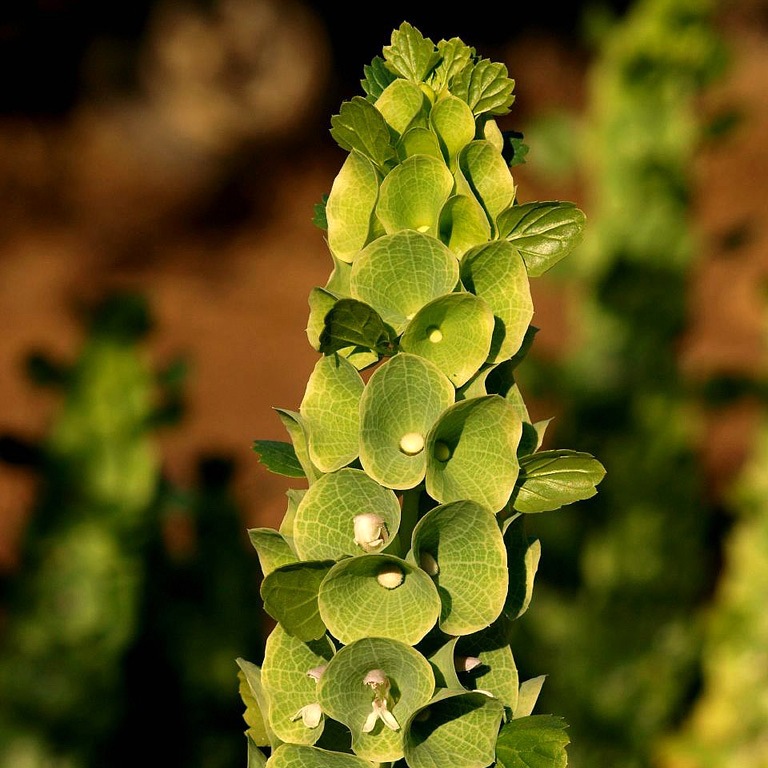
A branching annual plant 75–90 cm tall with rounded, toothed leaves. The flowers are small, white, faintly scented, embedded in an enlarged pale green calyx that is funnel-shaped. They are arranged in a dense spike-like inflorescence. Flowering lasts from late June until autumn. Seeds are gray-brown, quadrangular, resembling buckwheat; there are about 180 seeds per gram. Germination viability is retained for at least 3 years. The first mention of its cultivation dates back to 1570.

Molucella has no cultivars. There is a form with smaller calyces arranged around the stems in dense tiers.
Location: Molucella is placed in a sunny or slightly shaded spot.
Soil: any well-drained garden soil is suitable.
Care: standard — watering during dry periods, fertilizing once every 2 weeks.
Propagation: grown by the seedling method. Seeds are sown at the end of March, covered with a 0.5 cm layer of sand, germinated on a bright windowsill but shaded from direct sunlight. Seedlings appear in 8–25 days. The plant is cold-hardy, so sown seeds and seedlings are kept at 13–16°C. Plant out in the ground at 45 cm spacing; cover if frost is threatened.
Uses: Molucella is used in mixed borders, where it serves as a green background for other plants. Its main use, however, is as a cut flower for summer bouquets as an original addition to familiar garden flowers. It is an excellent plant for winter arrangements. In the dried state the flower calyces retain their green color. For this purpose Molucella is pulled up with roots when all the calyces in the inflorescence have opened. Stems are hung "upside down" in a cool, ventilated, shaded room. With dried plants, shriveled leaves are removed and roots are trimmed. In over-dried stems the calyces may break off.