
Flowers for the garden
Mirabilis
Mirabilis
Mirabilis, or Beauty of the Night (Mirabilis) - a perennial plant of the family Nyctaginaceae, grown as an annual; the genus includes about 60 species native to the warm regions of the Americas. The name comes from the Latin word 'mirabilis' - wonderful; the species of this genus have flowers of varied colors that open after noon, remain open at night and wither the next morning.

Perennial plant cultivated as an annual. Plants form elongated-ovoid bushes 30-80 cm high, with tuberous, swollen roots. Stems erect, densely branched, reddish, becoming woody in the lower part. Leaves opposite, elongate-ovate, petiolate, with entire margins, glabrous, green. Flowers funnel-shaped, up to 2.5 cm in diameter, white, yellow, orange, raspberry, purple, bright red or bicolored, 3-5 in a cup-shaped involucre, gathered in corymb-like inflorescences at the ends of shoots, fragrant, opening from around 4 p.m. and remaining open until the next morning.
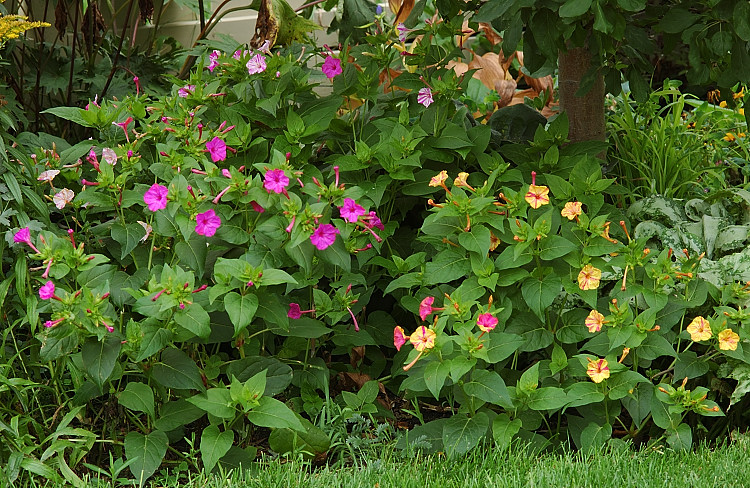
Beauty of the Night has one interesting feature - often flowers of different colors form on the same plant. It is usually pink, with shades ranging from salmon to raspberry, but can be white or yellow. Sometimes the petals bear multicolored stripes. Blooms abundantly from June until the first frosts. The fruit is single-seeded, fairly large, dark brown, with five sharp ribs. Seeds mature well and retain viability for up to 3 years. There are varieties up to 30 cm tall with plain or variegated leaves.


In the 'Tea Time Formula Mixture' variety the flowers come in a wide range of colors, while 'Tea Time Red' has pink-red flowers.
Location: a light- and warmth-loving, drought-tolerant plant. During prolonged drought it halts growth and flowering.
Soil: prefers deep, loamy or clay soils containing lime. Does not tolerate acidic or waterlogged soils.
Propagation: by seed, sown in a mildly heated greenhouse in early April or outdoors in early May. Seedlings are pricked out one per 7-9 cm pot. In June they are planted in the ground. Tubers can be stored like dahlia tubers. However, this plant is so easily propagated by seed that in most cases preserving tubers is unnecessary.
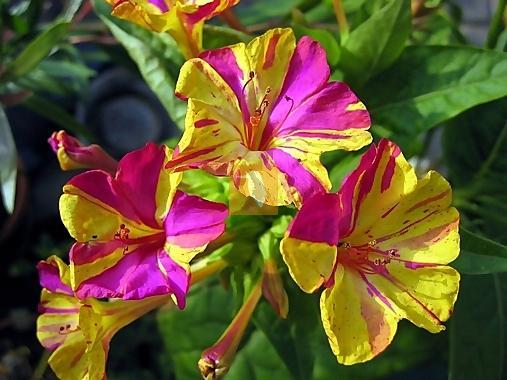
Usage: in mixed beds, groups; low varieties - in borders. The flowers of this remarkable plant emit a delightful fragrance and attract many nocturnal moths searching for nectar in the depths of their long tubular corollas.