
Indoor plants
Mascarena (Hyophorbe)
Mascarena (Hyophorbe)
Mascarena (Hyophorbe) — the native habitat of this palm is the islands in the Indian Ocean. It is small in size – its height does not exceed
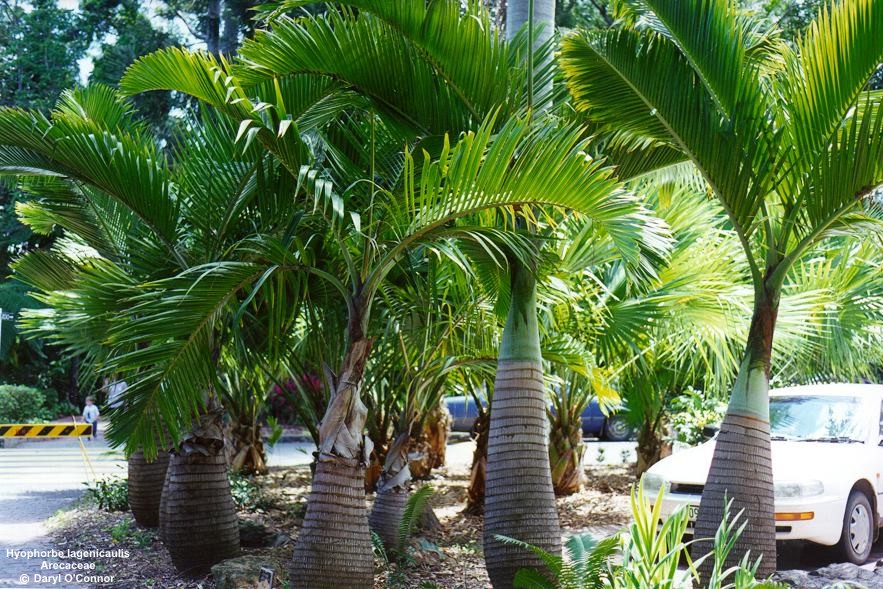
Mascarena (Hyophorbe) bottle-trunked (Mascarena (Hyophorbe) lagenicaulis).
Occurs on the hills of Mauritius. The trunk is short, 1.5—1.8 m high and 40—45 cm in diameter from the base to half its length, bottle-shapedly constricting (in the narrow part to 15—17 cm in diameter) and slightly expanded at the leaf crown. Leaves pinnate, 1.5—2 m long, curved to the side; leaflets numbering 30—40 (50) pairs, 40—45 cm long and 3.5—5 cm wide; the midrib and two lateral ribs are prominent underneath. Petiole 30—40 cm long, initially reddish. Inflorescence located below the leaf crown, in the narrow part of the trunk, 50—60 cm long. Slow-growing palm.
Mascarena (Hyophorbe) Verschaffeltii (Mascarena (Hyophorbe) verschaffeltii).
Occurs on the slopes of the hills on the island of Rodrigues. Trunk 6-8 (up to 9) m high, spindle-shapedly expanded in the middle, ringed, 20-
Light: bright, diffused; tolerates some shading. Optimal placement is on east or west windows; on south windows provide diffused light using gauze or tulle curtains.
Temperature: in the spring-summer period 20-
Watering: during the active growing period water abundantly as the top layer of the substrate dries, using soft, settled water. Do not allow the substrate to dry out.
Watering is reduced in winter; water with warm (30 °С) water. Watering is done two to three days after the top layer of the substrate has dried. In winter do not allow either drying out or overmoistening of the root ball. After watering drain the water from the tray: in summer - two hours after watering, in winter - after half an hour.
Air humidity: not less than 50%. In summer spray daily; every two weeks wash the leaves or wipe with a damp sponge. In winter spray less often, but if the air temperature is above +25 °C, spray daily.
Fertilization: from spring to autumn weekly with a mineral or organic fertilizer.
Repotting: young plants are repotted annually. Mature potted plants are repotted once every 3-4 years, as they fill the pot with roots; specimen (container) plants — approximately once every 5 years. It is best to plant Mascarena in a roomy tall pot and avoid disturbing the plant with frequent repotting. Also do not plant the specimen deeper in the soil.
All repotting work should be completed at the beginning of summer, and plants should be shaded for a short period afterwards. The top layer of soil can be renewed annually; do this carefully so as not to damage the roots.
The potting soil should be slightly acidic and fertile with a large amount of sand. Composition: turf soil — 1 part, humus soil — 1 part and sand — 2 parts. Ensure good drainage at the bottom of the pot.
Propagation: by seeds.
Possible problems: regular overwatering causes root rot. Yellowing of leaves may indicate excess calcium in the soil. Too dry air causes the leaves to dry out.