
Fruit trees
Ornamental apple 'Golden Hornet'
Malus Golden Hornet
Synonyms: Malus × zumi 'Golden Hornet', Malus x zumi var. calocarpa 'Golden Hornet'
Ornamental apple Golden Hornet – a cultivar of ornamental apple from the rose family (Rosaceae). It was raised at the Waterer Son & Crisp nursery in England in 1949. One of the parents is Malus prunifolia Rinki. In 1993 it was awarded the Royal Horticultural Society's prestigious AGM (Award of Garden Merit).
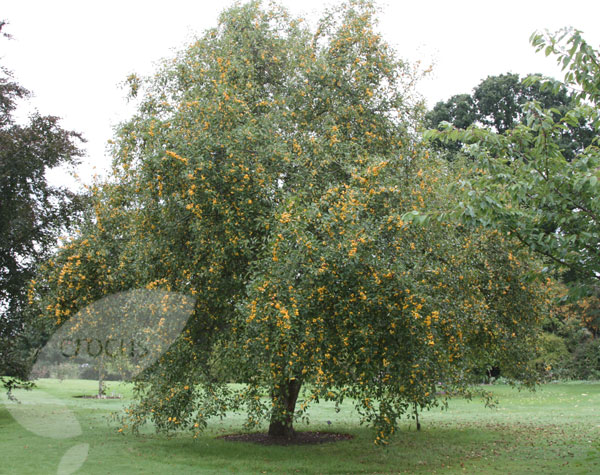
It is a large multi-stemmed shrub or small tree 4-6 m high and 3-5 m wide. The crown is dense, rounded. Main shoots grow upright, lateral branches hang down. Bark shiny, grayish-brown, fissured.
The root system is deep, sensitive to road surfacing and digging, and produces suckers when damaged.
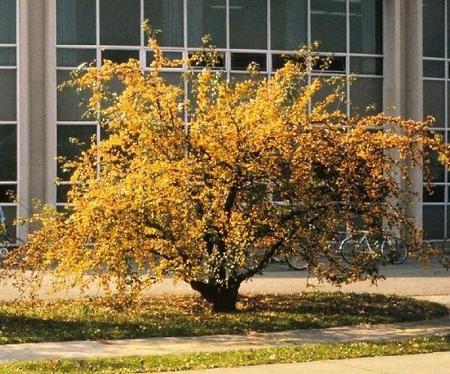
Leaves alternate, elliptic or ovate in shape, toothed, less often lobed, up to 9 cm long, green, turning golden-yellow in autumn.
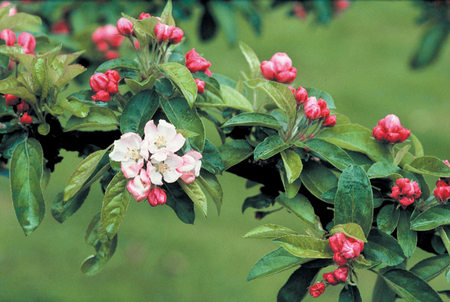
Flower buds pinkish. Blooms profusely in May. Flowers white with a pink edge, simple, 3-5 cm in diameter, arranged in corymb-like or umbel-like inflorescences, fragrant. A good nectar source.
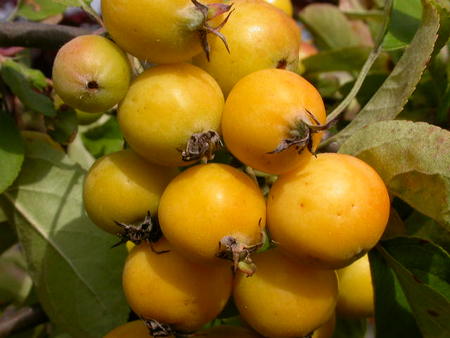
Fruits numerous, small spherical apples, up to 2.5-3 cm in diameter, golden-yellow, with a waxy surface and creamy-white flesh. Edible. They persist on the tree until frosts.
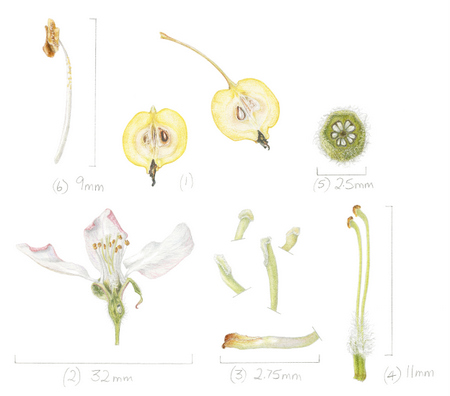
Illustration Gaynor Dickeson
Hardiness zone: 4a-8b. In severe winters one-year-old shoots may suffer frost damage.
Exposure: sun-loving. Grows well on rich sandy-loam and fresh loam soils (pH 5.0-7.5). Planting should be carried out in sheltered and warm locations. Sensitive to salinity, does not like heavy soils. Drought-tolerant, copes well with urban conditions.
Planting: planting can be done in spring until the end of April and in autumn – late September to early October. Best establishment occurs with spring planting. Planting hole size: 60x60x60 cm.
Care: responds well to feeding and watering.
Pruning: Pruning is done in late winter or early spring, removing damaged, diseased or crown-thickening branches.
Diseases and pests: resistant to scab
Propagation: propagated by root suckers and grafting.
Uses: used in avenue and group plantings in gardens, parks and squares, as specimens, on the edges of tall tree groups. Looks good in flowering, espalier and free-growing hedges. Can also be used in the creation of seasonal groups and woody-shrub groupings. Ornamental in spring when flowering, in autumn and winter. Fruits can be used for making jam or cider.