
Fruit trees
Apple 'White Sinap'
Malus domestica
Synonyms: Sultansky Kandil, Tauvshan-bash (from Turkic 'hare's head'), Istanbul Sinap.
The 'White Sinap' apple – a popular late-autumn-ripening cultivar of unknown breeding. Originates from Crimea.
It is a small tree with a compact crown. Branches are covered with yellow bark with a slight gray tint and grow from the trunk at an acute or nearly right angle.
Blooms about a week later than European cultivars. Flowering is abundant, but under poor conditions flowering may extend over 3 weeks.
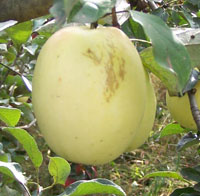
Fruits on spurs, occasionally on fruiting shoots. The peduncle is thin, long, emerging from a deep, sharply conical cavity covered with slight russeting. The calyx basin is wide and deep, with a closed persistent calyx. Fruits are medium-sized, weighing 130-150 (up to 250) g, cylindrical in shape, regular, and covered with a dense waxy bloom. Skin thin, waxy-white to greenish, with a diffuse broad blush on the sun-exposed side. Flesh loose, fine-grained, tender, sweet, juicy, of excellent sweet-and-sour flavor with a delicate aroma. Ripens in late September to early October. An intensive-type cultivar, very high-yielding; on dwarf rootstock it can produce up to 60 kg of fruit per tree. Shows little tendency to alternate bearing.
Hardiness zone: 4-6. Tolerates spring cold returns well.
Location: prefers sunny sites but can grow in shade. Prefers light, fertile, moist soil. Does not tolerate shallow groundwater. Drought-tolerant; can withstand prolonged dry spells in hot summers.
Planting and care: the same as for the domestic apple.
Training/pruning: spindle, gruzbek, spindle-bush. On dwarf rootstocks it may take a weeping form.
Propagation: propagated by grafting. On vigorous rootstock it gives stable annual yields; on weak-growing rootstock it behaves like a classic intensive cultivar (produces first yields already in the nursery).
Diseases and pests: resistance to powdery mildew is high, degree of infection 2 points, to scab – 1 point. May be moderately affected by codling moth.
Uses: apples are eaten fresh and are ideal for storage in straw. Store until April-May; in a refrigerator they can keep for up to 2 years. Jams, preserves, marmalade, fruit pastes and juices made from White Sinap are of exquisite flavor.