
Deciduous shrubs
Magnolia Susan
Magnolia Susan
Magnolia Susan (Magnolia Susan) – a hybrid of flowering plants from the genus Magnolia (Magnolia) of the family Magnoliaceae (Magnoliaceae). The hybrid was obtained from Magnolia liliiflora 'Nigra' × Magnolia stellata 'Rosea' in 1955-1956 at the U.S. National Arboretum in Washington by botanist William F. Kosar and Dr Francis de Vos. The cultivar was introduced to commerce in 1968. It belongs to the ‘The Little Girl series’ group: ‘Ann’, ‘Betty’, ‘Jane’, ‘Judy’, ‘Pinkie’, ‘Randy’, ‘Ricki’. Plants from this series flower 2-4 weeks later than Magnolia stellata (M. Stellata) and Magnolia x soulangeana (M. x soulangiana), which reduces the risk of flower damage from late spring frosts. The hybrid was awarded the Royal Horticultural Society's Award of Garden Merit (AGM) in 1993.
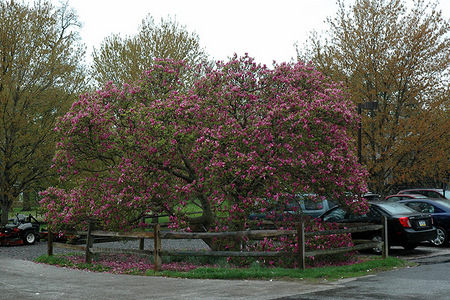
It is a deciduous, upright-growing shrub or small tree 2.5-4 (6) m in height and width. Slow-growing. The crown is pyramidal when young, later becoming rounded and dense. Roots are fleshy and sensitive, located both deep and near the surface. Bark gray, smooth. Lives up to 50 years.
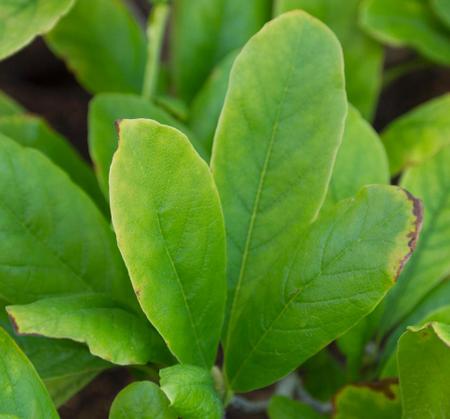
Leaves are obovate or elliptic, 6-10 (15) cm long and 3-5 cm wide, dark green. In autumn the leaves turn a yellowish-bronze color.
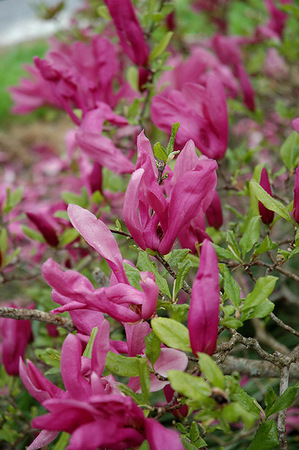
Flowers are cup-shaped, fragrant, and oriented upright. There are 6 petals, reaching 9.5-12 cm long and 3.5-4.5 cm wide; some petals are turned inward. At the base the outside is purple, the tips lighter, purple-red to gray-purple. Flowers while the leaves are unfolding, for a long period, from late April until June.
Fruit are cone-like aggregate follicles. Fruiting occurs in September.
Hardiness zone: 6a (-25°C).
Location: the optimal planting site is a sunny spot sheltered from north and east winds. Relatively shade-tolerant. Moisture-loving, tolerates waterlogging easily. Requires high air humidity. Needs watering during dry periods. Mulching the root circle with peat, peat-compost or wood chips 8-12 cm thick is recommended.
Soil: prefers acidic or neutral soil.
Planting: soil mixture – leaf mold, peat, sand in the ratio 3:2:2. Place drainage of crushed stone or coarse sand 15-20 cm thick at the bottom of the hole. Transplanting should be done with care, as thick and fleshy roots can be easily damaged. It is recommended to purchase plants with a closed root system and plant them outdoors in spring.
Pruning: sanitary pruning is recommended.
Care: young plants require winter protection with conifer boughs or non-woven fabric; trunks are wrapped with burlap.
Propagation: propagated by seed, grafting and cuttings. Seeds should be sown immediately after collection or stratified in a cool place in sand. Before sowing, seeds are recommended to be rubbed with sand to remove the fleshy coating and rinsed in water. Sowing is carried out in March-April in pricking-out boxes placed in a room at +15+18°C. After the appearance of 3 leaves, seedlings are pricked out to beds. When propagated by seed it flowers for the first time at about 15 years.
Pests: Two-spotted spider mite (Tetranychus urticae), broad mite (Hemitarsonemus latus), field slug (Deroceras agrestis and Limax maximus), grove snail (Cepaea nemoralis), Roman snail (Helix pomatia), striped greenhouse aphid (Aulacorthum circumflexum or Neomyzus circumflexum), peach aphid (Myzus persicae), rose thrips (Thrips fuscipennis, Haliday), cabbage moth (Mamestra oleracea), ivy scale (Aspidiotus hederae), grape mealybug (Pseudococcus maritimus), eastern May beetle (Melolontha hippocastani), western May beetle (M. melolontha).
Diseases: bacterial leaf spot (Pseudomonas syringae), damping-off of seedlings (Pythium ultimum, Fusarium spp., Rhizoctonia solani), powdery mildew (Erysiphe magnifica), dieback of shoots (Botrytis cinerea, Botryospheria sp.), scab (Elsinoe magnoliae), gray mold (Botrytis cinerea), sooty mold (Cladosporium sp.).
Uses: Used as a specimen planting on lawns, and in groups to create avenues, in urban landscaping. Can also be used to create tall informal hedges.