
Flowering shrubs
Star magnolia
Magnolia stellata
Synonyms: Buergeria stellata Siebold & Zucc., Talauma stellata (Siebold & Zucc.) Miq., Magnolia kobus f. stellata (Siebold & Zucc.) Blackburn, Magnolia kobus var. stellata (Siebold & Zucc.) Blackburn, Yulania stellata (Maxim.) N.H.Xia
Star magnolia (Magnolia stellata (Sieb. & Zucc.) Maxim.) – a species of flowering plants in the genus Magnolia (Magnolia) of the family Magnoliaceae. «stellata» from Latin means «starry». The species was first described in Systema Naturae, Editio Decima 2 in 1082 by F. F. von Siebold, J.G. Zuccarini and C. I. Maximovich. Until 1998 it was considered a variety or even a form of Magnolia kobus, but in that year in Hunt's monograph it was recognized as a separate species.
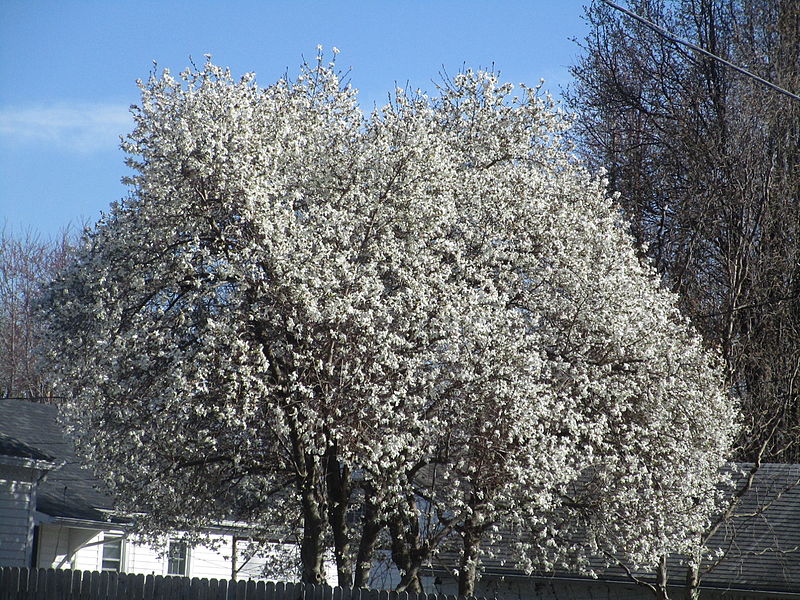
It was first introduced into cultivation in 1862 by Dr. George Robert Hall in North America. In 1877 or 1878 the species was first brought to the United Kingdom to the Veitch nursery.
In the wild it grows in forests, on moist or swampy sites in the Ise Bay area (Honshu) or Zhejiang province (Jingning) in Japan. It ascends into the mountains up to 1000 m above sea level. It grows together with Enkianthus cernuus, Corylopsis glabrescens var. Gotoana and Berberis sieboldii.
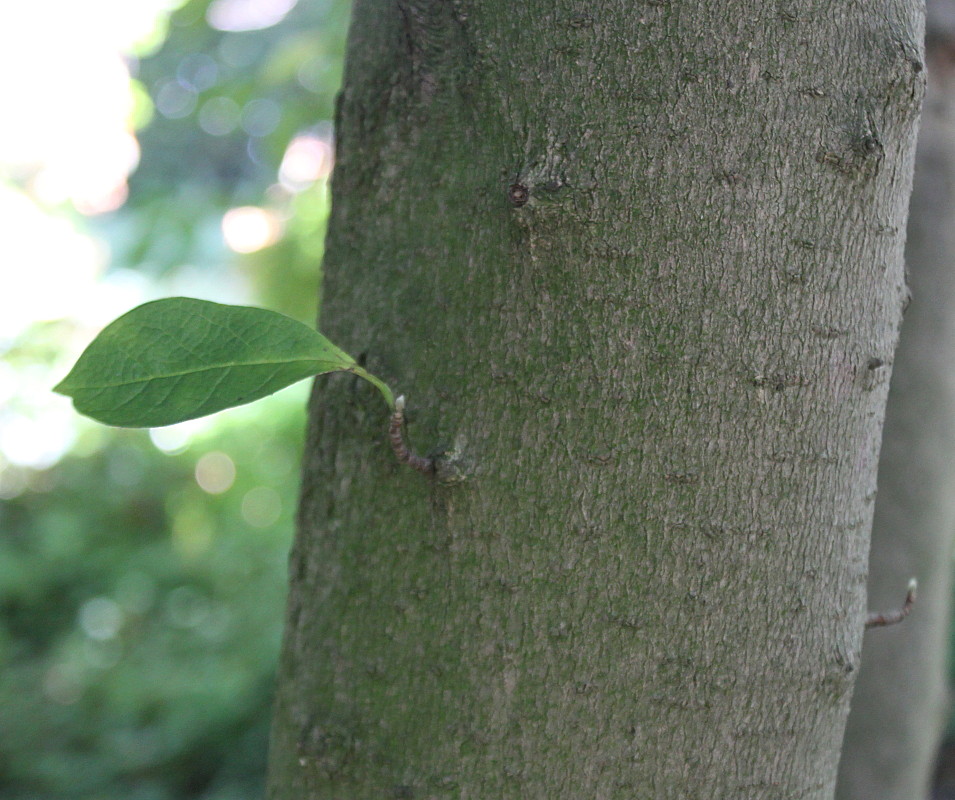
It is a deciduous shrub or small tree up to 2.5 (4) m tall, often growing as a bush. It grows slowly. Crown compact, broadly rounded or spherical. Shoots at first densely silky-pubescent, thin, greyish-green, later becoming glabrous. Branches brownish-grey. Bark shiny, smooth, greyish-brown.
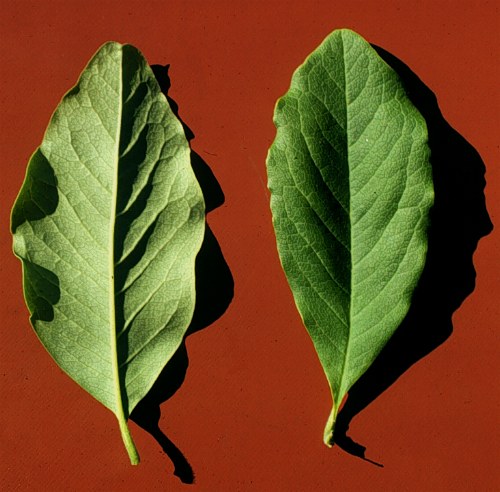
Buds up to 1 cm long and 0.3 cm in diameter, densely pubescent. Leaves narrowly elliptic, more rarely narrowly ovate, 10-12 cm long and 3.4-4 cm wide, gradually tapered to the apex, more rarely obtuse or with a slightly emarginate tip, base cuneate. Upper surface of the blade dark green, glabrous, underside lighter, along the midrib rarely appressed-pubescent. Petioles 3-10 mm long.
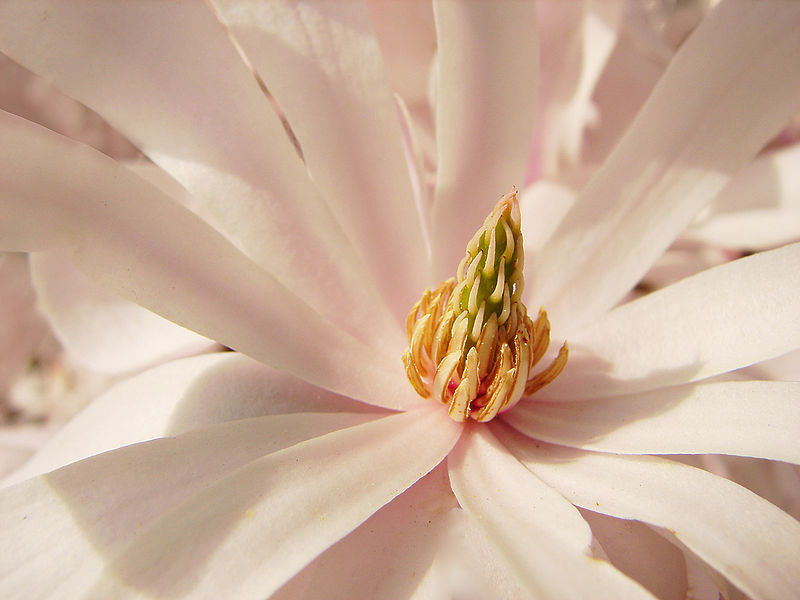
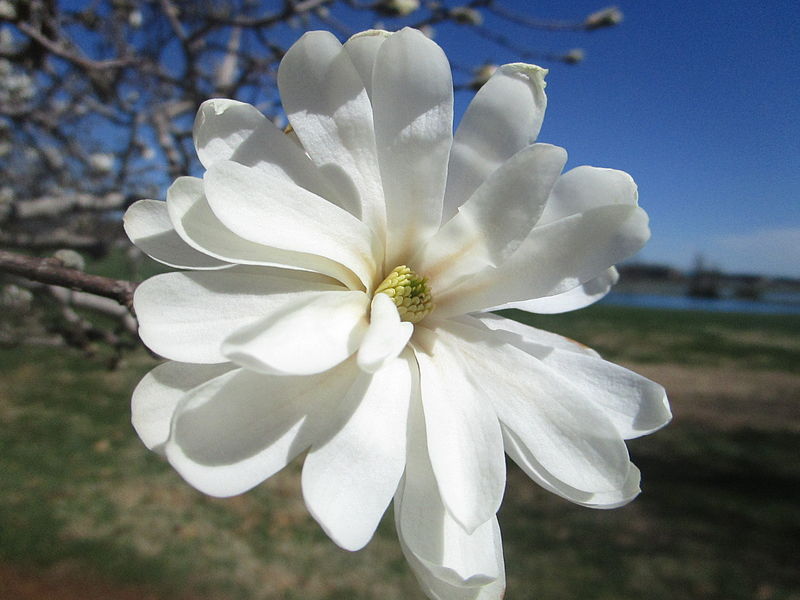
Flower buds 1.5-2 cm. Pedicel 3-5 mm, densely yellow, silky. Flowers snow-white, sometimes cream, becoming pale pink as they fade, 8-10 cm in diameter, widely open, star-shaped, facing upward or nodding. Perianth segments uniform, 12-18 (33) in number, strap-shaped, up to 6 cm long and 1.5 cm wide, pointed, at first spreading, then slightly drooping as they fade. Stamens 86-99, 7-10 mm long; filaments 1-2 (-3) mm; anthers 6-7 mm. Gynoecium cylindrical, 6-8 × 2-4 mm; carpels numerous, slightly ovate, up to 2 mm long, glabrous; stigmas 1.5 mm long. Aroma delicate, pleasant, reminiscent of apples with honey. Blooms before leaf emergence, in March, annually and abundantly.
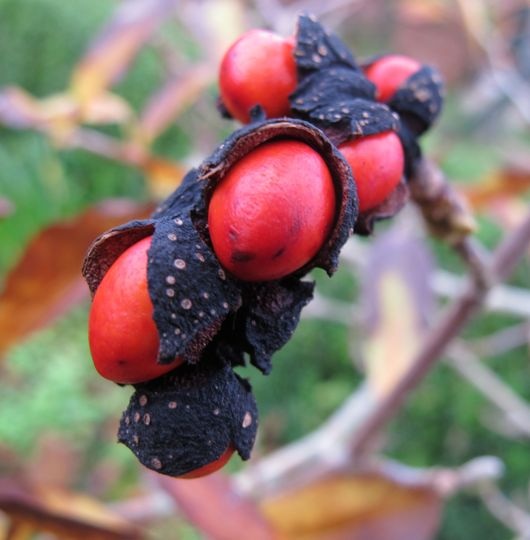
Fruits are aggregate cone-like follicles 5-6 cm long, often twisted, pink-red in color. Fruits in September.
Hybrids:
- Magnolia × loebneri = Magnolia kobus × Magnolia stellata.
- Magnolia × proctoriana = Magnolia salicifolia × Magnolia stellata.
- Magnolia liliiflora × Magnolia stellata
Forms: pink (f. rosea), keiskei form (f. keiskeis)
Cultivars: 'Royal Star', 'Merrill', 'Ballerina'
Hardiness zone: 4a (-34°C). Young shoots may be damaged by frost. It is recommended to cover with canvas at night.
Location: the optimal planting site is a sunny place sheltered from north and east winds. Shading is acceptable only in the southern regions. Moisture-loving, tolerates waterlogging easily. Some forms are drought-tolerant. During dry periods it needs watering. Mulching the root circle with peat, peat-compost or wood chips 8-12 cm thick is recommended.
Soil: prefers acidic or neutral soil.
Planting: soil mixture – leaf mold, peat, sand in the ratio 3:2:2. Drainage of crushed stone or coarse sand 15-20 cm thick should be placed at the bottom of the hole. Transplanting should be carried out with caution, as thick and fleshy roots can be easily damaged. It is recommended to buy plants with a closed root system and plant them in the open ground in spring.
Pruning: sanitary pruning is recommended.
Care: young plants require winter protection with conifer branches or non-woven material; trunks are wrapped with burlap.
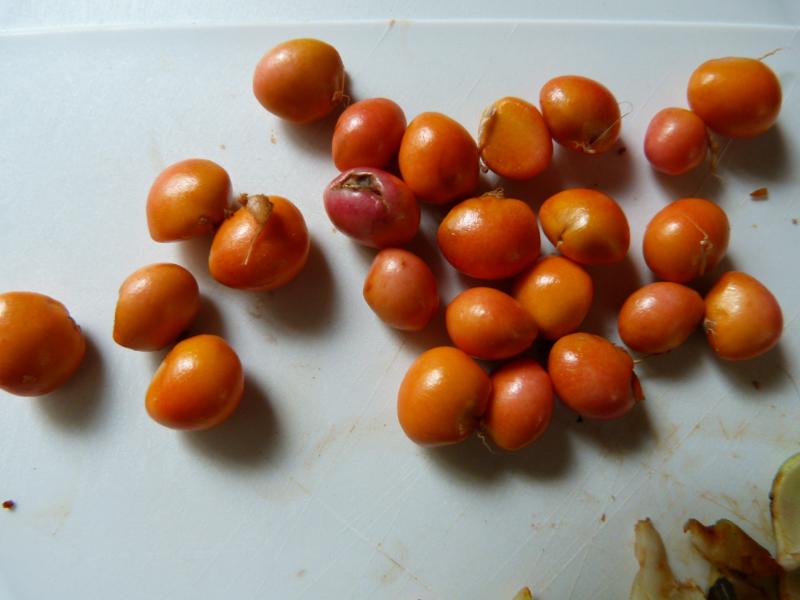
Propagation: propagated by seeds, grafting and cuttings. Seeds after collection should be sown immediately in the ground or stratified in a cool place in sand. Before sowing, seeds are recommended to be rubbed with sand to remove the fleshy coat and rinsed in water. Sowing is done in March-April in seedling boxes placed in a room with a temperature of +15+18°C. After the appearance of the 3rd leaf, seedlings are pricked out to beds.
Pests: Common spider mite (Tetranychus urticae), Broad mite (Hemitarsonemus latus), field slug (Deroceras agrestis and Limax maximus), grove snail (Cepaea nemoralis), Roman snail (Helix pomatia), greenhouse aphid (Aulacorthum circumflexum or Neomyzus circumflexum), peach aphid (Myzus persicae), rose thrips (Thrips fuscipennis, Haliday), cabbage moth (Mamestra oleracea), ivy scale (Aspidiotus hederae), grapevine mealybug (Pseudococcus maritimus), eastern May beetle (Melolontha hippocastani), western May beetle (M. melolontha).
Diseases: Bacterial leaf spot (Pseudomonas syringae), damping off of seedlings (Pythium ultimum, Fusarium spp., Rhizoctonia solani), powdery mildew (Erysiphe magnifica), dieback of shoots (Botrytis cinerea, Botryospheria sp.), scab (Elsinoe magnoliae), gray mold (Botrytis cinerea), sooty mold (Cladosporium sp.)
Uses: One of the most graceful early-flowering magnolias. Striking during bud formation and flowering. Looks beautiful in solitary plantings on lawns as well as in groups. Suitable for creating alleys.