
Deciduous trees
Obovate magnolia
Magnolia obovata Thunb.
Synonyms: Houpoea obovata (Thunb.) N.H. Xia & C.Y. Wu, Liriodendron liliiflorum Steud., Magnolia hypoleuca Siebold & Zucc. variety concolor Siebold & Zucc., Magnolia honogi P.Parm., Magnolia hypoleuca Siebold & Zucc., Yulania japonica Spach variety obovata (Thunb.) P.Parm., Yulania japonica var. obovata (Thunb.) P.Parm., Houpoea obovata (Thunb.) N.H.Xia & C.Y.Wu., white-backed magnolia, white-bellied magnolia, white-flowered magnolia.
Magnolia obovata (Magnolia obovata Thunb.) – a species of flowering plants in the genus Magnolia (Magnolia) of the family Magnoliaceae (Magnoliaceae). The species was first described in 1794 by the Swedish naturalist Carl Peter Thunberg in the journal «Transactions of the Linnean Society of London». The species was introduced into cultivation in 1865.
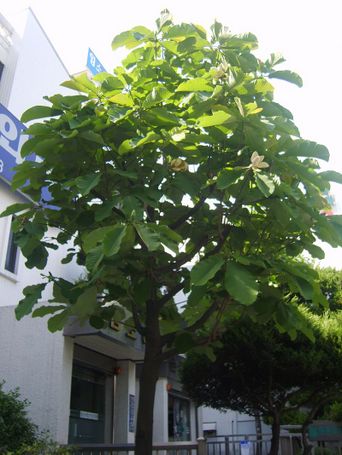
In the wild it mainly occurs in Japan (Hokkaido, Honshu, Shikoku, Kyushu), where it rises to an altitude of 600–1800 m above sea level. It is also found on Hokkaido Island. The northernmost point of its range is Kunashir Island (Kuril Islands). It does not form pure stands. It grows in montane broad-leaved and mixed coniferous-broad-leaved forests, solitary or in small groups. It co-occurs with Fraxinus longicuspis and other maple species, with Fagus japonica (Japanese beech), Quercus crispula (Japanese oak), Carpinus cordata (heartleaf hornbeam) and Betula species (birches).
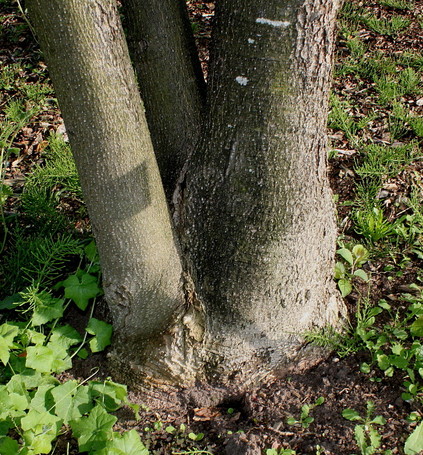
It is a deciduous tree up to 30 m tall with a trunk diameter of 60–70 cm. In Kyiv, at 17 years of age, it reaches 5.5 m in height. It grows quickly. Crown broad-pyramidal, loose. Bark light gray, smooth, covered with large lenticels. Shoots are initially silky-pubescent, later becoming glabrous; by autumn they acquire a brownish-chestnut color with a glaucous waxy bloom.
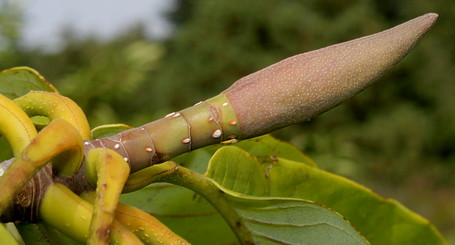
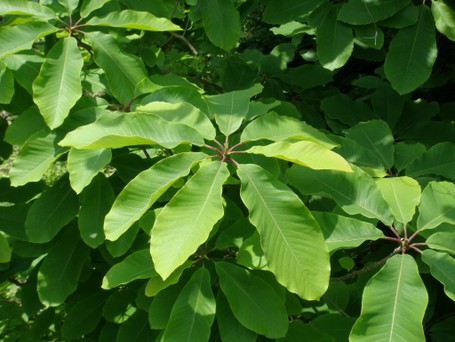
Buds 3–9 cm long and 0.7–1 cm in diameter, pubescent, light green, with a slight yellowish tint in autumn. Leaves grow at the tips of shoots, in clusters of 8–10. Leaf blades leathery, spreading, obovate, 20–40 cm long and 15–20 cm wide. The blade has a rounded base and is abruptly narrowed to a short obtuse apex, above green and glabrous, below bluish-yellow, pubescent along the veins or glabrous. Petioles 2.5–4 cm long. In autumn the leaves acquire brownish-red tones.
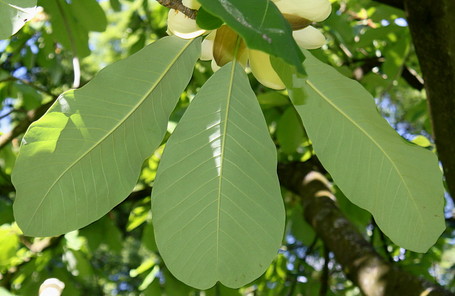
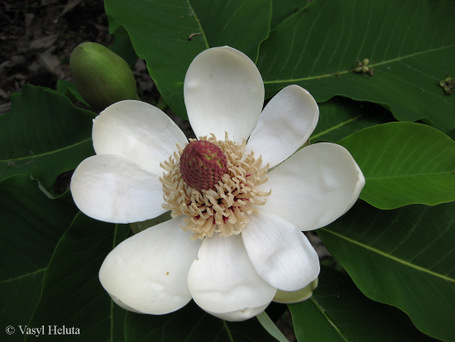
Flowers white or creamy-white, with a pale lemon tint toward the end of flowering, fragrant, widely cup-shaped, 13–18 cm in diameter. The perianth consists of 12–13 segments; outer segments with obtuse tips, pink or reddish; inner segments obovate, narrowed toward the base, up to 8 cm long and 1.8–3.8 cm wide. Stamens numerous, 1.5–2 cm long. Filaments purplish-red. Gynoecium up to 3 cm in diameter. Flowering occurs after leaf flush, sporadically, in June–July.
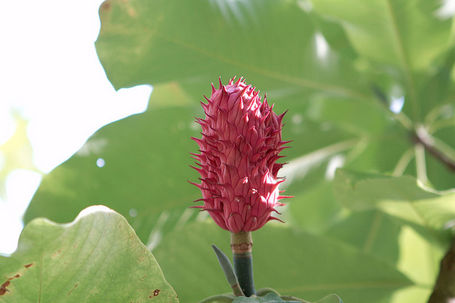
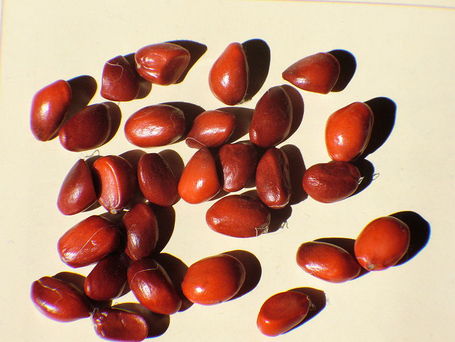
Fruits are bright-red aggregated follicles elliptical in shape, 12–18 cm long and about 6 cm in diameter, pendulous. Seeds ovoid, up to 1 cm long, with a fleshy aril. Fruits ripen in September–October.
Hybrids:
- Magnolia sieboldii × Magnolia obovata = Magnolia × wieseneri Carrière
Varieties:
- Magnolia obovata var. denudata
- Magnolia obovata var. liliiflora
- Magnolia obovata var. purpurea
- Magnolia obovata var. soulangeana
Hardiness zone: 6a (-25°C).
Exposure: the optimal planting site is a sunny place sheltered from north and east winds. Relatively shade-tolerant. Moisture-loving, tolerates temporary waterlogging. Demanding of air humidity. In dry periods requires watering. Mulching the root zone with peat, peat-compost or wood chips 8–12 cm thick is recommended.
Soil: prefers acidic or neutral soil.
Planting: soil mixture – leaf mold, peat, sand in ratio 3:2:2. Place drainage of crushed stone or coarse sand 15–20 cm thick at the bottom of the planting hole. Transplanting should be done with care, as thick and fleshy roots can be easily damaged. It is recommended to buy plants with a closed root system and plant them in the open ground in spring.
Pruning: sanitary pruning is recommended.
Care: young plants require winter protection with conifer boughs or non-woven material; trunks are wrapped with burlap.
Propagation: propagated by seeds, grafting and cuttings. Seeds after collection should be sown immediately in the ground or stratified in a cool place in sand. Before sowing it is recommended to rub the seeds with sand to remove the fleshy coating and rinse in water. Sowing is carried out in March–April in pricking-out boxes placed in a room at +15+18°C. After the appearance of the 3rd leaf, seedlings are pricked out to beds. When grown from seed, first flowering occurs at about 15 years.
Pests: two-spotted spider mite (Tetranychus urticae), broad mite (Hemitarsonemus latus), field slug (Deroceras agrestis) and leopard slug (Limax maximus), grove snail (Cepaea nemoralis), Roman snail (Helix pomatia), greenhouse striped aphid (Aulacorthum circumflexum or Neomyzus circumflexum), green peach aphid (Myzus persicae), rose thrips (Thrips fuscipennis, Haliday), cabbage moth (Mamestra oleracea), ivy scale (Aspidiotus hederae), grapevine mealybug (Pseudococcus maritimus), eastern May chafer (Melolontha hippocastani), western May chafer (M. melolontha).
Diseases: bacterial leaf spot (Pseudomonas syringae), damping-off/seedling rot (Pythium ultimum, Fusarium spp., Rhizoctonia solani), powdery mildew (Erysiphe magnifica), shoot dieback (Botrytis cinerea, Botryospheria sp.), scab (Elsinoe magnoliae), gray mold (Botrytis cinerea), sooty mold (Cladosporium sp.).
Uses: Very striking throughout the year. Ornamental due to its huge leaves, beautiful flowers and bright red fruits. Used as a solitary specimen on lawns, as well as in groups to create alleys and in urban landscaping.