
Flowering shrubs
Lily-flowered magnolia
Magnolia liliiflora
Synonyms: Lassonia quinquepeta Buc'hoz, Magnolia atropurpurea Steud., Magnolia discolor Vent., Magnolia gracilis Salisb., Magnolia liliiflora var. gracilis (Salisb.) Rehder, Magnolia purpurea Curtis, Magnolia quinquepeta (Buc'hoz) Dandy, Talauma sieboldii Miq., Yulania japonica Spach, Yulania liliiflora (Desr.) D.L.Fu, Magnolia quinquepeta auct., му-лан, Magnolia obovata var. liliiflora (Desr.) Ser., Magnolia purpurea var. liliiflora (Desr.) Loudon, Magnolia plena C.L.Peng & L.H.Yan, Magnolia polytepala Y.W.Law, R.Z.Zhou & R.J.Zhang, Magnolia purpurea Curtis, Magnolia purpurea var. discolor (Vent.) Loudon, Magnolia × soulangeana var. nigra G.Nicholson
Magnolia liliiflora (Magnolia liliiflora Desr.) – a species of flowering plants of the genus Magnolia (Magnolia) of the family Magnoliaceae (Magnoliaceae). The species was first described in 1712 by the German traveler Engelbert Kaempfer, later republished by Joseph Banks. In 1792 the species was named "Magnolia liliiflora" and scientifically described by the French botanist Louis Auguste Joseph Desrousseaux in the "Encyclopedia Botanique de Lamarck". Brought from Japan to England in 1790 by the 3rd Duke of Portland.
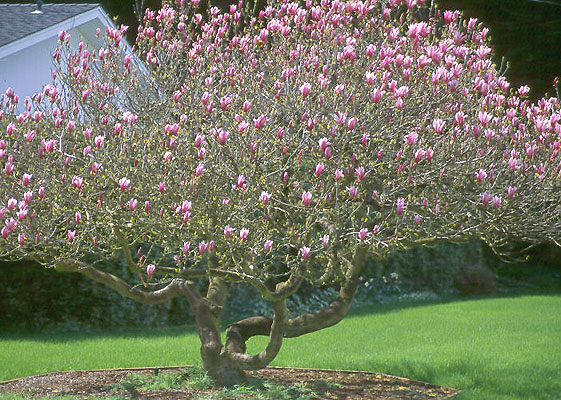
Native to China – the provinces of Chongqing, Fujian, Hubei, Shaanxi, Sichuan, Yunnan. Occurs in forest clearings and slopes. Ascends mountains from 300-1600 m above sea level. Cultivated throughout Europe and Asia, little known in the wild. In Ukraine it is found in Crimea, Lviv, Odessa.
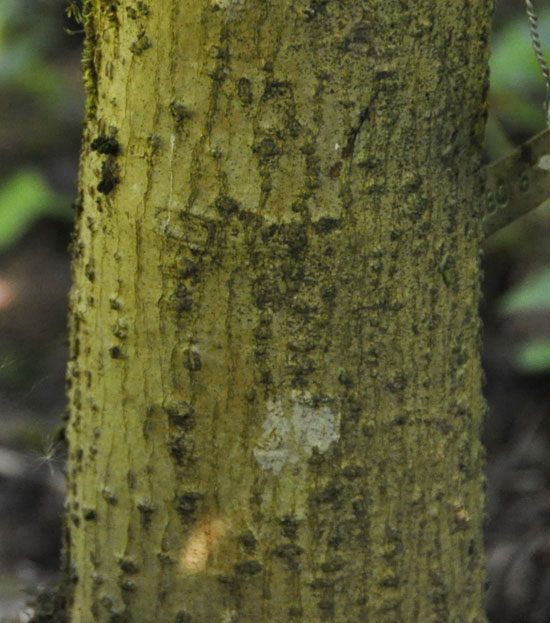
It is a deciduous shrub or small tree 2-3 (5) m high. Grows slowly. Crown globular, somewhat spreading, branched, dense. Shoots at first slightly pubescent at the tips, later glabrous, brownish-green, by winter become dark green, on the exposed side brown, with sparse lenticels. Bark gray.
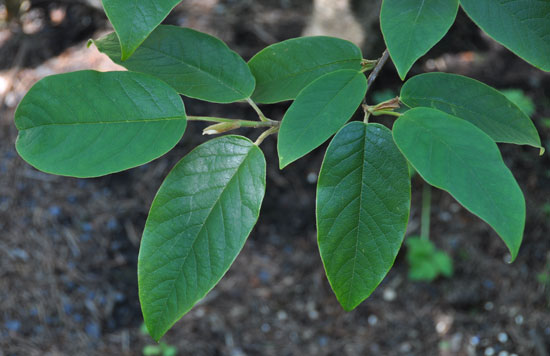
Buds greenish, long and softly pubescent. Leaves broadly elliptic or obovate, 15-20 cm long and 8-10 cm wide, apex shortly and bluntly acuminate, base cuneate. Leaf blade dark green above, slightly hairy; below pale green with prominently raised pubescent veins. Petiole 0.8-2 cm long.
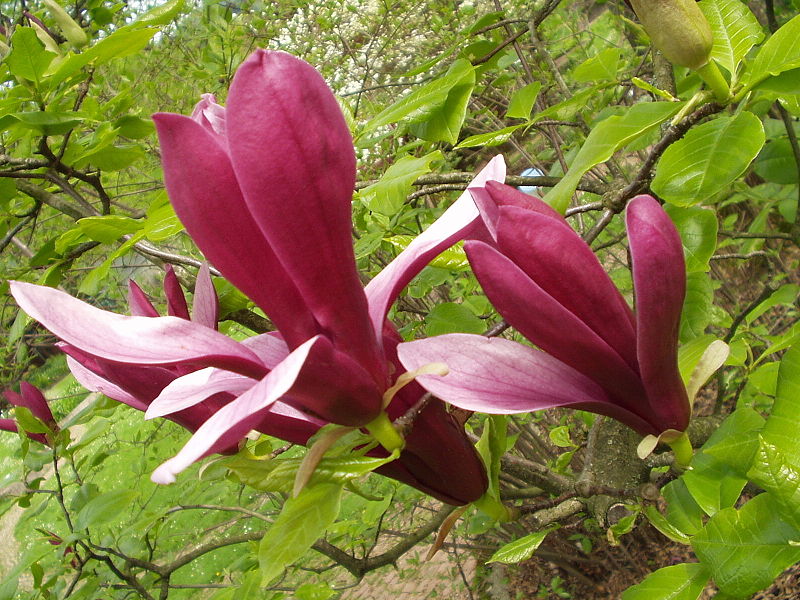
Flower buds ovoid, pale yellow, silky. Pedicels short, thick. Flowers up to 3-4 (10) cm in diameter, narrowly cup-shaped, faintly fragrant, reddish-magenta outside and white or whitish-pink inside. Perianth segments 6—9: outer ones lanceolate, 2.5-3 cm long; inner ones convex, oblong-obovate, 9.5—10.5 cm long and 2.5—3.5 cm wide. Stamens 8-10 mm long, purplish-red; anthers up to 7 mm long, dehiscing laterally. Gynoecium pale violet, 1.5 cm long, glabrous. Flowering intermittent, in March-April.
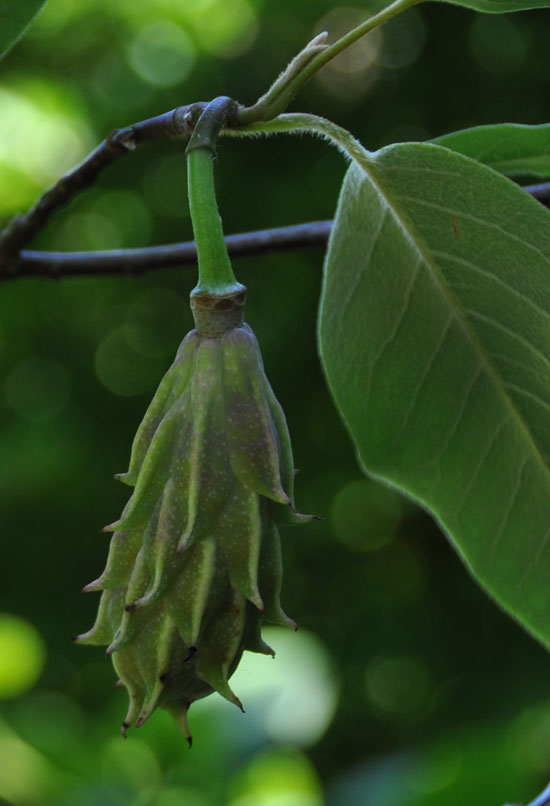
Fruits – dark purplish-brown aggregate cone-like follicles of cylindrical shape, 7-10 cm long. Fruits ripen in October-November.
Chromosome number: 2n = 76
Hybrids:
- Magnolia liliiflora × Magnolia stellata
- Magnolia acuminata L. × Magnolia liliiflora Desr. = Magnolia × brooklynensis G.Kalmbacher
- Magnolia denudata Desr. × Magnolia liliiflora Desr. = Magnolia × soulangeana Soul.-Bod.
- Magnolia campbellii × Magnolia Liliiflora
- Magnolia stellata × Magnolia Liliiflora
- Magnolia liliiflora × Magnolia Sprengeri
- Magnolia liliiflora × (Magnolia × veitchii) = „Gresham-Hybriden“
Forms: black (f. nigra), graceful (f. gracilis)
Cultivars: 'Holland Red', 'Mini Mouse', 'Betty', 'Susan'.
Hardiness zone: 5a (-23 to -20°C). Young shoots may be frost-damaged.
Location: the optimal planting site is a sunny place sheltered from north and east winds. Shading is acceptable only in the southern regions. Moisture-loving, easily tolerates waterlogging. Some species are drought-tolerant. Requires watering during dry periods. Mulching the root circle with peat, peat-compost or wood chips 8-12 cm thick is recommended.
Soil: prefers acidic or neutral soil.
Planting: soil mix – leaf mold, peat, sand in a ratio of 3:2:2. A drainage layer of crushed stone or coarse sand 15-20 cm thick should be placed at the bottom of the hole. Transplanting should be carried out with caution, as thick fleshy roots can be easily damaged. It is recommended to buy plants with a closed root system and plant out in spring.
Pruning: sanitary pruning is recommended.
Care: young plants require winter protection with fir boughs or non-woven fabric; trunks are wrapped with burlap.
Propagation: propagated by seeds, grafting and cuttings. Seeds after collection should be sown immediately outdoors or stratified in a cool place in sand. Before sowing, seeds are recommended to be rubbed with sand to remove the fleshy coat and rinsed in water. Sowing is carried out in March-April into pricking-out boxes, which are kept in a room at +15–+18° C. After the appearance of the 3rd leaf seedlings are pricked out to beds.
Pests: Two-spotted spider mite (Tetranychus urticae), Broad mite (Hemitarsonemus latus), field slug (Deroceras agrestis и Limax maximus), grove snail (Cepaea nemoralis), Roman snail (Helix pomatia), striped greenhouse aphid (Aulacorthum circumflexum или Neomyzus circumflexum), green peach aphid (Myzus persicae), rose thrips (Thrips fuscipennis, Haliday), cabbage moth (Mamestra oleracea), ivy scale (Aspidiotus hederae), mealybug (Pseudococcus maritimus), eastern May bug (Melolontha hippocastani), western May bug (M. melolontha).
Diseases: Bacterial leaf spot (Pseudomonas syringae), Seedling rot (Pythium ultimum, Fusarium spp., Rhizoctonia solani), Powdery mildew (Erysiphe magnifica), Shoot dieback (Botrytis cinerea, Botryospheria sp.), Scab (Elsinoe magnoliae), Grey mould (Botrytis cinerea), Sooty mould (Cladosporium sp.)
Uses: Very decorative during bud formation and flowering. Used as solitary plantings on lawns, as well as in groups to create avenues, in urban landscaping. Often used as a rootstock.