
Deciduous trees
Magnolia × brooklynensis 'Yellow Bird'
Magnolia × brooklynensis Yellow Bird
Synonyms: Yellow Lily Tree
Magnolia × brooklynensis «Yellow Bird» (Magnolia × brooklynensis Yellow Bird) – the best yellow cultivar of Magnolia × brooklynensis from the genus Magnolia (Magnolia) of the family Magnoliaceae. The hybrid was obtained at the Brooklyn Botanic Garden in 1967 by Doris Stone from Magnolia acuminata L. × Magnolia brooklynensis “Evamaria”.
It is an evergreen tree 5 (12-15) m in height and up to 3 m in width. The crown is dense, broadly pyramidal. Bark gray, branches grow vertically upward. Growth rate moderate.
Leaves obovate, entire, large, 12-20 cm long, leathery, glossy, glabrous and dark green above, below with glandular pubescence. As young leaves grow, the old ones fall.
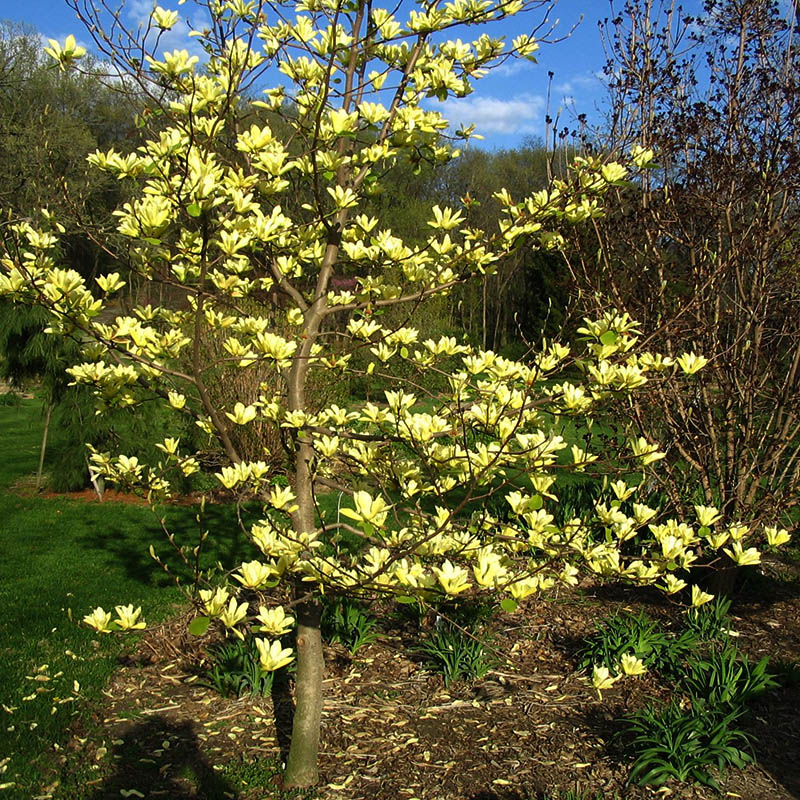
Flowers large, cup-shaped, located at the ends of shoots and directed vertically upward, with a slight fragrance, of a beautiful yellow color. Blooms for an extended period, from April to June.
Fruits – reddish-brown multi-follicles.
Hardiness zone: 7a (-15°C).
Location: the optimal planting site is a sunny place sheltered from northern and eastern winds. Relatively shade-tolerant. Moisture-loving, tolerates waterlogging easily. Requires high air humidity. Needs watering during dry periods. Mulching the root circle with peat, peat-compost or wood chips 8-12 cm thick is recommended.
Soil: prefers acidic or neutral soil.
Planting: soil mix – leaf mold, peat, sand in the ratio 3:2:2. At the bottom of the hole it is necessary to place drainage of crushed stone or coarse sand 15-20 cm thick. Transplanting should be carried out with caution, as the thick and fleshy roots can be easily damaged. It is recommended to buy plants with a closed root system and plant them in an open site in spring.
Pruning: sanitary pruning is recommended.
Care: young plants require winter protection with spruce boughs or non-woven fabric; trunks are wrapped with burlap.
Propagation: propagated by seed, grafting and cuttings. Seeds after collection should be sown immediately in the ground or stratified in a cool place in sand. Before sowing, seeds are recommended to be rubbed with sand to remove the fleshy coating and rinsed in water. Sowing is carried out in March-April in pricking-out boxes, which are placed in a room with a temperature of +15+18°C. After the appearance of 3 leaves, the seedlings are pricked out to beds. With seed propagation, the first flowering occurs at 15 years.
Pests: Common two-spotted spider mite (Tetranychus urticae), Broad mite (Hemitarsonemus latus), field slug (Deroceras agrestis and Limax maximus), grove snail (Cepaea nemoralis), Roman snail (Helix pomatia), greenhouse aphid (Aulacorthum circumflexum or Neomyzus circumflexum), peach aphid (Myzus persicae), rose thrips (Thrips fuscipennis, Haliday), cabbage moth (Mamestra oleracea), ivy scale (Aspidiotus hederae), mealybug (Pseudococcus maritimus), eastern May chafer (Melolontha hippocastani), western May chafer (M. melolontha).
Diseases: Bacterial leaf spot (Pseudomonas syringae), damping-off of seedlings (Pythium ultimum, Fusarium spp., Rhizoctonia solani), powdery mildew (Erysiphe magnifica), shoot dieback (Botrytis cinerea, Botryospheria sp.), scab (Elsinoe magnoliae), gray mold (Botrytis cinerea), sooty mold (Cladosporium sp.).
Uses: Used as solitary plantings on lawns, and also in groups to create alleys, in urban landscaping. Can also be used to create tall informal hedges.