
Deciduous trees
Osage orange
Maclura pomifera
Synonyms: Ioxylon pomiferum Raf., Joxylon pomiferum Raf., Maclura aurantiaca Nutt., Toxylon aurantiacum (Nutt.) Raf., Toxylon maclura Raf., Toxylon pomiferum Raf., inedible orange, false orange, Indian orange, dyer\'s mulberry, Osage orange, hedge apple, horse apple, monkey ball, bois d\'arc, bodark or bodock, Maclura apple-bearing, Chinese orange, Adam\'s apple.
Osage orange (Maclura pomifera (Raf.) C.K.Schneid) – a species of fruit-bearing trees of the genus Maclura (Maclura) of the mulberry family. The species was first described in 1906 in the book by the Austrian botanist Camillo Karl Schneider «Illustriertes Handbuch der Laubholzkunde». The tree was introduced into cultivation by the Scottish explorer William Dunbar, who in 1804 traveled from the Mississippi River to the Washita River. In March 1804 he sent cuttings of this tree to U.S. President Thomas Jefferson, who sent them to the Osage tribe, which propagated this tree across its territory. It reached Europe in 1898. Named in honor of the Scottish and American geologist William Maclure.
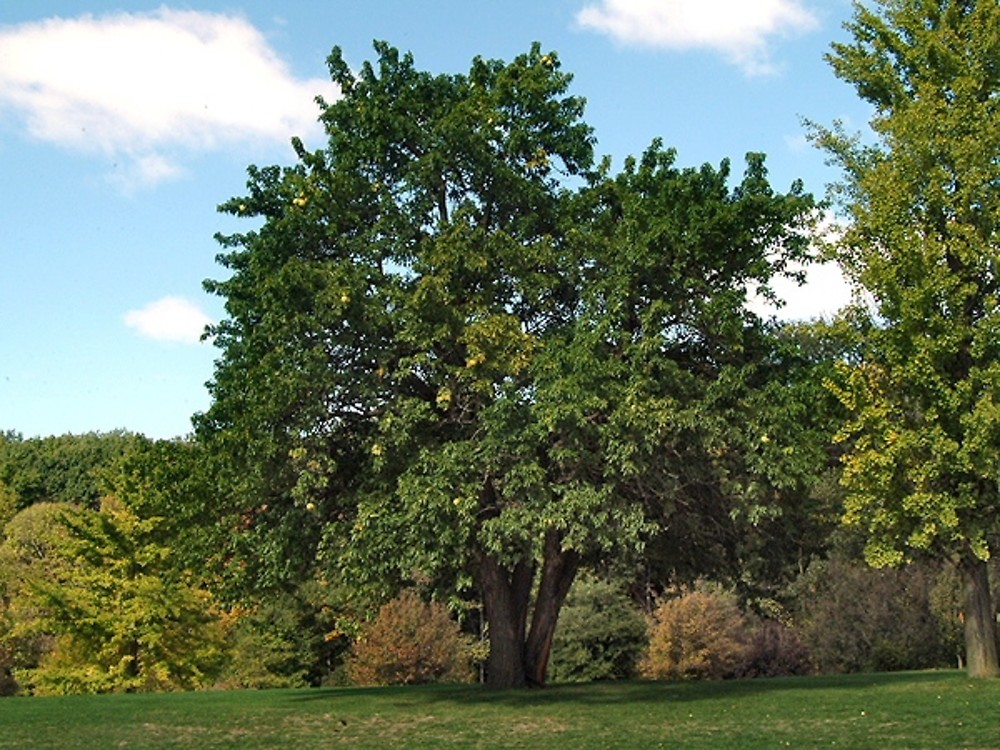
Native to the southeastern United States – Oklahoma, Arkansas, Louisiana, Texas. Cultivated in Turkmenistan, Uzbekistan, Crimea, the Caucasus, Italy, the former Yugoslavia, Romania, India.
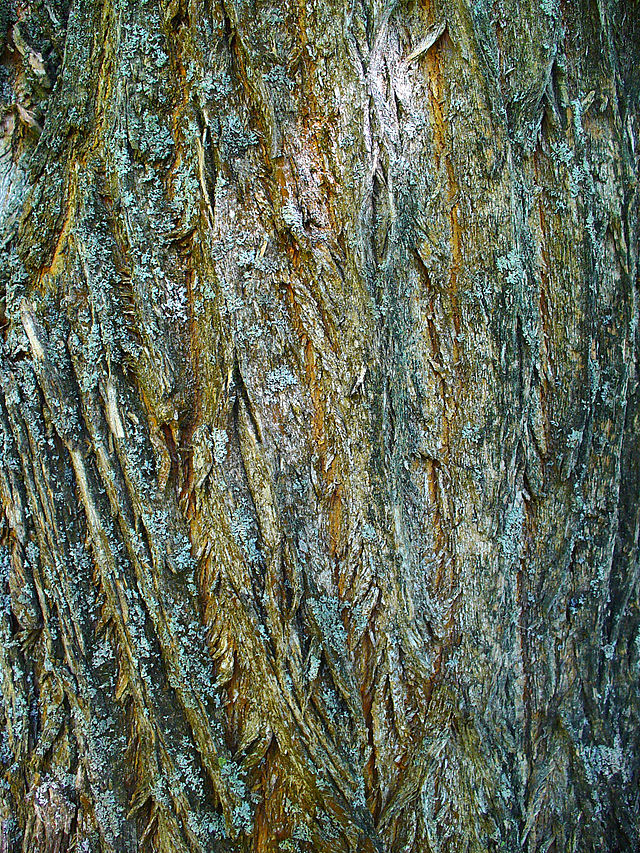
It is a dioecious deciduous tree up to 20 m tall. Grows rapidly up to 15-20 years. At 40 years in Central Asia it reaches 13-15 m in height and 40-45 cm in diameter. Crown dense, irregularly rounded, spreading, open. Trunk slender, covered with dark brown fissured bark. Branches knee-bent-curved, orange-brown in color, glossy. Shoots green, initially pubescent, later glabrous, covered with axillary thorns up to 2.5 cm long. Sap milky and acrid. Wood golden-yellow, dense, flexible, strong, very beautiful.
Roots thick, fleshy, covered with bright orange bark.
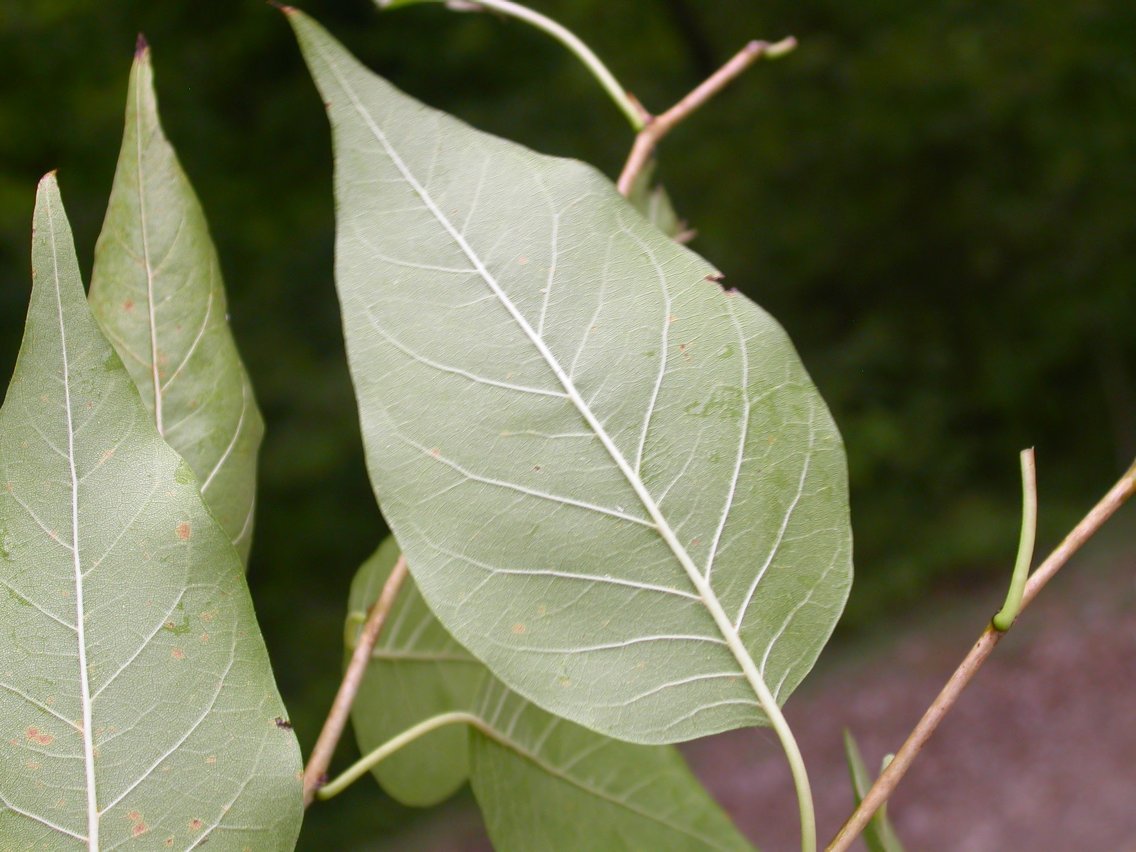
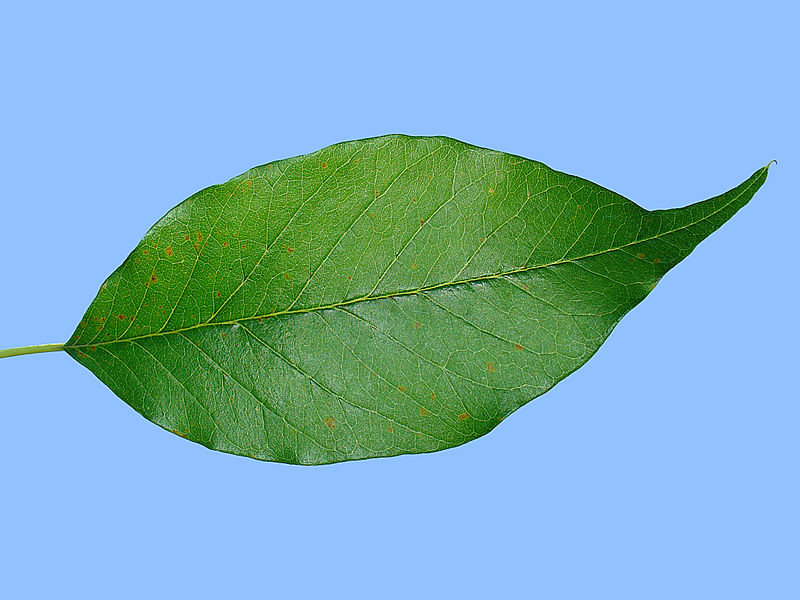
All buds lateral, flattened on the sides, globular. Bud scales pale chestnut in color. Leaves alternate, ovate to oblong-lanceolate in shape, up to 12 cm long and up to 7.5 cm wide, apex acute, base rounded, cuneate or cordate, margins entire. Leaf blade dark green, glossy, underside lighter, pubescent to woolly. Stipules acute, narrow, deciduous. Petioles slender, pubescent. In autumn the leaves turn golden-yellow.
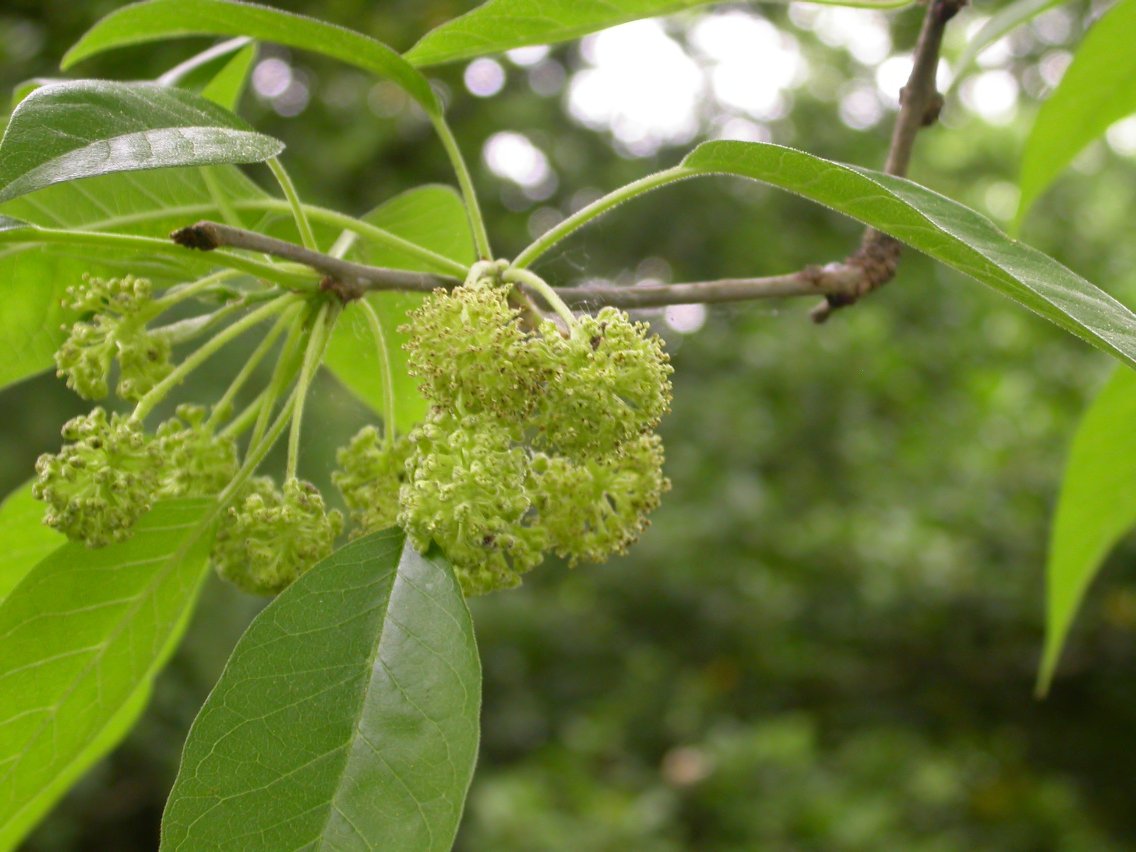 | 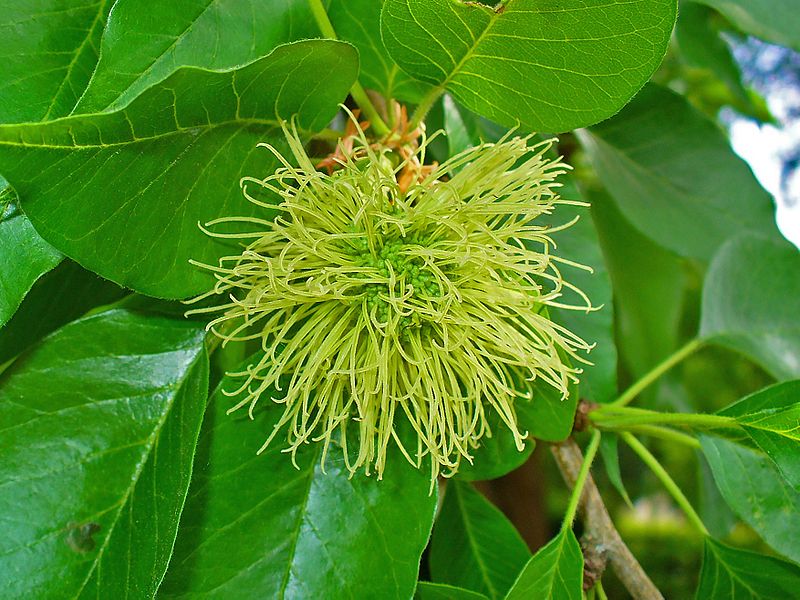 |
| Male inflorescences | Female inflorescences |
Flowers are located in axillary inflorescences, small, green, inconspicuous. Male flowers are gathered in elongated or nearly globular raceme-like clusters 2.5-4 cm long, on long slender peduncles. Calyces hairy, four-lobed. There are 4 stamens, located on the opposite lobes of the calyx, on the margins of a thin disk. Filaments flat, anthers elongate. Female flowers grow in compact, rounded, dense heads up to 2.5 cm in diameter, located on short thick shoots of the current year. Calyx hairy, 4-lobed. Ovary superior, ovoid. Blooms in May-June.
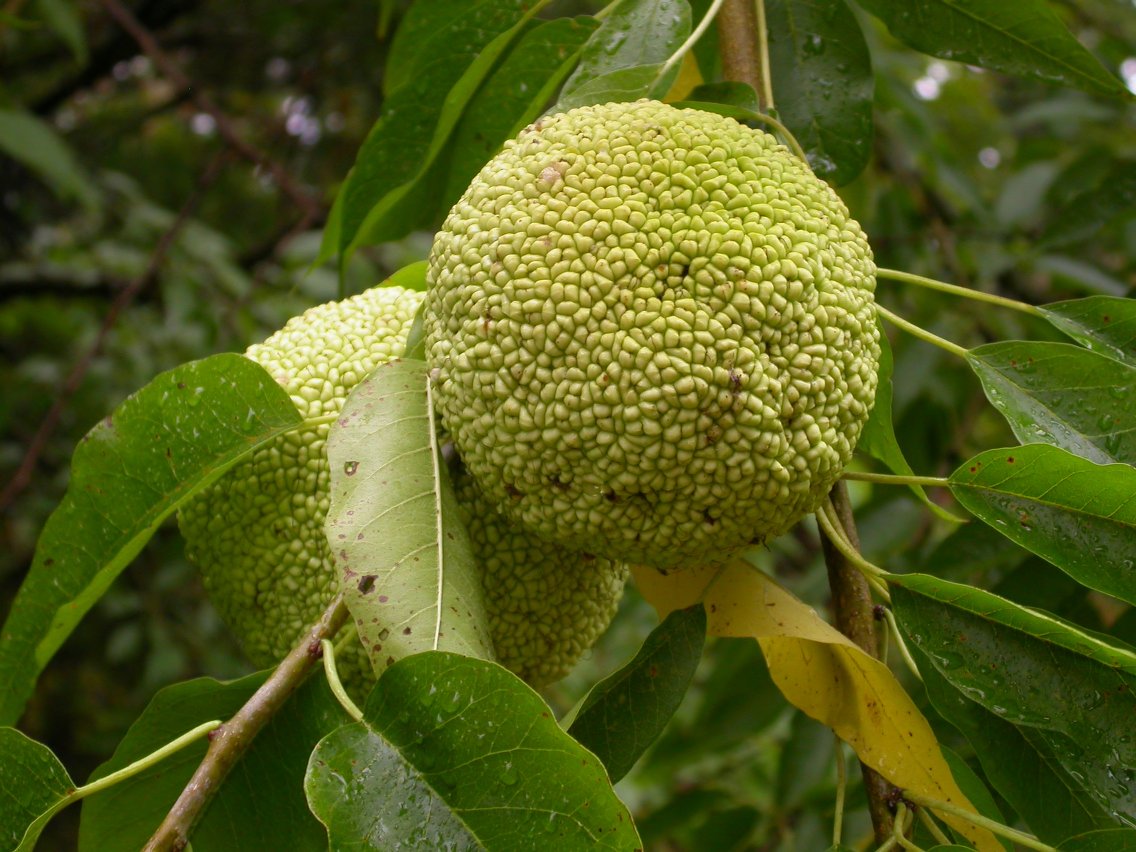
Syncarps spherical, pale green, 10-13 cm in diameter, densely wrinkled, glossy, consisting of numerous small oblong, light-brown drupules immersed in the syncarp tissue. When cut, the syncarp releases a thick milky sap. Fruits ripen in October. A number of studies have shown that the fruits are not toxic to humans and animals, but are inedible due to their hard texture. Syncarp weight 0.4-0.6 kg. At 18-2 years it yields 80-100 syncarps weighing 40-50 kg. When collecting syncarps before ripening they have a pleasant orange aroma. Each syncarp contains 300-400 seeds. Weight of 1000 absolutely clean seeds = 33.59 g. Seed fullness 90-100%. Seed yield from fruits 3.5-4.5%. When harvesting fruits be careful of pricks from dry spines; green ones are harmless.
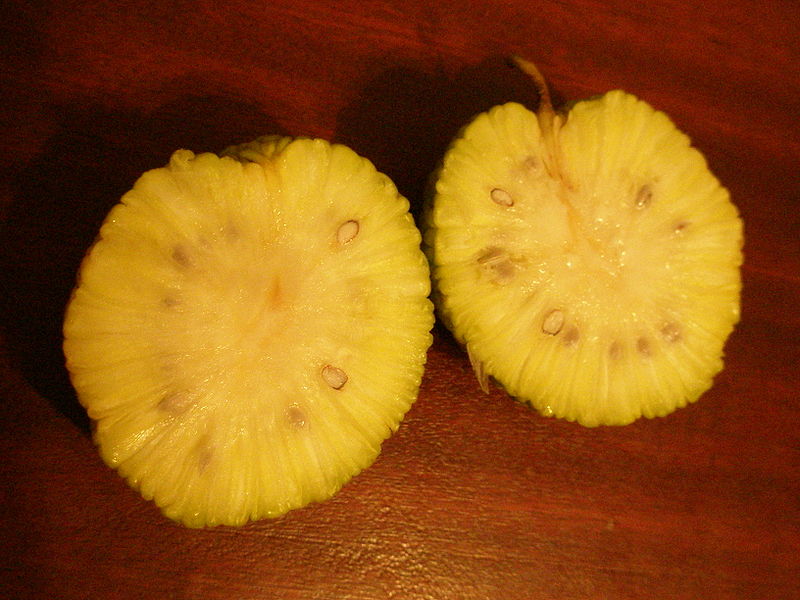
Forms: inermis – spineless form
Hardiness zone: zone 5b (-25°C).
Location: Prefers light; in the south can tolerate light shade. Drought-resistant, wind-resistant and salt-tolerant. Heat-loving. Adapts well to urban conditions.
Soil: undemanding, but prefers deep fertile soil, tolerates even saline conditions.
Planting: planting mix – compost consisting of topsoil, peat and sand in proportions 2:1:2. Planting should be to a depth of at least 40-50 cm. Recommended spacing between plants – 1.5-2.4 m.
Care: practically requires no care.
Pruning: requires heavy pruning, otherwise in the first years growth will reach 1-2 m.
Propagation: seeds retain viability for 1 year. For autumn sowing seeds are not removed from the syncarps. They are simply cut into 6-8 pieces and buried at a depth of 2-5 cm. With such sowing 10-15 seedlings emerge in one hole. Seedlings appear in April; they need to be thinned and pricked out. Seedlings grow very fast and by the end of summer reach up to 1 m in height. For spring sowing the syncarps are covered with soil and allowed to decompose until spring. In spring the decomposed mass is washed on a sieve under running water. Washed seeds are sown in a greenhouse – up to 50 seeds per linear meter when sown at a depth of 2-3 cm. Seedlings are planted in the ground at the age of 2 years. Also propagated by cuttings, layering, cuttings and root suckers.
Diseases and pests: not affected by diseases and pests.
Uses: the wood is much stronger than oak, and was used to make the best bows and expensive furniture. It has a beautiful amber color that over time becomes golden. Widely used in medicine. Leaves are used as feed for silkworms. A yellow dye is made from the bark and roots. In landscape design it is valued for its distinctive syncarps. Used in parks and gardens to create impenetrable thorny hedges, planted on forest edges, in group and solitary plantings, for creating protective belts and reclamation plantings.