
Flowers for the garden
Lunaria
Lunaria
Lunaria (lat. Lunaria) — a small genus of annual or perennial herbaceous plants of the cabbage family (Brassicaceae). The genus comprises only 2 species native to Europe.
The scientific name of the genus comes from the Latin "luna" — the moon.
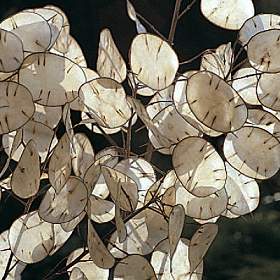
Annual and perennial plants. Stems erect, 40–90 cm high, covered with fine hairs. Leaves arranged oppositely or alternately; upper — sessile, alternate; lower — cordate, petiolate, toothed, opposite. Flowers large, fragrant, lilac, light purple, violet or white, gathered in paniculate inflorescences. Fruit a large, elliptical silique with a membranous silvery, translucent septum. Both Lunaria species grow easily in cultivation and can be grown in gardens and city parks.
In cultivation:
Annual lunaria — Lunaria annua
In England this plant is called "honesty", which translated into Russian means honesty, truthfulness. The name was given because of the transparency of the fruits: through the thin outer valves of the silique the dark seeds are clearly visible. In addition, the English have given Lunaria other names: moonwort (moonwort), moneyflower (moneyflower), pennieflower (pennieflower).
The plant is annual, grown as a biennial. Stems branched up to 60 cm tall. Leaves petiolate or nearly sessile, broadly ovate, shortly acuminate, rough-hairy, arranged alternately. Flowers white, violet or lilac, collected in racemose inflorescences at the ends of stems. Blooms from May to mid-June in the second year after sowing. Then flat seed pods of an oval shape, green in color, begin to develop in place of the flowers. By September they ripen and become light-brown, rigid pods. At this time the stems are cut at the root and dried in a dry room for two weeks. During this time the leaves dry and the seeds mature. Fruits abundantly produced, fruits up to 3 cm in diameter.
Perennial lunaria — Lunaria rediviva
A perennial herb up to 100 cm tall. Stems erect, branched in the upper part, covered with fine hairs. Upper leaves oval, alternate, sessile; lower leaves petiolate, opposite, cordate, toothed. Flowers violet, fragrant, up to 4 cm in diameter, gathered in a paniculate inflorescence. Fruits large, up to 5 cm long, oval-lanceolate siliques, pointed at both ends, ripen in August. In cultivation since 1597.
Prefers shady forests, but is also found in open areas. Does not tolerate late frosts. Grows mainly on rich, well-aerated soils with neutral reaction. Ascends to the mountains up to 1400 m above sea level. Propagated mainly by seed, less often by rhizomes. Seeds germinate in spring in late April — early May. The first pair of leaves appears in May, the second in August. In mature plants the flower buds are fully formed in autumn (a year before flowering): in April shoots emerge from the buds, and at the end of May they flower. Fruits set at the end of August, seeds shed in September. Sometimes damaged shoots flower a second time in August. Lunaria flowers are pollinated by bumblebees and butterflies. In the wild lunaria blooms in the fifth to seventh year of life, in cultivation in the second year.
Location: best grown in an open sunny site, but light partial shade is also acceptable.
Soil: annual lunaria grows in any sufficiently fertile garden soil.
Propagation: by seed. Sow annual lunaria outdoors in late spring or in early to mid-summer. It is important to choose well-matured, completely dark-brown seeds. By the end of the first year of life only a rosette of leaves forms; the flowering stem appears in the second year. Flowers in May-June, fruits in August. If seeds are sown in March in a greenhouse and then seedlings are planted outdoors at the end of May — beginning of June, flowering occurs in the first year of life. Literature sometimes recommends lightly covering this plant for the winter, however experience shows that annual lunaria overwinters well without covering and may even self-seed.