
Deciduous shrubs
Glossy honeysuckle
Lonicera nitida
Synonyms: Lonicera nitida Wils., Lonicera nitida Wilson, Wilson's honeysuckle, Wilson honeysuckle, Wilson's honeysuckle
Glossy honeysuckle (Lonicera nitida) – a species of the genus Lonicera in the honeysuckle family (Lonicera). Native to China, where it grows in Yunnan and western Sichuan provinces at an altitude of 1200-3000 m above sea level. Introduced into cultivation in 1908.
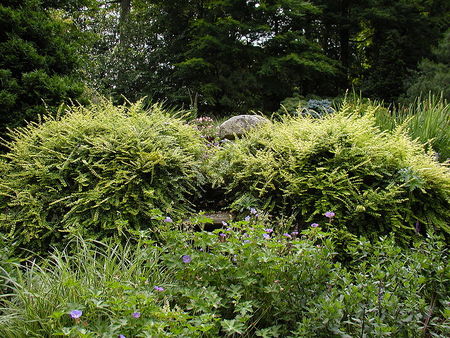
It is an elegant evergreen shrub 1.2-2 m in height and 1.2-2.5 m in width. Branches are thin, sprawling, often pendulous. Growth rate in youth is moderate, later it grows faster. The crown is fairly dense and fluffy.
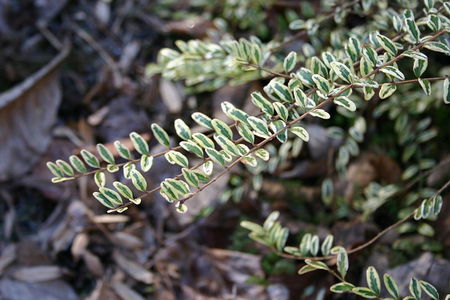
Lonicera nitida variegata
Leaves ornamental, glossy, ovate, very small, 20 mm long and 3 mm wide, dark green, remaining on the branches until frosts. In winter they acquire a bluish or steel tint.
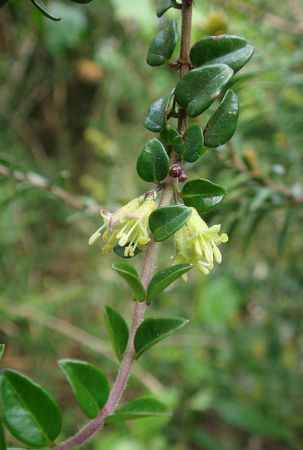
Flowers small, creamy-white, fragrant, 6 mm long and 2.5 cm in diameter, borne in pairs. Flowers in mid-spring for 15-20 days.
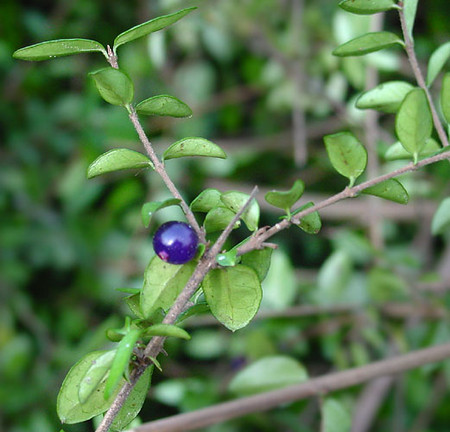
Fruits large spherical berries, light violet in color, conspicuous against the foliage. They appear rarely on clipped shrubs, inedible.
Forms: 'Baggesen's Gold', 'Briloni' ('Edmee Gold'), 'Lemon Beauty', Lonicera nitida Maigrun, Lonicera nitida Elegant, 'Silver Beauty', 'Graziosa'.
Hardiness zone: 6-9 (-15°C)
Site: not demanding to soil, can grow on sandy, clayey or loamy soils, but prefers fertile, well-drained and moderately moist soil. Prefers sunny or partly shaded locations. More tolerant of urban conditions and drought than other honeysuckles. Warmth-loving.
Pruning: tolerates formative trimming and pruning well. Pruning is done in summer or autumn.
Planting: Transplants well. Planting is recommended in late autumn. Plants with a closed root system can be planted from spring until late autumn. Recommended spacing between plants is 1.5-2 m. Soil mix: topsoil, humus, peat or sand in ratio 3:1:1. Root collar at ground level. Planting pit depth 25-30 cm, diameter – 25 cm for 2-3 year-old shrubs; for 5-7 year-old shrubs the depth and diameter of the pit reach 50 cm. When planting you can add 5-7 kg of manure, 50-80 g of superphosphate and 40-50 g of potash salt per shrub. Drainage layer of broken brick or gravel 5-7 cm thick. When planting, branches do not need to be cut; this is done in spring before strong bud swelling. If planted in spring, branches are cut immediately.
Care: Responsive to fertilization and watering. In the first 2 years it is recommended to fertilize in spring with nitrogen. Dissolve 30 g (about a matchbox) of urea or ammonium nitrate in 10 L of water and water with 1-1.5 L per plant. Watering can be done over the leaves, providing both root and foliar feeding. Such feedings can be carried out from the beginning of the growing season every 2 weeks until mid-June. With abundant mineral fertilization, serial (reserve) buds may open, from which additional shoots appear, densifying the crown.
Diseases and pests: leafroller, aphids, scale insects, powdery mildew, cane dieback, leaf spot.
Propagation: easily propagated by seed, green cuttings and layering.
Uses: used for bonsai, for edging borders, framing groups, glades, as well as decorating rock gardens and creating clipped hedges.
Companions: fescue, Felicia, pelargonium