
Deciduous shrubs
Maack's honeysuckle
(Lonicera maackii (Rupr.) Herder
Synonyms: Xylosteon maackii Rupr., Amur honeysuckle
Maack's honeysuckle (i (Rupr.) Herder)) – a species of the genus Lonicera of the honeysuckle family (Lonicera). The largest species of honeysuckle. The species was named after the Russian naturalist of the 19th century Richard Karlovich Maack. The first specimens were collected in the Amur River region, which is why the species received its second name – Amur honeysuckle. It occurs naturally in Central Asia, in western and central China, Japan, Mongolia, in southeastern Russia and in Primorsky Krai, Korea. In cultivation since 1860.
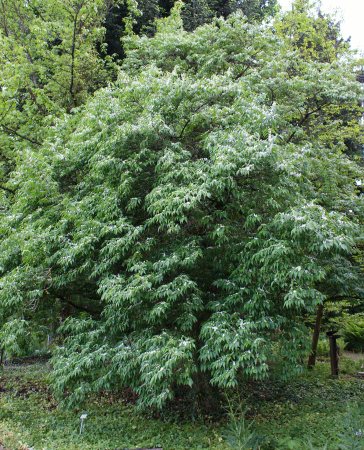
It is a spreading deciduous shrub or small tree with a crown of medium density. It reaches 4-6 m in height and 4-6 m in width. Annual growth reaches 35 cm in height and width. It attains its final height by 10-20 years. Lives 50-60 years.
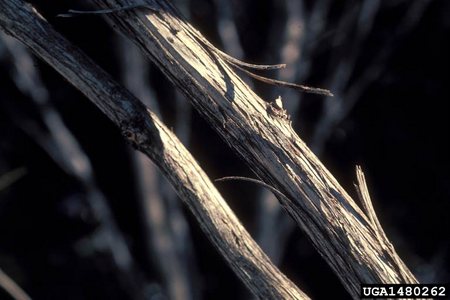
Bark light gray, peels off in large plates. Shoots light gray, young shoots covered with a dense pubescence of short hairs.
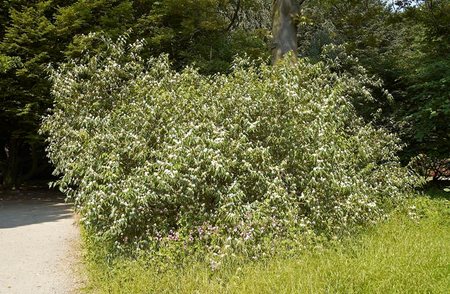
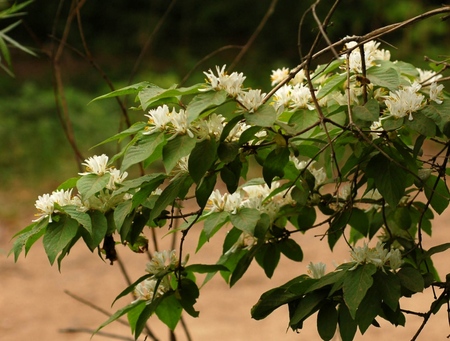
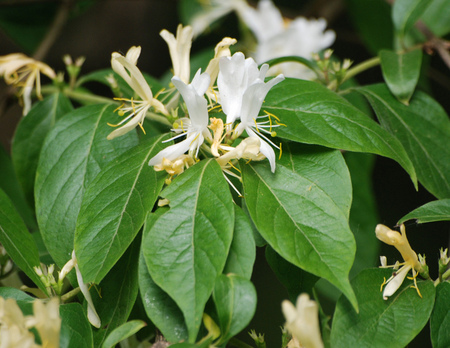
Leaves opposite, broad-lanceolate or ovate-elliptic in shape, 4-8.5 cm long, with entire margins, pointed at the tip, on short petioles. The upper surface of the blade is dark green, the underside slightly lighter. In autumn they change color to purplish-yellow or lilac.
Vegetation begins in mid-April and ends in September or early October. Flowers from 4-5 years, fruits from 5-8 years, annually and very abundantly.
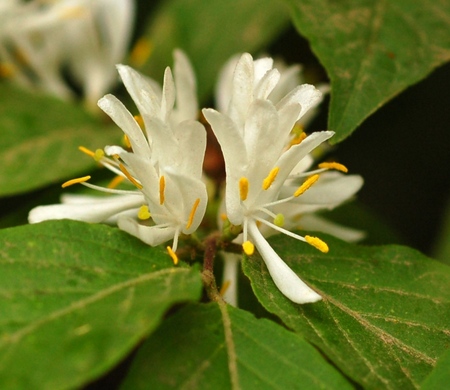
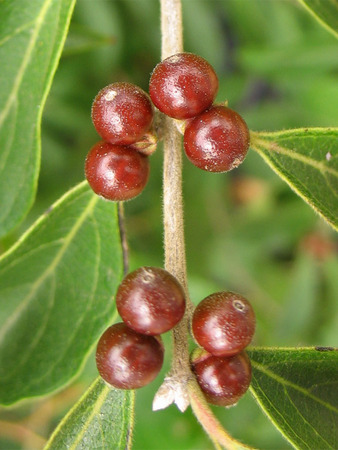
Blooms in June, flowering lasts 25-30 days. Flowers are arranged in pairs in the leaf axils, white, up to 2.5 cm long, with a faint pleasant fragrance, nectar-bearing; as they fade they become yellowish. Fruits are spherical berries dark red in color about 6 cm in diameter, inside which are numerous small seeds. Due to the deeply divided lobes of the corolla, the flowers resemble butterflies in shape. They ripen in August-September and remain on the branches for a long time. Inedible.
Varieties: 'Erubescens', 'Rem Red'
Hardiness zone: 3-8 (down to -34°C).
Location: shade-tolerant and drought-resistant. Grows well on fertile and moderately moist soils. Can tolerate short-term waterlogging.
Pruning: does not require special pruning. Sanitary pruning is recommended, removing dead and weak branches. To rejuvenate shrubs, remove old branches from the center of the bush.
Planting: Tolerates transplanting well at almost any age. Planting is recommended in late autumn. Plants with a closed root system can be planted from spring until late autumn. Recommended spacing between plants 1.5-2 m. Soil mixture: topsoil, humus, peat or sand in a ratio of 3:1:1. Root collar at ground level. Planting pit depth 25-30 cm, diameter – 25 cm for 2-3 year-old shrubs; for 5-7 year-old shrubs – the depth and diameter of the pit reach 50 cm. When planting you can add 5-7 kg of manure, 50-80 g of superphosphate and 40-50 g of potash salt per shrub. Drainage layer of broken brick or gravel 5-7 cm thick. Do not prune branches when planting; this is done in spring before strong bud break. With spring planting, branches are pruned immediately.
Care: Responsive to fertilization and watering. In the first 2 years it is recommended to feed in spring with nitrogen. Dissolve 30 g (a matchbox) of urea or ammonium nitrate in 10 l of water and water with 1-1.5 l per plant. Watering can be done over the leaves, providing both root and foliar feeding. Such feedings can be carried out from the beginning of the growing season once every 2 weeks until mid-June. With abundant mineral fertilization, serial (reserve) buds may open, from which additional shoots appear and thicken the crown.
Diseases and pests: aphids, powdery mildew, trunk cankers and trunk dieback.
Propagation: propagated by seeds and cuttings. Seed germination rate is 15%. Summer cuttings root poorly; when treated with a rooting agent, rooting success is 90%.
Uses: used to create fast-growing hedges. Used for solitary and group plantings, can be planted in apiaries.