
Climbing plants
Japanese honeysuckle
Lonicera japonica
Synonyms: kaprifol Japanese, Caprifolium chinense S.Watson ex Loudon, Caprifolium japonicum (Thunb.) Dum.Cours., Caprifolium roseum Lam., Lonicera brachypoda Siebold, Lonicera chinensis P. Watson, Lonicera fauriei H. Lév. & Vaniot, Lonicera shintenensis Hayata.
Japanese honeysuckle (Lonicera japonica Thunb.) – a species of the genus Lonicera from the honeysuckle family (Caprifoliaceae). Native range: East Asia (Japan, China, Korea). Introduced from Japan in 1806. Naturalized in Argentina, Australia, Brazil, Mexico, New Zealand, much of the United States (including Hawaii), on islands of the Pacific and the Caribbean, in Europe, Ukraine, Russia; on the Caucasus it has become feral and a weed of tea plantations; also present in Central Asia. In the USA it serves as a host plant for the virus that causes Pierce's disease, which severely damages grapevines. In some countries it is an invasive species.
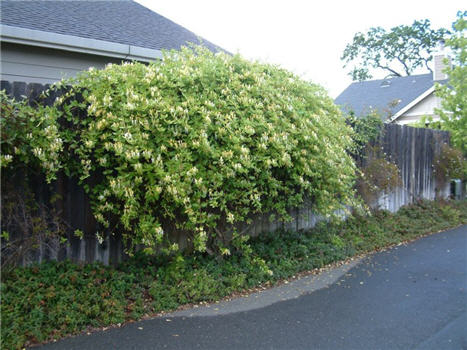
It is a semi-evergreen or evergreen, climbing or trailing, fast-growing liana up to 10 m long. Young shoots are pubescent.
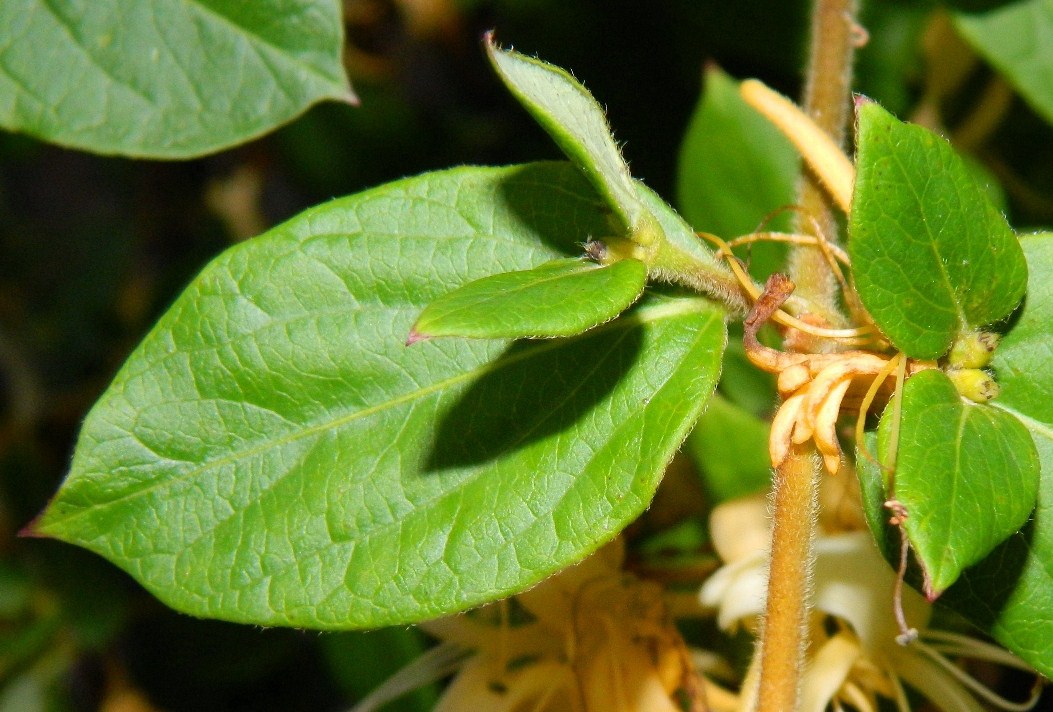
Leaves ovate to ovate-oblong, less often oblong-elliptic, shortly acuminate and acute, less often obtuse, with a slightly cordate or rounded base, 3–8 cm long and 1.5–4.5 cm wide, pubescent on both sides, later glabrous above, with a finely ciliate margin. Petiole glabrous or pubescent, about 5 mm long.
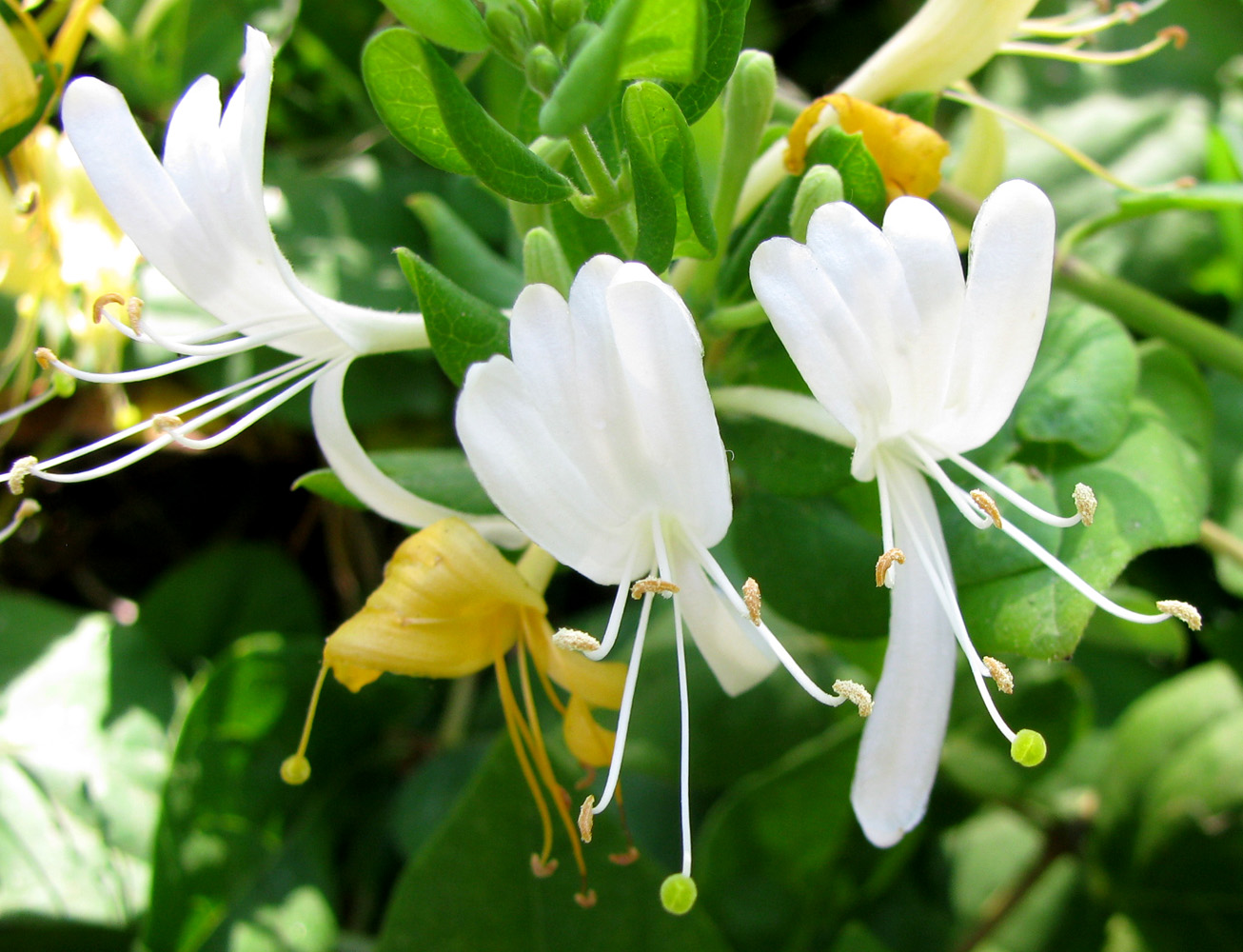
Flowers paired, borne in the axils, two-lipped, very fragrant, white with a purplish tinge, borne on pubescent peduncles that are usually longer than the petiole. Ovaries 3-celled, divergent, free, crowned by a calyx with teeth fringed by long cilia, below covered on 1/3 by free, semicircular, ciliate bracts. Bracts broadly ovate or leaflike. Corolla 3–5 cm long, externally furnished with glands and pubescent, with a smooth thin tube the same length as the limb; stamens and styles longer than the limb. Flowers from the second year after planting, abundantly and for a long period, from June to September.
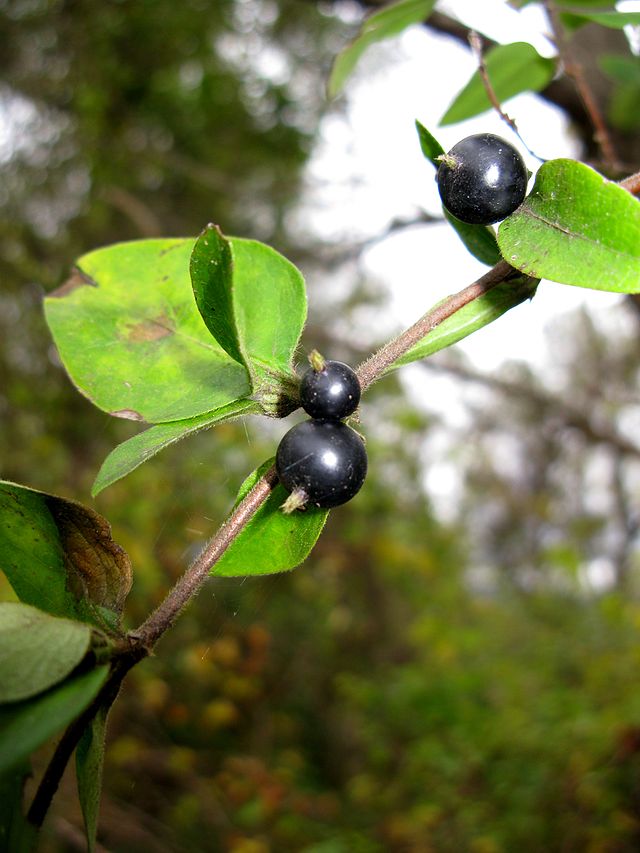
Berries black, shiny, rounded, 3–4 mm in diameter, containing a small number of elliptical, slightly angled, black seeds, with an indistinct external longitudinal ridge and a biconvex inner surface. Fruits in October–November.
Forms: var. Halliana Nichols. ('Hall's Prolific'), L. japonica var. Repens (presumably 'Purpurea'), var. chinensis (Wats.) Alter (L. chinensis Wats.), var. flexuosa Nichols., f. aureo-reticulata Nichols., Superba.
Hardiness zone: 4a (-34°C). In Crimea and Odessa it fruits; in Kyiv it rarely flowers.
Location: undemanding, light-loving, not particular about soil. Mesophyte, mesotroph, eutroph.
Planting: Substrate: turf, leaf mold, river sand in ratio 2:4:1.
Care: feeding is recommended once every 2 weeks. The optimal feed is a cow manure infusion at a ratio of 1:8.
Pruning: tolerates trimming and pruning well.
Propagation: propagated by seed and by layering. For seed propagation, seeds are best sown in autumn immediately after ripening, sowing depth 1 cm. Older seeds require cold stratification for several weeks.
Diseases and pests: under conditions in Ukraine it has no diseases or pests.
Uses: can be used for all types of vertical greening, for creating borders and carpet beds, as a fast groundcover, and for erosion control on slopes, decorating fences and enclosures, as well as for creating a screen or shade. Can be grown indoors or in a conservatory, on trellises, columns, stands, and in hanging baskets. Flowers can be used in perfumery. Used in Chinese medicine.