
Climbing plants
Heckrott's Honeysuckle
Lonicera heckrottii
Synonyms: caprifol Heckrott, Lonicera Heckrott, fire honeysuckle.
Heckrott's Honeysuckle (Lonicera × heckrottii) – a hybrid Lonicera sempervirens L × Lonicera × americana (Mill.) K. Koch from the genus Lonicera of the family Caprifoliaceae. It appeared in America in 1895.
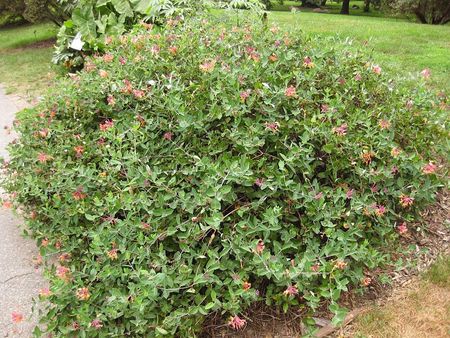
It is a bushy deciduous, vertically growing, weakly twining shrub that becomes slightly bare with age. It reaches 2-4 m in height and 1.5-3 m in width. Annual growth is 30-50 cm. Young shoots are purplish-red, becoming bright purplish-red in the sun.
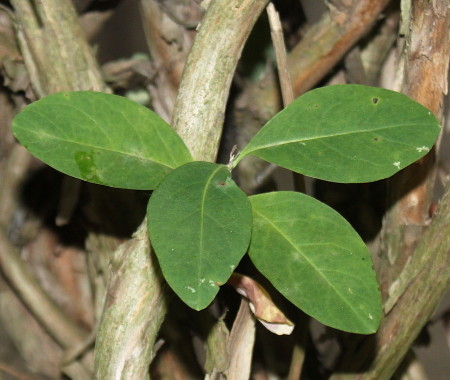
Leaves are broadly elliptic in shape, arranged oppositely, large, 8-10 cm long and 3.5-5.5 cm wide, blue-green in color, rough, sessile, the upper pair of leaves fuse beneath the inflorescences forming almost circular discs.
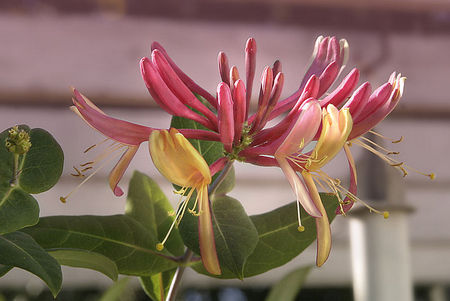
Flowers are fragrant (pleasant vanilla scent), arranged in the axils of the fused leaves in groups of 15-30, some flowers form tubes up to 4 cm long, symmetrical, two-lipped, with a red-blue or purple corolla on the outside and light yellow inside, which become yellow as they fade.
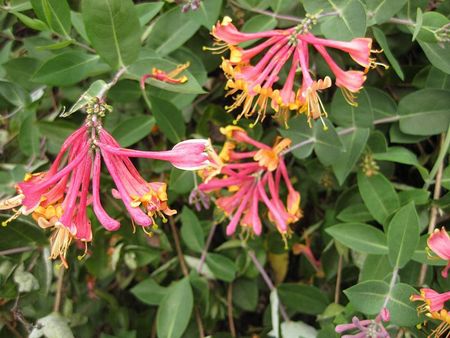
Flowers abundantly from June to September.
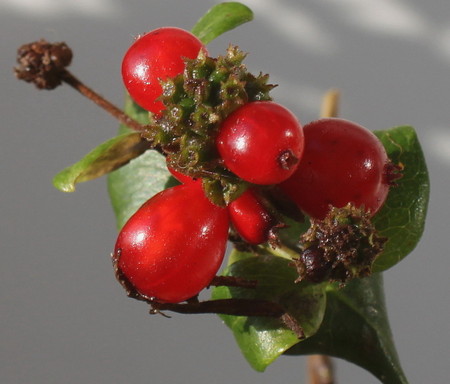
Fruits – small berries the size of a pea, red in color, borne singly, poisonous.
Hardiness zone: 3a. In winter, light freezing of shoots is possible, which then recover quickly.
Site: Prefers light shade or partial shade. In full sun it can be grown only with sufficient moisture and mulched soil. Does not flower in shade. Not demanding on soil, tolerates all cultivated garden soils. Prefers fresh, moist, fertile humus soil with good drainage, from neutral to alkaline. Does not grow with insufficient watering. Does not tolerate drought and high temperatures. Planting near a support is recommended.
Pruning: recommended in autumn (after leaf fall) or early spring (March). Every 2-3 years rejuvenation pruning and thinning of the crown are necessary. Remove old and small branches, leaving no more than 5 strong stems; new suckering shoots will actively develop. After 6-7 years only sanitary pruning is required.
Planting: Transplants well. Planting is recommended in late autumn. Plants with a closed root system can be planted from spring until late autumn. Recommended spacing between plants is 1.5-2 m. Soil mix: garden soil, humus, peat or sand in a ratio of 3:1:1. The root collar at ground level. Planting hole depth 25-30 cm, diameter – 25 cm for 2-3 year-old shrubs; for 5-7 year-old plants, hole depth and diameter reach 50 cm. To set fruit, plant at least 3-5 shrubs of different cultivars. When planting you can add 5-7 kg of manure, 50-80 g superphosphate and 40-50 g potassium salt per bush. Drainage layer of broken brick or gravel 5-7 cm thick.
Care: In early spring you can apply a mineral fertilizer (20-30 g/m2). Before flowering you can apply liquid Kemira-Universal (20 g per 10 l of water). For weak young growth, foliar feeding is recommended (0.1% urea, 1% superphosphate, 0.5% potassium chloride). Responds well to summer overhead watering of the crown. In autumn wood ash can be applied when digging (100-200 g/m2). Watering moderate, 2-3 times per season, in hot weather 8-10 l per plant. Without watering fruits may become bitter. Remove weeds by loosening the soil to a spade depth (20-25 cm). Mulch with peat around plants to a thickness of 3-5 cm.
Diseases and pests: practically not affected by diseases or pests.
Propagation: propagated vegetatively by cuttings and layering.
Use: used for vertical greening of trellises, building walls, balconies and other structures.