
Climbing plants
Brown's honeysuckle
Lonicera brownii
Synonyms: Lonicera x brownii (Regel) Carriere, fuchsia-like honeysuckle, Lonicera x brownii 'Fuchsioides' (Regel) Carriere
Brown's honeysuckle (Lonicera brownii) – the most exotic species of the genus Lonicera of the honeysuckle family (Lonicera). A hybrid of evergreen honeysuckle (Lonicera sempervirens L.) and rough honeysuckle (Lonicera hirsuta Eaton) (L. sempervirens L. x L. hirsuta Eaton). Native to North America.
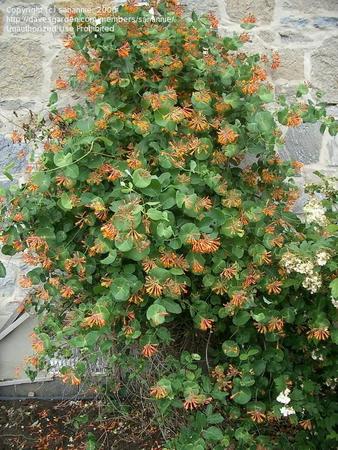
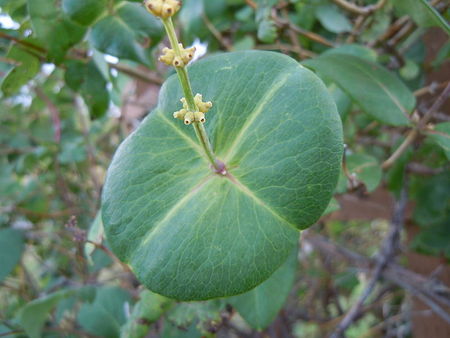
It is a climbing semi-evergreen shrub 2.5-3 m in height and 3 m in width. Leaves smooth, elliptical, green on the upper side, gradually becoming darker, bluish and slightly pubescent beneath, emerge early. In autumn they acquire a yellowish tint.
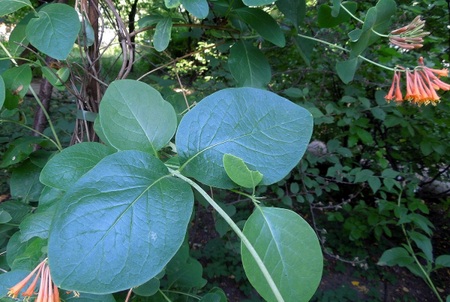
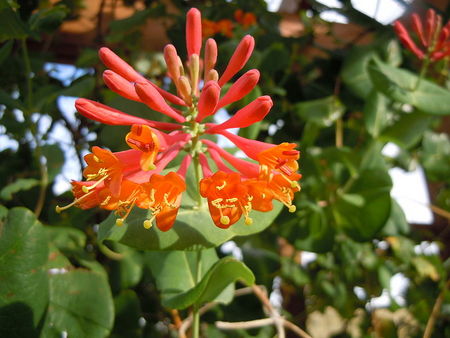
Flowers small, funnel-shaped, paired, from red to orange-red in color, very ornamental, not fragrant. Blooms abundantly from late spring until the first frosts.
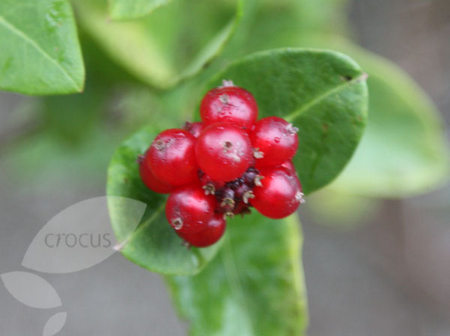
Fruits globular red-orange juicy berries containing numerous seeds. Fruits rarely.
Cultivars: "Dropmore Scarlet", "Golden Trumpet", «Toison D'or»
Hardiness zone: 3-8 (down to -34°C).
Location: Light-loving, but can tolerate partial shade. Undemanding to soil (tolerates a wide pH range from 3.9 to 7.7), but flowers best on slightly acidic to neutral soils (pH 5.5-6.5). Moisture-loving, but does not tolerate waterlogging.
Pruning: In the first 5-7 years perform only sanitary pruning; in subsequent years the crown becomes dense, so rejuvenation pruning is recommended in autumn after leaf fall or in spring in March-April. The aging part of the crown should be cut back above the point of origin of major basal shoots by 30-50 cm. For fundamental crown rejuvenation, a severe cut "to a stump" is applied at a height of 0.5 m from the ground.
Planting: Transplants well at almost any age. Planting is recommended in late autumn. Plants with a closed root system can be planted from spring until late autumn. Recommended distance between plants is 1.5-2 m. Soil mix: turf soil, humus, peat or sand in a ratio of 3:1:1. The root collar at ground level. Planting pit depth 25-30 cm, diameter – 25 cm for 2-3 year-old shrubs; for 5-7 year-old shrubs the pit depth and diameter reach 50 cm. When planting, you can add 5-7 kg of manure, 50-80 g of superphosphate and 40-50 g of potash salt per bush. Drainage layer of broken brick or gravel 5-7 cm thick. Do not prune branches when planting; this is done in spring before strong bud break. For spring planting, prune branches immediately.
Care: Needs a sturdy support. Train young shoots on the support, distributing them evenly over the surface (taking into account that honeysuckle twines counterclockwise). Once the desired height is reached, cut the vine tip to allow lateral shoots to develop. Responsive to fertilization and watering. In the first 2 years it is recommended to apply nitrogen in spring. Dissolve 30 g (a matchbox) of urea or ammonium nitrate in 10 l of water and water with 1-1.5 l per plant. Foliar watering can be used, providing both root and foliar feeding. Such feedings can be performed from the start of vegetation every 2 weeks until mid-June. With abundant mineral feeding, serial (reserve) buds may open, producing additional shoots that thicken the crown. For winter, it can be covered with spruce boughs or fallen leaves, as some shoots may freeze.
Diseases and pests: aphids, powdery mildew, stem cankers and dieback.
Propagation: propagated by seeds, cuttings and layering. Softwood cuttings should be taken at the end of flowering (early July). Each cutting should have 2 internodes. Remove the lower leaves and cut the upper ones in half. Plant them in a shaded greenhouse at 20-25 cm apart, to a depth of 2-3 mm and cover with glass. Soil mix: peat, coarse sand and garden soil in a ratio of 2:2:1. Also mist 2-3 times a day. When leaves appear, the glass can be removed. For winter, mulch cuttings with peat, and in spring they can be transplanted to a permanent place. Rooting of cuttings without preliminary treatment is 50%.
Seed propagation is a longer process. Seeds are collected at the end of July, cleaned of pulp, washed and dried. Store seeds at room temperature. After storage for 0.5; 1.2 and 3 years, seed germination rates are 85; 71.5; 71.4% respectively. After 4 years germination falls to 36%, and after 5 years – only 6%. A two-stage stratification is used for propagation by this method: I - at 2°C for 1-2 months, II - at 5°C for 1-2 months. Seed germination is slow; at 20°C (50% of seeds germinate in 1.5-3 months). Seed sowing depth is 0.9-1 cm.
Uses: Attracts bees and butterflies to the garden. Used for hedging, creating screens or borders, and for decorating fences or trellises.