
Deciduous shrubs
Honeysuckle
Lonícera
Synonyms: caprifolium, Lonicera
Honeysuckle (Lonicera) – the type genus of the family Caprifoliaceae. The genus was named in honor of the German botanist, mathematician and physicist Adam Lonicer (1528—1586). Originally Carl Linnaeus wanted to name the genus Caprifolium, since that is the most popular species from the genus cultivated in gardens.
Distributed in almost all regions of the Northern Hemisphere, mostly in the Himalayas and East Asia. Also found in North America and Europe. In the southeastern part of Asia it extends into subtropical and tropical zones.
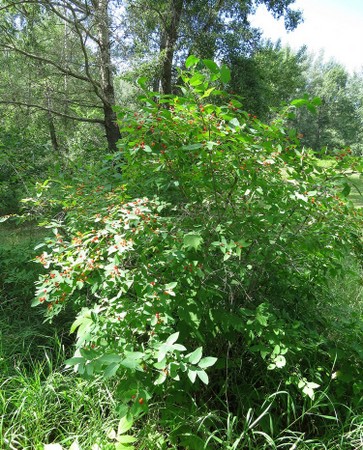
Lonicera tatarica L. (Tatarian honeysuckle)
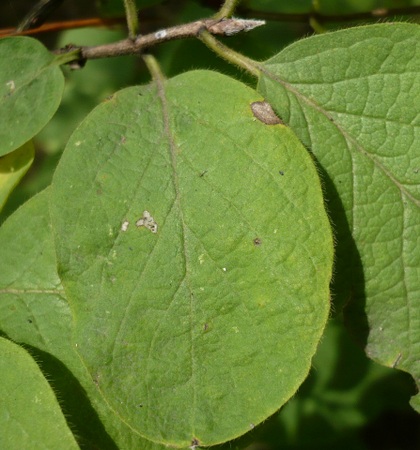
Members of the genus are climbing, erect or creeping shrubs. Leaves are opposite (arranged in pairs opposite each other), uniform in shape, elliptic or oval, more often with entire margins, less often with wavy edges. The leaf apex is usually rounded or pointed, more rarely acuminate.
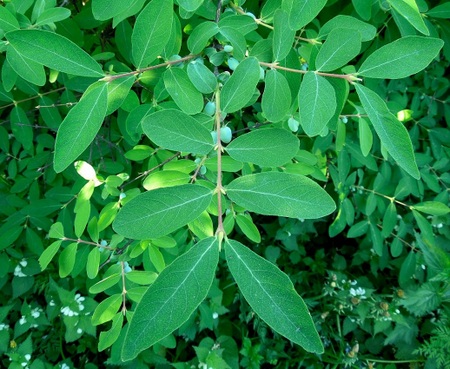
Lonicera altaica Pall.
Root system is located close to the surface.
Pollination is cross. Flowers are nectar-bearing, often pleasantly scented, large, white, pink, yellow or blue. They most often grow at the ends of branches in head-like inflorescences or in pairs in the leaf axils. The calyx is weakly developed; in most species an irregular tubular corolla emerges from it, divided at the tip into five lobes. In climbing species flowers are gathered in head-like inflorescences without pedicels. Inflorescences are surrounded by oval or round discs formed by the fusion of leaves.
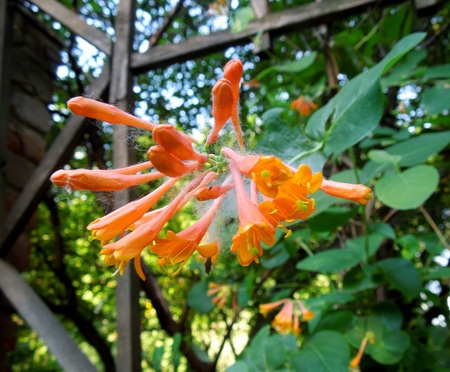
Lonicera × brownii Hort.
Fruits are juicy berries that may be red, orange, black or blue, with small seeds inside. Pairs of berries often fuse together, forming an aggregate fruit, at the top of which are the attachment points of two corollas.
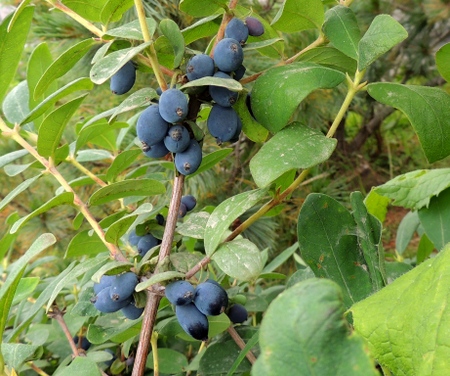
Lonicera edulis Turcz. ex Freyn
Species: There are more than 200 species of honeysuckle. Some of them:
- Lonicera caprifolium L.— Lonicera caprifolium, or fragrant honeysuckle
- Lonicera maackii (Rupr.) Maxim. — Maack's honeysuckle
- Lonicera nitida E.H.Wilson – box honeysuckle (glossy honeysuckle)
- Lonicera chrysantha Turcz. ex Ledeb. — golden honeysuckle
- Lonicera xylosteum L. — Lonicera xylosteum, or common/woodland honeysuckle
Hardiness zone: 4a
Site: Not demanding to soil, undemanding. Grows well on moist, loose and fertile soils under the canopy of tall trees, but not in deep shade. Under heavy shading flowering may be poor. Optimal soil pH 7.5 - 8.5. Performs poorly on poor sandy soils and heavy wet soils.
Pruning: recommended in autumn (after leaf fall) or early spring (March). Rejuvenation pruning and crown thinning should be carried out every 2-3 years. This requires removing old and small branches, leaving no more than 5 strong stems; new suckering shoots are actively produced. After 6-7 years only sanitary pruning is necessary.
Planting: Transplants well. Planting is recommended in late autumn; for late-growing species planting can be done in spring. Plants with a closed root system can be planted from spring to late autumn. Recommended spacing between plants is 1.5-2 m. Soil mix: topsoil (sod), humus (compost), peat or sand in the ratio 3:1:1. The root collar should be at ground level. Planting hole depth 25-30 cm, diameter – 25 cm for 2-3 year-old shrubs; for 5-7 year-old plants the planting hole depth and diameter should reach 50 cm. To set fruit, plant at least 3-5 bushes of different varieties. At planting you can add 5-7 kg of manure, 50-80 g of superphosphate and 40-50 g of potassium chloride per bush. A drainage layer of broken brick or gravel 5-7 cm thick.
Care: In early spring you can feed with mineral fertilizer (20-30 g/m²). Before flowering, apply liquid Kemira-Universal (20 g per 10 L of water). If young plants grow poorly, foliar feeding is recommended (0.1% urea, 1% superphosphate, 0.5% potassium chloride). Responds well to summer crown watering. In autumn wood ash can be applied when digging (100-200 g/m²). Watering moderate, 2-3 times per season; in hot weather 8-10 L per plant. Without watering bitterness may appear in the fruits. Remove weeds by loosening the soil to the depth of a spade (20-25 cm). Mulch with peat around plants in a 3-5 cm layer.
Diseases and pests: Most ornamental honeysuckles are practically not affected by diseases or pests. Edible honeysuckle is affected by honeysuckle aphid, honeysuckle mite, scale insects, caterpillars of the honeysuckle striped sawfly, larvae of the honeysuckle miner and the ermine moth, sawflies, geometer moths (inchworms), phytophagous bugs, and the honeysuckle plume moth. To control pests use 0.05% Decis, «Inta-Vir», «Elexar». Among diseases, cercospora leaf spot and powdery mildew are most common. To combat fungal diseases early spring spraying with 0.02% Fundazol or a copper-soap solution of copper sulfate (100 g per 10 L of water) is recommended. For powdery mildew use «Topaz», colloidal sulfur or wood ash, as well as calcined soda 0.57%. It can also be infected by potato virus and cucumber mosaic virus, as well as mosaic of rock cress (Arabis).
Propagation: Easily propagated by seed and vegetatively (by layering, green and hardwood cuttings (for Lonicera morrowii), produces suckers from the stump). Green cuttings are the most effective method of propagation. Cuttings are taken during the period of green fruit development. Readiness of shoots for cutting is checked by bending (ready shoots do not bend but break with a characteristic crunch). If cuttings are harvested earlier, their survival decreases to 45-60%. Cuttings taken at the end of July will not have time to harden for winter. Cuttings are cut in the morning or in cool weather. First cut strong current-year shoots. For green cuttings take the middle part of the shoot with 1 internode and 2 nodes (2 pairs of leaves). Cutting length is 7-12 cm, diameter 0.4-0.5 cm. The top cut is straight, leave 1-1.5 cm from the buds; the bottom cut is oblique at 45°. Leaf blades should be completely removed on the lower nodes, on the upper nodes cut more than half. Cuttings with a "heel" also have good survival; these are obtained by breaking off the lower part of the shoot from last year's twigs. Soil mix for cuttings: peat and sand in the ratio 1:3. Plant cuttings at a 45° angle. Planting scheme 7x5 or 10x5. Recommended air and substrate humidity 85%, temperature 20-25°C. Roots appear 8-10 days after planting. When propagated by seed, characteristics of the parent plant are not preserved.
Uses: Tall shrubs can be used to create hedges. Looks good in group and solitary plantings, on forest edges and as an understorey. Abundantly flowering plants can be placed in ornamental groups near the house or recreation areas. Low-growing honeysuckles are planted among large stones in rock gardens. Climbing species can be used to create an arch or gazebo, or to decorate a wall or slope.