
Indoor plants
Livistona
Livistona
The genus Livistona (Livistona R.Br.) includes about 30 species of the palm family. Livistonas are distributed in the tropics and subtropics of South and Southeast Asia, on the islands of the Malay Archipelago, on the island of New Guinea, in Polynesia and in eastern Australia.
These are large palms up to 20—25 m tall. The trunk bears scars and is covered with the leaf-sheaths of the petioles, with a large crown of leaves at the top. Leaves are fan-shaped, rounded, split to the middle or deeper, with radially pleated segments. The petiole is stout, in cross-section concavo-convex, with sharp edges and spines at the end, and a heart-shaped ligule (an anterior crest). The petiole continues into the leaf blade as a midrib 5—20 cm long. Inflorescence axillary.
Livistonas have become widespread in indoor horticulture. They are easily propagated by seed and are fast-growing — even young 3-year-old specimens have ornamental value. In spacious rooms livistonas do not form a trunk, instead expanding by means of numerous leaves. With good care a Livistona produces 3 new leaves per year. However, the tips of Livistona leaves dry out easily, and the drying subsequently spreads deeply, which significantly reduces the value of the plants. This drawback can be eliminated by proper care: keeping the plants at 16—18 °C, frequent washing and regular spraying of the leaves with water.
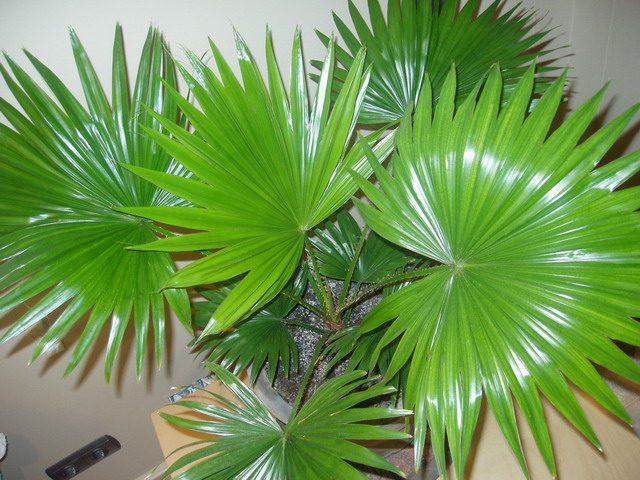
Livistona chinensis (Livistona chinensis). Native to southern China. Trunk 10—12 m tall and 40—50 cm in diameter, toothed in the lower part, in the upper part covered with remnants of dead leaves and fibers. Leaves fan-shaped, split to half their length into pleated segments (50—60, up to 80), deeply incised at the tips, acutely tapering and drooping. Petiole 1—1.5 m long, broad, up to 10 cm wide, narrowing upward to 3.5—4 cm, along the lower third or up to the middle with sharp, short straight spines on the edges, extending into the leaf blade for up to 20 cm; ligule raised, with parchment-like margins, up to 1 cm wide. Inflorescence axillary, up to 1.2 m long. Suitable for moderately warm rooms.
Livistona rotundifolia (L. rotundifolia). Grows in coastal zones on sandy soils on the island of Java and the Moluccas. Trunk 10—12 (up to 14) m tall and 15—17 cm in diameter. Leaves fan-shaped, rounded, 1—1.5 m in diameter, divided to 2/3 of their length into pleated segments, radiating evenly from the upper part of the petiole, green, glossy. Petiole 1.5 m long, densely covered with spines along the edges from the base for about 1/3 of its length. Inflorescence axillary, 1—1.5 m long, red. Flowers yellow. Highly ornamental plant, suitable for moderately warm rooms.
Livistona australis (L. australis). Grows in subtropical moist forests in eastern Australia, reaching south to Melbourne. Trunk columnar, up to 25 m tall and 30—40 cm in diameter, thickened at the base, covered with remnants of leaf sheaths and leaf scars (traces of fallen leaves). Leaves fan-shaped, 1.5—2 m in diameter, radially pleated, divided into segments (up to 60 and more), dark green, glossy. Segment tips are bifid. Petiole 1.5—2 m long, with frequent, sharp, sturdy, almost brown spines along the edges. Inflorescence axillary, branched, up to 1.2—1.3 m long. A valuable ornamental plant. Cultivated in warm-temperate greenhouses, grows well indoors.
Light: bright, diffused. The plant tolerates some direct sunlight.
Temperature: 16—20 °C from spring to autumn. From autumn it is desirable to lower the temperature. Overwintering is preferably cool — 14—16 °C.
Watering: abundant in the spring-summer period; watering is somewhat reduced in autumn.
Air humidity: high. Regular spraying and washing of the leaves with warm, soft, settled water are necessary.
Feeding: with organic fertilizers once every ten days, from May—June to September; in winter — once a month.
Dormant period: in winter, weakly expressed. Keep the plant in a bright place at 14—16 °C, water moderately.
Repotting: in spring — in April—May. Young plants are repotted annually, middle-aged ones — once every 2—3 years, mature ones — once every 5 years. Repot only if the palm's roots have filled the entire pot volume.
Propagation: by seeds or by side suckers/pups, if they appear.