
Indoor plants
Liriope (Indoor mouse hyacinth)
Liriope
Liriope, or indoor mouse hyacinth, is an undemanding rhizomatous plant from the lily family. Its inflorescences resemble those of the mouse hyacinth, but they are pink. The mature clump looks magnificent thanks to its elongated, arching, narrow leaves. Its name was given in honor of a nymph.
It requires diffused light, regular watering, and fertilization once every two weeks during the growing season. If not deprived of these comforts, it will reward you with abundant flowering. After flowering, faded inflorescences are removed. It is propagated by numerous offsets that are separated during repotting.
Shade tolerance and hardiness mean that liriope is often used in compositions with other plants and as groundcover.
The genus includes 6 species of evergreen perennial herbaceous plants native to East Asia.
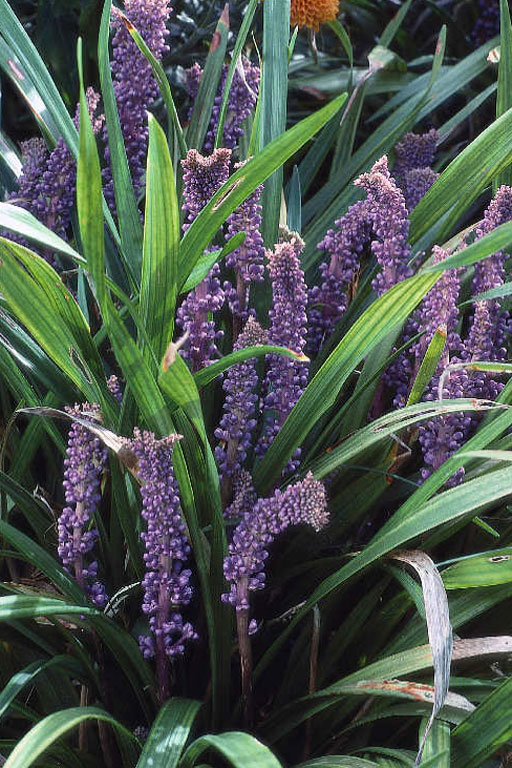
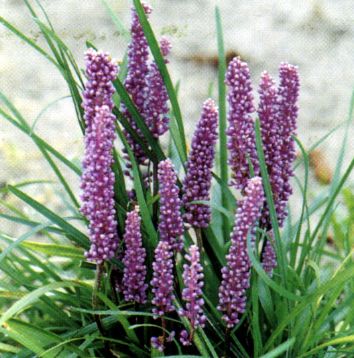
Liriope spicate – (Liriopelour spicata). Rhizomatous herbaceous plant. Leaves are gathered in basal rosettes, up to 40 cm long, 0.8 cm wide, linear, rounded at the apex, slightly grooved, rough along the edge, dark green. Flowers up to 0.5 cm in diameter, arranged in clusters of 2-3 in a raceme-like inflorescence on a leafless, often reddish scape up to 40 cm tall, light lilac or light purple, more rarely white. Native to China and Vietnam; grows in subtropical and montane tropical forests. In cultivation before 1862.
Liriope (mouse hyacinth) – (L. muscari). Differs from the previous species mainly by the larger leaf size (up to 60 cm long, 1.5 cm wide) and a taller scape (up to 45 cm). Native to India and Japan. Plants are kept at temperatures of 10-14 °C.
Light: prefers bright diffused light but also tolerates shade well.
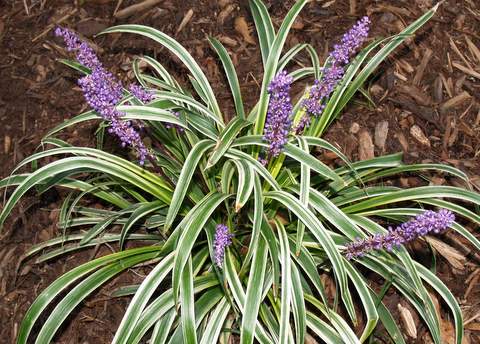
Watering: moderate; do not allow the substrate to dry out excessively.
Humidity: moderate.
Feeding: every two weeks during the growing period.
Propagation: by numerous offsets that are separated during repotting.
Repotting: as needed. Soil mix: turf, leaf, humus soil, peat and sand in equal parts.