
Flowers for the garden
Edelweiss
Leontopodium
The scientific Latin name Leontopodium comes from Greek λέων (leon) — lion and ποδεών (podion) — paw, since the appearance of this plant's inflorescence resembles a lion's paw. The Russian generic name Эдельвейс — is a transliteration from German Edelweiß, from German edel — noble and weiß — white.
The name of this plant has been widely used to denote a variety of objects not related to botany or natural history.
Edelweiss has long been and remains a favorite plant among gardeners for rock gardens. For many it has become a symbol of the mountains. The edelweiss flower is mentioned in a number of fairy tales and legends as an image of inaccessibility and good fortune.
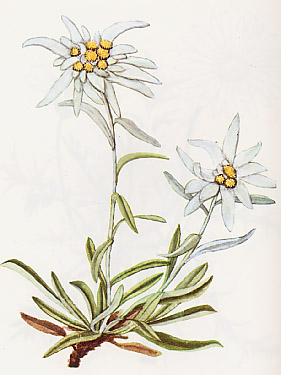
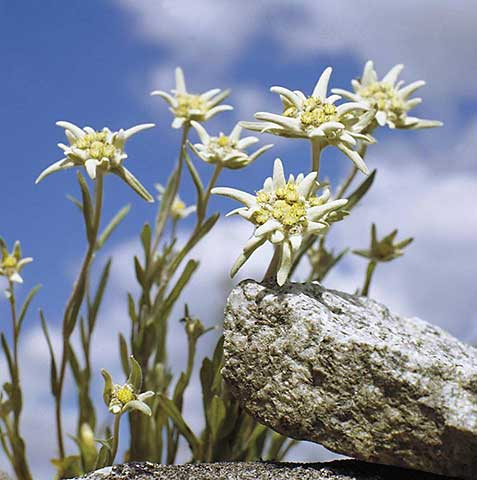
Edelweiss — annual or perennial herbaceous plants 12—25 cm tall that grow on high limestone mountains. Narrow leaves are hairy beneath, which protects the plants from excessive moisture loss; above the leaves are silvery. The inflorescence is terminal, compound, consisting of several clusters of tightly grouped heads of white or yellowish flowers. The heads are surrounded by linear or lanceolate, star‑spreading bracts.
In cultivation since 1587.
Alpine edelweiss — Leontopodium alpinum Cass.
Occurs in Central Asia, Europe and Asia Minor.
A beautiful plant that grows on rocks and ledges, exposed limestone and slate, and scree slopes in the alpine and subalpine belts of mountains. Slightly curved stems form low cushions up to 25 cm high, branched in the upper part. Lanceolate leaves are gathered in a basal rosette. The whole plant is densely hairy, which gives it a light-silvery color. Flowers are white, gathered in small heads, which in turn form small corymbs, surrounded by decorative, grayish-silvery bracts. Blooms in July for 20–25 days. Fruit — achenes with a pappus. Up to 6000 seeds per gram.
Two-colored edelweiss — Leontopodium discolor Beauv.
An original graceful plant with a beautiful "flower" formed by woolly bracts. Range of an East Asian continental‑island type: Russia (Sakhalin and Moneron islands; Ussuri, Uda districts), Japan (Hokkaido), Korean Peninsula. Grows on rocky slopes, cliffs and screes of sea and river shores and highlands. A small perennial with a prostrate thin rhizome and ascending stems 20—30(35) cm. Leaves lanceolate to linear-lanceolate, green above, thinly appressed white-woolly beneath. The bracts forming the "star" are unequal in length, lanceolate or ovate-lanceolate, white-woolly above, numbering no more than 10. Diameter of the "star" 3—3.5(4) cm. Flowers in July, fruits in August. Decorative from the moment the bracts appear during June — August.
Location: sunny. Drought-tolerant, they do not tolerate waterlogged soil. With excessive moisture in summer, overly fertile soil, or shading they completely lose their decorative value, becoming elongated and less hairy and compact.
Soil: requires light, dry soils. Responds well to the addition of leaf mold. When planting in soil it is desirable to add gravel or coarse sand. In humus-rich soil its leaves develop best, but it flowers little.
Propagation: in spring and autumn by division of the clump or by cuttings. By autumn a clump consists of small annual leaf rosettes. They are so tightly intertwined by their roots that they must be separated very carefully for propagation. These young plants, separated from the dead mother plant, overwinter. The following year they will flower, give rise to new young rosettes and then die. For cuttings use small shoot tips, which root most successfully in May–June. Young plants flower the next year. Edelweiss is also grown from seed. Seeds are sown under glass in February–March in a seed tray with compost. Sow thinly. Cover the sowings with polyethylene to retain moisture and place in a shaded spot. Germinate at 13–15 °C. Seedlings appear in 14–21 days. After emergence remove the cover and move the seedlings to a lighted place. Plants grow very slowly. Seedlings are especially sensitive to overwatering. When plants reach 2 cm they are transplanted into individual pots. Plants are set out in the open ground in late June – early July.