
Climbing plants
Clematis viticella
Сlematis viticella
Synonyms: Lomonos vinogradnichkovy, purple clematis, Lomonos purple, Clematis viticella f. purpurea (Loudon) Rehder, Clematis viticella Linnaeus, Clematis lugubris Salisb., Clematis lugubris Salisb., Virgin's Bower., Clematis caerulea Flore Pleno
Clematis viticella (Clematis viticella L.) – a species of perennial woody plants in the genus Clematis (Clematis) of the Ranunculaceae family. This group of clematises was first distinguished and named by the well-known Swedish biologist and writer considered the father of modern scientific classification, Carl Linnaeus, in 1753. Introduced into cultivation in 1797. The first mention of the species appeared in an English Botanic Garden plant catalogue in 1648, where it was listed as «Clematis peregrina caerulea». It was first brought to Europe in 1569 by Queen Elizabeth's apothecary, Hugh Morgan.
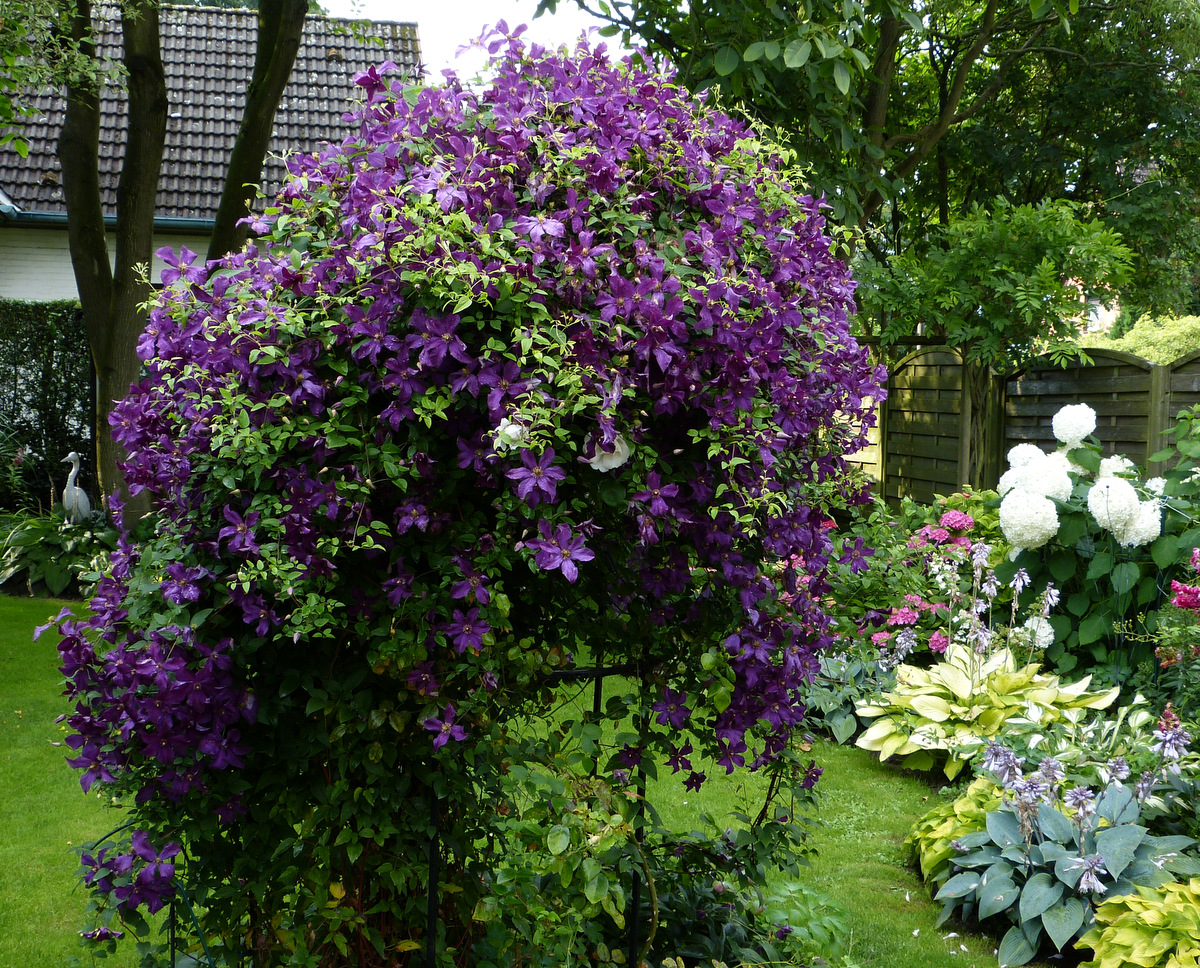
Clematis Viticella Polish Spirit
In the wild it occurs in Southeastern Europe (Albania, Bosnia and Herzegovina, Bulgaria, Croatia, Greece, Italy, Macedonia, Montenegro, Slovenia), Southwestern Europe (Portugal, Spain), and in Asia (Georgia, Iran, Cyprus, Turkey). It is found on rocky slopes, in shrub thickets and along hedgerows.
This is a woody climber reaching 2–4 (6) m in height. It grows rapidly, 40–60 cm per year. The stem is thin, climbing, angled, covered with hairs, more densely hairy at the base of the petioles.
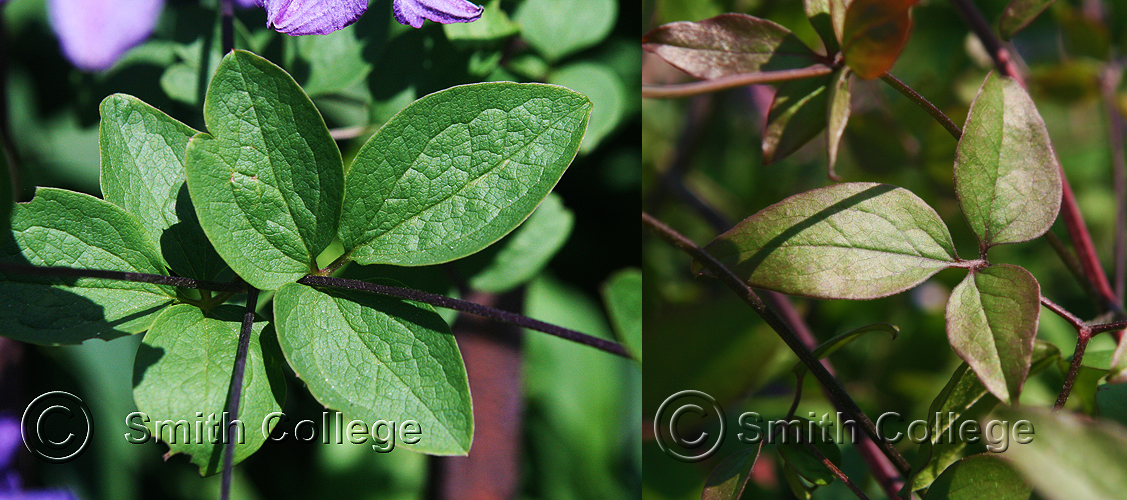
Leaves are twice pinnate, consisting of 5–7 leaflets. Leaflets are ovate or ovate-lanceolate, 1.5–5 cm long, acute or obtuse, with a rounded base, entire or three-lobed, slightly leathery, with entire or crenate margins, glabrous or nearly glabrous.
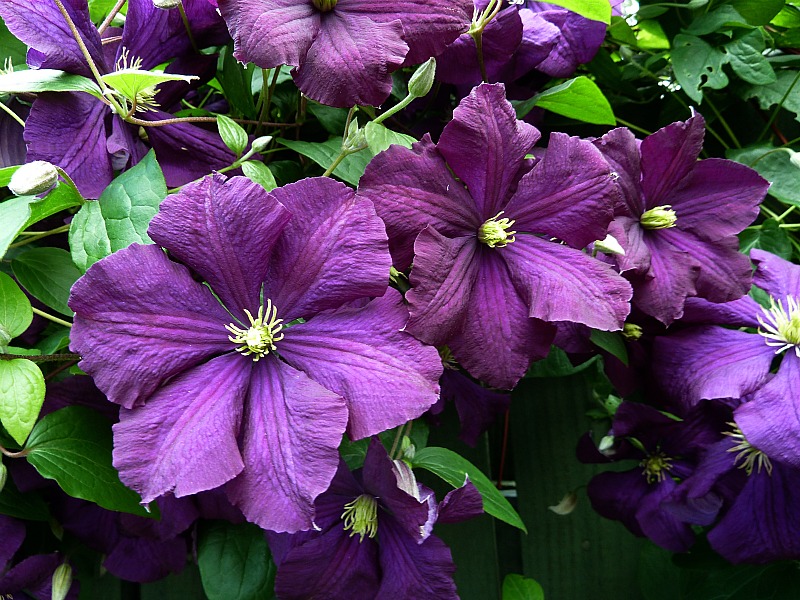
Clematis viticella 'Étoile Violette'
Flowers are terminal or axillary, borne on long peduncles (up to 10 cm), 3–5 cm in diameter, blue, purple, pink-purple or violet. There are 4 sepals, obovate, up to 3 cm long and 2.8 cm wide; the outer surface is glabrous in the middle and pubescent on the sides, margins wavy, toothed. Staminal filaments are glabrous, or have a few hairs in the upper part beneath the anthers. Blooms from June to August. On mature plants up to a hundred flowers can open at the same time.
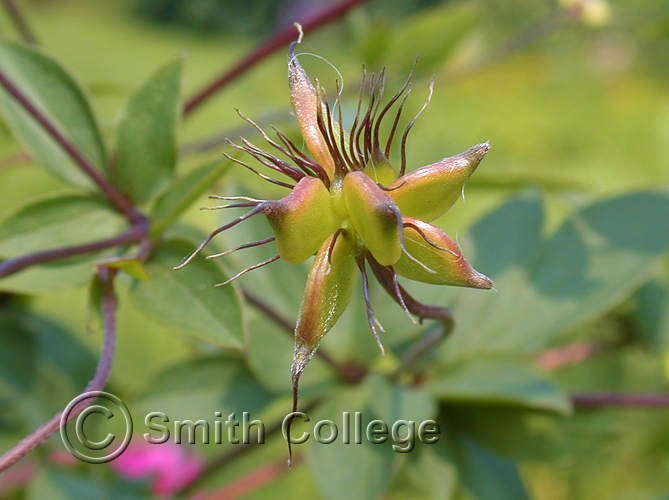
Fruits – achenes, up to 8 mm long and about as wide, laterally compressed, pubescent, with a thickened margin around the edge, and an awl-shaped bare beak 3–4 mm long. 1,000 seeds weigh 24 g. Fruits ripen in August–September.
Varieties:
- Clematis viticella f. albiflora Ktze. — white flowers;
- Clematis viticella f. coerulea Loud. — blue-violet flowers;
- Clematis viticella f. kermesina Lem. — bright wine-red flowers;
- Clematis viticella f. multiplex G.Don — double, dark-violet flowers;
- Clematis viticella f. nana Carr. — grows up to 1 m tall, flowers abundantly in mid-summer;
- Clematis viticella f. purpurea Loud. — red-purple flowers.
Cultivars: "Karmencita", "Ville de Lyon", "Rassvet", "Lesnaya Opera", "Alexandrite", "Emilia Plater", "Prince Charles".
Hardiness zone: 5 (-29°C)
Site: prefers partial sun, needs protection from strong and cold winds. Prefers nutrient-rich and moderately moist acidic or alkaline soil, fertile loams, well-drained. In the temperate zone it is recommended to plant in sunny or slightly shaded locations. In southern regions it may suffer from overheating, so it can be planted in shade. In urban conditions it tolerates dust and smoke.
Planting: Planting hole size - 60x60x60 cm. Soil mix – mix the topsoil with 2–3 buckets of compost or humus, 1 bucket of peat, 1 bucket of sand, 100–150 g superphosphate, 200 g complete mineral fertilizer, preferably 100 g bone meal, 150–200 g lime or chalk, 200 g ash. For light soils it is recommended to add more peat. If the soil is wet, clayey or compacted, a 10–15 cm layer of crushed stone should be placed for drainage. In southern regions planting is done in late September – early October, in the temperate zone in September, in northern regions in spring (late April or early May) or early autumn. In containers planting can be done throughout the growing season. For group plantings the distance between plants should be at least 1 m. For autumn planting the planting material should have developed vegetative buds; for spring planting there should be at least one shoot. Seedlings should have a minimum of 3 roots shorter than 10 cm.
Care: in early spring clematis can be watered with lime milk (200 g lime per 10 L water per m²). During dry hot periods water the plant infrequently but thoroughly, avoiding directing the stream into the center of the bush. Feed clematis at least four times per season after watering with a complete mineral fertilizer with microelements at a rate of 20–40 g per 10 L of water or with diluted fermented cow manure (1:10). Alternate mineral and organic feedings. In summer once a month water the plants with a weak solution of boric acid (1–2 g) and potassium permanganate (2–3 g per 10 L of water), and also spray the bushes with urea (0.5 tablespoon per 10 L of water). In spring after feeding and watering it is recommended to mulch the soil with peat or humus (northern regions) and sawdust (southern regions). To protect from overheating annuals can be planted near the clematis.
Pruning: bushes are recommended to be pruned in autumn or early spring, leaving 2–3 nodes (approximate height from the ground 20–50 cm). The more buds left, the more abundant the flowering. A full cut to the root reduces the number of flowers but makes them larger. To encourage branching, after the onset of growth of the annual shoots pinch at a height of 10–15 cm from the soil; a second pinch is done when shoots reach 20–30 cm, the last – at 40–50 cm. Pruning is done with a disinfected pruner or knife 5–7 cm above the nearest bud. The cut should be slanted so water does not collect on the cut tips and they are less prone to rot. Such pruning is carried out starting from the third year. Young one-year seedlings are cut back completely before the onset of cold, leaving one bud at soil level. This pruning stimulates the awakening of dormant buds at the base of the plant and also increases the number of stems.
Propagation: mainly by seeds, green and woody cuttings, division of the bush. Can also be propagated by layering. Seeds are sown in April–May. Before sowing, a two-stage stratification for 3–3.5 months is necessary: first in warmth (at 15–16°C), then in a refrigerator (at +5°C). Seeds germinate in 1–9 months in a hotbed at 20°C. When seedlings appear they can be transplanted into separate pots and grown in a cold frame for the first winter. Plant outdoors in late spring or early summer. Take cuttings from late July to the end of August. Cuttings root well when treated with Kornevin.
Diseases: gray rot, powdery mildew, rust, wilt.
Pests: nematodes, spider mite, beet aphid, scale insects, bugs, slugs and snails, rodents (field vole, brown rat).
Companion plants: pairs well with climbing roses, forsythia, spirea, mock orange, lilac.
Uses: used for vertical decoration of trellises, supports, arches, gazebos, posts, walls. Suitable for creating floral accents in main parts of the garden. Ideal for growing near fences, especially mesh fences, which they cover with a dense layer of decorative foliage and flowers. They create impressive screens, are effective among trees and small shrubs, decorating them with abundant flowering when those plants are less attractive or blending beautifully with their foliage. Can be grown in large containers on balconies or terraces. Cut flowers can be used for interior arrangements, as they remain fairly fresh in water for a long time.